
.png) 3 weeks ago
31
3 weeks ago
31
ARTICLE AD BOX
Norton Manx R Review
Norton’s reborn V4 makes its case
By the time I climbed off the new Norton Manx R after more than 250 kilometres of Spanish road riding, the grin had done enough work to require its own stretching program. My track time on the bike had started in properly wet conditions, which rather tempered the early getting-to-know-you phase, but the road ride was a different matter altogether: dry tarmac, glorious Spanish scenery, and sequences of bends that reminded me why fast road bikes can still be so intoxicating when they are built with the real world in mind.
 The new Norton Manx R is not just a nostalgia play, but a 206 hp V4 statement from a reborn British brand now backed by TVS.
And that, more than any single number on a spec sheet, is the point Norton is trying to make with the Manx R. This is not a WorldSBK homologation special, nor is it simply a nostalgia project wearing a famous badge. It is a bold statement from a reborn British brand now operating on much firmer footing under TVS, the Indian manufacturing powerhouse that ranks among the world’s largest motorcycle makers and produces millions of machines each year.
 The Manx R blends British branding, Indian industrial backing and European premium componentry.
TVS Motor Company remains guided by the T.V. Sundaram family, with Sudarshan Venu now leading the business and overseeing Norton’s latest chapter. Motorcycle manufacturing is not some side hustle here; it is the core business. Sudarshan’s great-grandfather, T.V. Sundaram Iyengar, founded the TVS Group, and that multi-generational industrial backbone now sits behind Norton’s rebirth. TVS has invested heavily in Norton’s new Solihull base, and MCNews.com.au was told Sudarshan’s brief to the Norton leadership was not to relive the past, but to create “something unique” and present a future vision for the brand.
 Norton’s rebirth is being built across Solihull, Bologna and TVS manufacturing resources in India.
That future is being built across several points on the globe. Norton has its headquarters and final assembly operation at Solihull, an engineering centre in Bologna, and the industrial-scale manufacturing facilities of TVS behind it in India. Solihull also places Norton in the thick of Britain’s high-end automotive and engineering belt, surrounded by companies that know a thing or two about low-volume, high-value manufacturing.
 The finish and surfacing are a major part of the Manx R’s appeal, with no visible bodywork fasteners to spoil the shape.
The global split of responsibilities is central to how Norton expects to become a self-sustaining brand within three years. The Manx R’s V4 engine is assembled by TVS in Hosur, while the cast and extruded frame components are also produced in India before being shipped to Solihull for welding, final machining and assembly. The bodywork comes from a TVS facility, as does the eight-inch TFT touchscreen, with the electronic architecture and interface work drawing on engineering resources from India’s technology sector.
From Europe come the familiar premium names: Brembo brakes, Marzocchi semi-active suspension, Akrapovic exhaust hardware and Pirelli tyres. So while the badge is British and the financial muscle is Indian, the finished Manx R is very much an international motorcycle, blending manufacturing scale with specialist componentry from some of the best suppliers in the game.
 Norton says the Manx R was shaped around road use rather than race homologation requirements.
Norton Manx R interview series
The story behind the ride
Our Manx R review covers what Norton’s reborn V4 is like to ride on the road and track. For the deeper story behind the bike’s design, engineering and TVS-backed relaunch, MCNews.com.au also sat down with three of the key people shaping Norton’s next chapter.
Simon Skinner on designing Norton’s future
Norton’s Head of Design explains the Manx R’s clean surfacing, hidden details, heat-management solutions, lighting theatre and the challenge of looking forward without losing the badge’s heritage.
Built around the road, not a rulebook
Norton also claims to have done its homework before settling on the Manx R’s character. The company bought and benchmarked the leading sportsbikes on the market, covering almost a quarter of a million kilometres on them while combining data logging with rider feedback. One of the clearest findings was that while many modern litre-class sportsbikes make their headline power around 13,000 rpm or beyond, most real-world riding happens far lower in the rev range, generally between 3000 and 7000 rpm. According to Norton’s data, more than 8000 rpm was used less than one per cent of the time.
 The Manx R’s strongest argument is made on fast, flowing roads rather than spec-sheet theatre.
That finding shaped much of the engineering brief. Because Norton is not building the Manx R to satisfy World Superbike regulations, it did not need to chase a rulebook or engineer the bike around racing homologation requirements. Instead, the company could decide for itself what a modern road-going superbike should feel like. The result is a 72-degree V4 machine designed around response, midrange drive, road usability and character, rather than simply chasing the tallest number on a dyno chart.
Norton has done a brilliant job here, because for this scribe, now edging into middle age, the Manx R managed to reawaken a part of the brain I thought modern sportsbikes had largely shut down. Like plenty of riders of my era, I was once a rusted-on sportsbike-or-nothing tragic, before road-going superbikes became so focused, so stiff and so impractical that naked bikes and adventure bikes started making far more sense.
They brought big power, quality suspension and serious brakes to the real world, while litre-class sportsbikes increasingly started to feel like road-registered indulgences. Wonderful things, no doubt, but not always wonderful things to live with. The Manx R changed that conversation for me. After a day on Norton’s new V4, I found myself wanting a road-going sportsbike again.
 Spanish roads around Rio Tinto gave the Manx R the perfect place to show its real-world sportsbike character.
And while I’m lucky enough to have some of Australia’s best riding roads on my doorstep, I’d quite happily take the Manx R’s Spanish playground home with me as well. The roads around Rio Tinto were superb: flowing, technical, grippy and varied enough to let the Norton show the breadth of its character without ever needing racetrack speeds to make sense of it. That, ultimately, is where the Manx R makes its strongest case. It feels like a superbike built for riders who still love sportsbikes, but no longer want to suffer for the privilege.
Which Manx R did we ride?
My ride time was spent on the Signature variant of the Manx R, which sits above the conventionally suspended base model and shares the groundbreaking Marzocchi semi-active suspension used on the Apex edition. The Signature then adds Rotobox Bullet Pro carbon-fibre wheels and full carbon-fibre bodywork to the mix, pushing it further into exotica territory. Above that again sits the Manx R First Edition, which crowns the four-model launch range.
 The Signature variant ridden here adds carbon bodywork and Rotobox carbon-fibre wheels to the semi-active suspension package.
Norton Manx R variants and Australian pricing
Australian pricing is yet to be confirmed, and a local distributor still has not been announced, but MCNews.com.au understands indicative pricing would see the base Manx R land here under $40,000. The Apex is expected to sit somewhere in the mid-$40,000 range, while the Signature version ridden here is likely to be in the vicinity of $70,000.
The Apex seems to be the sweet spot in the range. You do give away those rather sexy carbon rims, with the Apex instead running OZ Racing forged alloys, but the core dynamic package remains very strong.
All Manx R variants come with a three-year warranty, with the possibility of extending that coverage further. Norton knows these bikes have to be backed properly by head office, and everyone I dealt with during the launch seemed acutely aware of the task ahead when it comes to projecting confidence in the brand.
The impression I came away with is that Norton understands trust has to be earned, not assumed, and that the current management team will move heaven and earth to make that happen. With TVS behind the brand, this latest Norton chapter appears to be built on much firmer ground than some of the more troubled chapters that came before it. I must admit, I am more than a little tempted to take the plunge.
The business behind the bike: For more on TVS backing, parts support, global distribution and why Norton believes this restart is structurally different, read our Richard Arnold Norton interview.
 The 1,200 cc V4 is tuned around response, midrange drive and character rather than chasing a racing rulebook.
Norton Manx R engine and performance
Let’s get down to the heart of the matter.
The 1,200 cc V4 cackles into life with a fairly unique phased-pulse firing order. Norton uses a 180/180/252/108-degree sequence, with that larger 252-degree pause helping give the engine its distinctive beat and, according to Norton, emphasising torque feel while helping maximise mechanical grip at the rear tyre.
 Norton’s 72-degree V4 uses a phased-pulse firing order as part of the character brief for the Manx R engine.
Engineering deep dive: Norton CTO Brian Gillen explains why the Manx R retained its 72-degree V4 layout, how the phased-pulse firing order shapes the bike’s character, and why real-world rpm data mattered more than chasing WorldSBK-style peak-power bragging rights in our Norton Manx R engineering interview.
It works. The thrust is impressively smooth and linear, with none of the snatchy aggression that can make big-power superbikes hard work in mixed conditions. Even Rain mode still gives access to the full 206 horsepower; it simply feeds it in more gently. Gently enough to be civilised, but not so gently that I didn’t still nudge 250 km/h down Monteblanco’s main straight, while leaving myself a very healthy margin for error under brakes at the other end. The track did become mainly dry towards the end of my second 20-minute track session.
 Trev’s track running began in wet and damp conditions before the surface improved late in the second session.
I already know Brembo Hypure calipers are right at the pointy end of the braking game, so with a wet and then damp track, an unfamiliar bike, and a long way from home, I saw no pressing need to put either them or my testicular fortitude through an unnecessarily public examination. I also knew Rennie was more than well-credentialled to probe the outer reaches of the Manx R’s track performance, and was hopeful he would get some dry weather in which to do it properly. Thankfully, he did.
 Rennie sampled the Manx R later in the launch programme and got the dry track conditions needed to evaluate track prowess
Rennie’s track impressions
On the chassis front, the Manx R is a little slow in the steering, but absolutely rock solid once you’ve got it into the corner. It likes a lot of front-end load being driven into the Pirelli Supercorsa SP before it really starts to turn, so it is not the quickest-steering steed out there. For plenty of riders, that will be absolutely fine. Remember, Norton is not pitching this as a race-homologation superbike.
The electronics, however, were another matter.
 Track mode brings key rider-aid settings to the lower right of the display, including traction, wheelie and slide-control parameters.
Even with everything switched to the track-focused settings, there was too much throttle lag. The result was missed apexes and more rider frustration than there should have been from a bike with this much chassis quality underneath you. Eventually, I just switched it all off: no traction control, no wheelie control, full power mode. (It must be noted here that Rennie is far from your average track day punter; he is the Pikes Peak lap record holder, no less…)
 With the rider aids backed right off, Rennie found a more direct and entertaining side to the Manx R.
And what a difference that made.
The Manx R suddenly woke right up and behaved like a bike this good-looking should, rather than a bunch of computers yabbering away in code to each other. Without lean-angle-sensitive throttle intervention getting in the way, hitting apexes became much easier, and the power delivery was progressive enough to let me slide the rear without feeling like it was about to spit me over the highside.
 The Manx R was not the quickest-steering bike on track, but Rennie found the chassis rock solid once loaded into the corner.
For a hard-core track punter, the Manx R’s electronics feel a little too intrusive. They mask what is otherwise a seriously impressive chassis and, of course, that glorious 72-degree V4.
After a day on track and on the road, I struggle to agree with Norton’s line that this is not a superbike built for race homologation. It looks like one, feels like one, and goes like one, so I’m out on that. But I will agree that Norton has created something genuinely distinctive in a marketplace where individuality can be hard to find.
 Rennie felt the electronics masked some of the quality in an otherwise impressive chassis package.
Norton Manx R road comfort and electronics
The Manx R looks small and lithe in the metal, more traditional Supersport than full-blown Superbike at first glance, but it actually proved quite roomy once aboard. With not a great deal of recent saddle time on serious sportsbikes — I leave a fair bit of that business to my stunt doubles these days — I half expected to climb off with my forearms singing. Instead, I felt remarkably fresh after both the track and road components of the launch. The seat is supportive, the reach to the bars friendly enough, and the riding position strikes a better balance than expected between intent and liveability.
 Despite its compact look, the Manx R proved roomier and more comfortable than expected on the road.
The switchgear has a quality, tactile feel, although time did not allow for a deep dive into every function buried within the menus. The eight-inch TFT offers Bluetooth functionality, GoPro control, smartphone synchronisation and app-driven navigation, and what I did use worked cleanly enough. The switchgear itself is also bespoke to the Manx R rather than lifted from another model, although only the central button on the left switchblock is backlit.
 The switchgear feels bespoke and high quality, although only the central ‘N’ button is backlit.
I did notice tyre-pressure readouts within the dash menus, but disappointingly, the hardware required for tyre-pressure monitoring is not fitted as standard. Personally, I would trade plenty of the connected-device frippery for the simple convenience and reassurance of proper tyre-pressure alerts.
A big positive, however, is that riding modes can be cycled through at any time, as can the level of traction-control intervention. Better still, the bike remembers your last selected preferences between ignition cycles, rather than defaulting back to some lawyer-approved baseline every time you thumb the starter. That’s a win. Cruise control works well, but I didn’t try out the hill hold or launch control systems.
 The eight-inch TFT is crisp and functional, with separate road and track layouts.
Marzocchi semi-active suspension
As you switch through the riding modes, the change in suspension poise is arguably even more pronounced than the change in engine character. That is the beauty of electronic suspension working in concert with sophisticated engine management, and the system fitted to the Manx R is very much top-shelf kit.
 The Marzocchi semi-active rear shock uses live suspension-position data rather than relying solely on IMU input.
Bologna-based Marzocchi worked with Norton’s international test team to develop a semi-active suspension package that is, in some respects, more advanced than anything we have seen on a production motorcycle to date. The key difference is that the forks use an internal linear potentiometer to measure position, velocity and acceleration in real time. At the rear, a dog-bone linkage is connected to a rotary sensor on the shock.
 The Manx R’s tight packaging leaves little wasted space around the rear suspension, exhaust and single-sided swingarm.
That means the suspension algorithms are not relying solely on input from the six-axis IMU, as most contemporary systems do, but are also receiving live data from the suspension itself. The result is a system with a much clearer picture of what the motorcycle is actually doing beneath the rider. In turn, it can respond more quickly and keep the chassis in a more neutral, composed state.
Importantly, it does not completely smother the bike’s natural behaviour. There is still enough weight transfer factored into the algorithms to preserve feel, while the combined braking system helps keep the Manx R settled and pressed into the road under hard braking. This combination leads Norton to claim more than 1 g of deceleration and the most impressive braking performance of any motorcycle on the road.
 The Marzocchi fork package feeds live suspension data into the semi-active damping strategy.
My previous suspension benchmark in this space was the latest Öhlins EC3 system, which I gushed about after sampling it on Triumph’s Speed Triple. Unlike many electronic suspension systems I have found less convincing in terms of damping control and outright poise, both the EC3 system and Norton’s Marzocchi package still require preload to be set manually, just like conventional suspension.
Strangely enough, Norton, like Triumph, does not see fit to supply the requisite tools to make those adjustments. Yes, they are essentially normal spanners, but I would still hate to leave marks on those very pretty fork tops by using something not quite right for the job.
 The Brembo Hypure set-up delivered serious power and excellent feel, from ordinary road pace through to hard track use.
That said, I know from experience that these two systems are right at the pointy end of the game, and having to set preload manually is an inconvenience I would gladly accept in return for suspension performance of this calibre. It is not as though this is an adventure bike that will regularly be loaded with luggage or asked to carry a pillion, so once set for the rider, it should largely be a case of leaving well enough alone.
The two-way quick-shifter worked brilliantly, and the shifts themselves were smooth and precise. A slip-assist clutch basket design means no hydraulics are required on the clutch perch.
While it is not the fastest-steering bike on the market, I would describe the handling as precise and surefooted, and it was an absolute joy to sweep through the perfect blacktop that snakes around the Sierra Morena mountains. My eyes are rolling back in my head at the memory…
 On the road, the Manx R felt precise and surefooted rather than nervous or hyperactive, although Trev did experience a couple of headshakes
Details, heat management and finish
Each headlight houses 30 individual LEDs, with Norton claiming best-in-class performance. Powerful lights generate heat, so each lighting bank gets its own heat sink, and there is even a subtly hidden duct in the nose that directs airflow across it. It is a neat piece of detail engineering, and typical of the level of airflow work that has clearly gone into the bike.
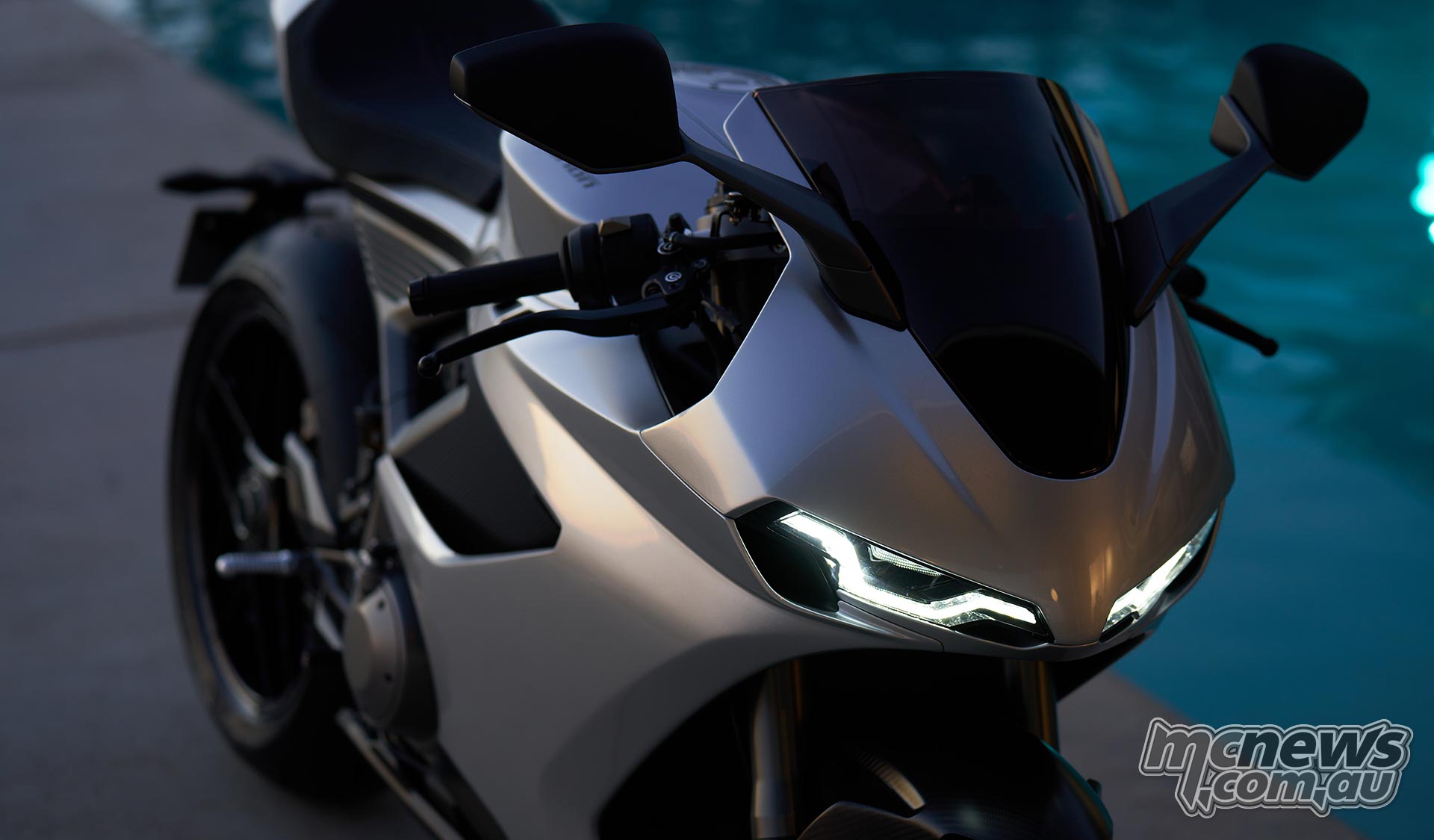 The Manx R’s slim LED face gives the bike a modern stare, while the lack of wings makes it look almost restrained by current superbike standards.
Packaging a big V4 tightly inside fully faired bodywork is never easy, particularly when the rear headers have to be routed through the already crowded space between the engine and shock absorber. Add emissions hardware, heat management, rider comfort and styling constraints to the same equation, and there are not many easy wins. Norton has clearly thrown a lot of simulation, wind-tunnel work and real-world validation at the Manx R to make all of that coexist.
 Packaging the rear headers between the V4 engine and shock is one of the harder jobs hidden beneath the Manx R’s clean bodywork.
My time on the bike was not exactly a torture test in that regard, with ambient temperatures not getting much beyond 25 degrees, and very little time spent stationary during the road ride. Even so, only a couple of times while stopped did I feel any significant heat being radiated towards me, and even then, it was only through my left boot.
It is also worth noting that I spent a couple of days observing other groups cycling through the launch bikes on road and track, and not once did I see a speck of coolant or any other fluid escape from any of them. That might sound like a small thing, but for a new-generation V4 superbike from a reborn brand with plenty to prove, it is significant enough to be worthy of mention.
 The low-exit exhaust sounds better from the roadside than it does from the saddle at speed.
While the Manx R sounds great on start-up and carries a proper, hard-edged baritone bark to anyone watching from the roadside, the low-exit exhaust means not quite enough of that acoustic theatre makes its way back to the rider once underway. There is character there, no question, but I would not have complained if a little more of it had been directed upwards to tickle the auditory nerve from the saddle.
The longer I looked at the Manx R, the more I wanted it. There are no visible fasteners on the bodywork to distract the eye, while the absence of wings and shouty graphics gives the bike a pure, uncluttered look that really works. In an era when many superbikes appear to be designed as much for turbulence as taste, the Norton’s restraint is a big part of its appeal.
 The Manx R’s uncluttered shape is a welcome change from the increasingly busy look of many modern superbikes.
Design deep dive: For more on the Manx R’s clean surfacing, hidden fasteners, airflow treatment and the thinking behind Norton’s new design language, read our Simon Skinner Norton Manx R design interview.
Norton Manx R model comparison
All four Norton Manx R variants use the same 72-degree 1,200 cc V4, producing 206 hp at 11,500 rpm and 130 Nm at 9000 rpm. The core chassis, Bosch six-axis IMU electronics package, Brembo Hypure front brakes, 14.5-litre fuel tank, 840 mm seat height, 1435 mm wheelbase, 24.1-degree rake, 94.5 mm trail, 16,000 km service interval and three-year warranty are also common across the range. The main differences are outlined below.
| Manx R | Marzocchi fully adjustable manual suspension Cast aluminium wheels Two-seat layout Steel 4-2-1 underslung exhaust 210 kg wet, no fuel |
| Manx R Apex | Marzocchi semi-active electronic suspension with DLC fork tubes OZ Racing forged aluminium wheels Split rider and pillion seat Steel 4-2-1 underslung exhaust 207 kg wet, no fuel |
| Manx R Signature | Marzocchi semi-active electronic suspension Rotobox Bullet Pro carbon-fibre wheels Full carbon-fibre bodywork Single rider seat Keyless seat lock added 203 kg wet, no fuel |
| Manx R First Edition | Marzocchi semi-active electronic suspension Rotobox Bullet Pro carbon-fibre wheels Full carbon-fibre bodywork Road-legal Akrapovic titanium exhaust Braced aluminium swingarm Titanium fixings, billet detailing, numbered top yoke, special paint and quilted seat 201 kg wet, no fuel |
The business behind the bike: For more on TVS backing, parts support, global distribution and why Norton believes this restart is structurally different, read our Richard Arnold Norton interview.
Norton Manx R colours
Colour availability varies by variant, with the First Edition offering the widest choice of carbon-accented finishes and launch-edition detailing.
Only Trophy Silver bikes were available to ride at the launch, while a single Glacier Blue example was on static display. That Glacier Blue bike also featured some details reserved for First Edition models, including yellow brake calipers and the subtle Union Jack treatment on the central inlays, so those elements should not be assumed to apply to every Glacier Blue Manx R.
 Norton Manx R in Glacier Blue, shown here on static display with several First Edition details, including yellow brake calipers and Union Jack centre inlays
The images below are Norton renders rather than studio photography, so they should be treated as indicative, but the colour names are as supplied by Norton.
 Norton Manx R in Trophy Silver, the colour used on the launch test bikes ridden on road and track in Spain
 Norton Manx R in Matrix Black, giving the V4 sportsbike a more understated and purposeful look
 Norton Manx R in Glacier Blue, one of the brighter colourways in the Manx R palette
 Norton Manx R in Celestial Grey, a more muted finish that works neatly with the bike’s clean bodywork and lack of visual clutter
 Norton Manx R in Aqua Green, one of the more distinctive finishes available across the range




 English (US) ·