
 4 months ago
75
4 months ago
75
ARTICLE AD BOX
Ken and Barry Horner on the Irving Vincent to Daytona project
Few stories in motorcycle racing blend romance, engineering purity and sheer bloody-minded perseverance quite like the Irving Vincent. Hand-built in Melbourne by Ken and Barry Horner, the bike has conquered everything from Phillip Island to Goodwood to Daytona. And in 2026, it’s heading back to Daytona.
As the team prepares for their second assault on the Daytona banking, we spoke to Ken and Barry about the project, the bike’s raw character, and the return to a place they conquered 18 years ago, when Craig McMartin rode an Irving Vincent to victory in the 2008 Daytona Battle of the Twins.
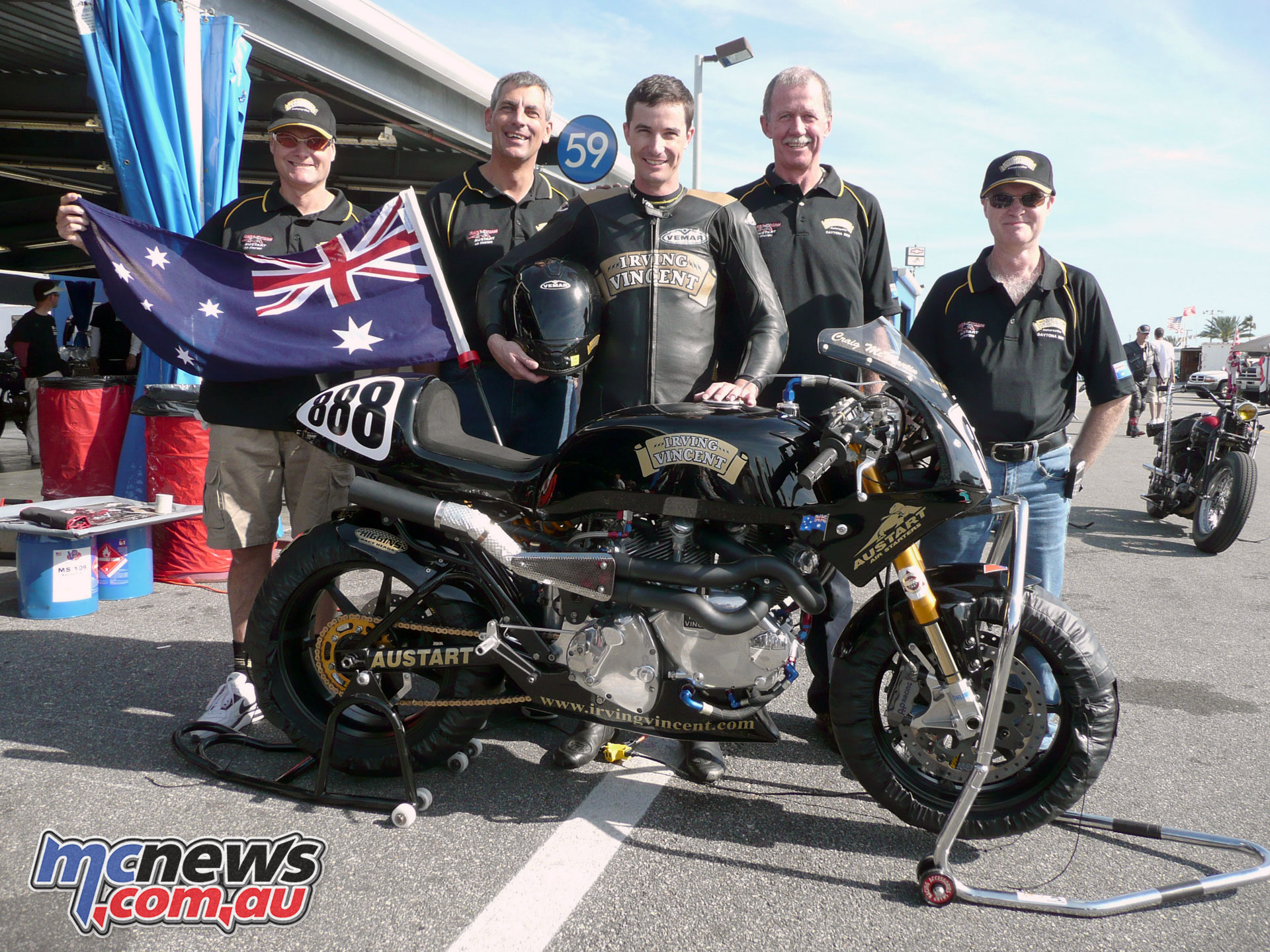 Irving Vincent targets 2026 Daytona, 18 years after their landmark win in 2008 with Craig McMartin
For many, the original Daytona campaign remains the stuff of folklore: a hand-built Australian special taking on the world’s best on one of the most intimidating circuits on the planet. Its long-awaited return brings with it unfinished business, hard-earned experience and a renewed sense of purpose.
This time around, the challenge is somewhat similar, but also very different. Beau Beaton will race the Irving Vincent in the Super Hooligan category against some very modern water-cooled machinery, including Harley Pan Americas, KTM Dukes, Yamaha MT-09s, Triumph 765 RS, and even Keanu Reeves’ Arch 2S-R.
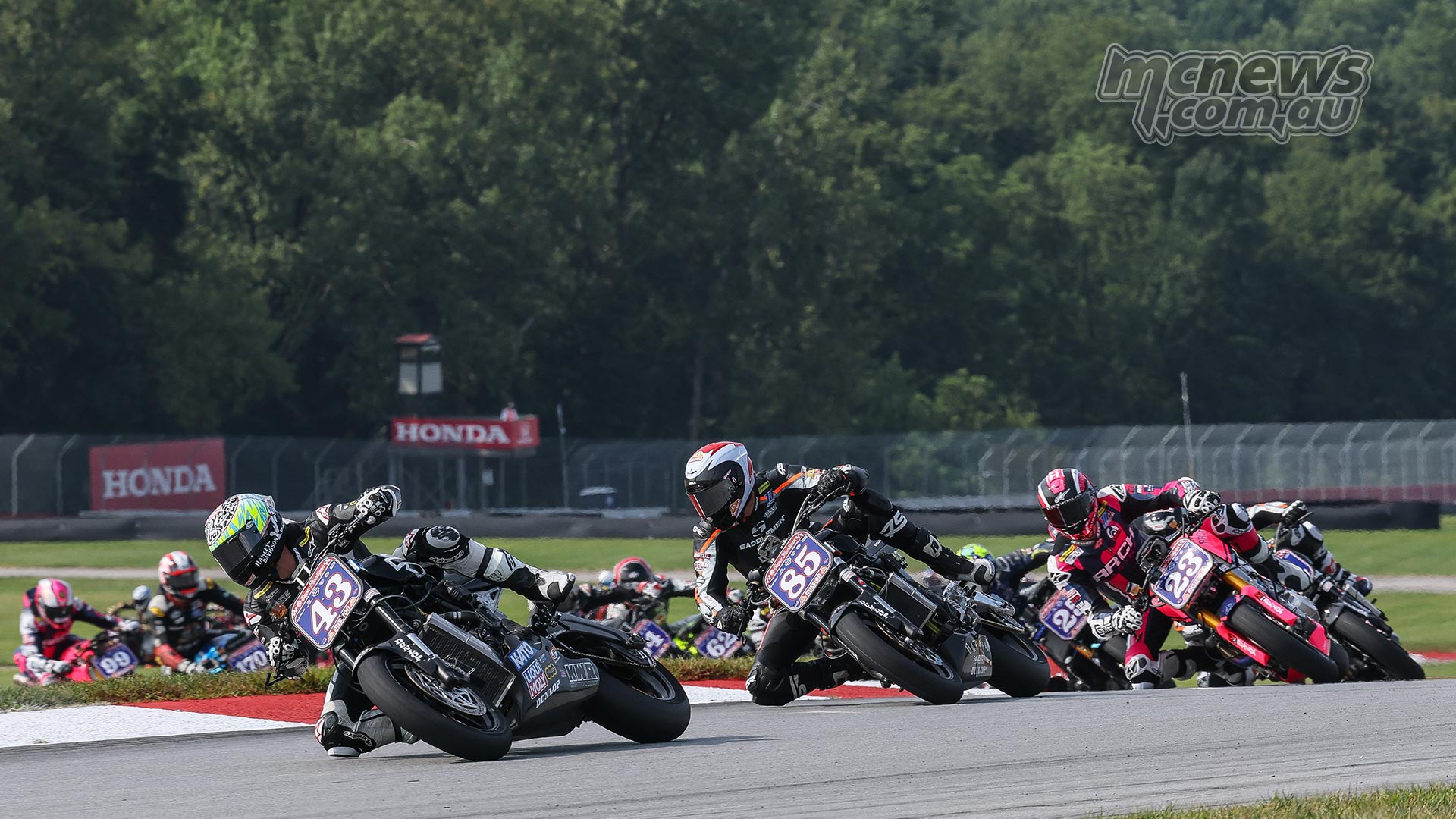 James Rispoli (43) leading Jake Lewis (85) in the Mission Super Hooligan National Championship race at Mid-Ohio in August, 2025 – Image by Brian J. Nelson
We sat down with Ken and Barry Horner to talk about the legacy of the original Daytona outing, the evolution of the Irving Vincent, and the deeper meaning behind its continued existence.
The answers are not separated between Ken and Barry; the brothers often respond to each question together, and their replies are not individualised here.
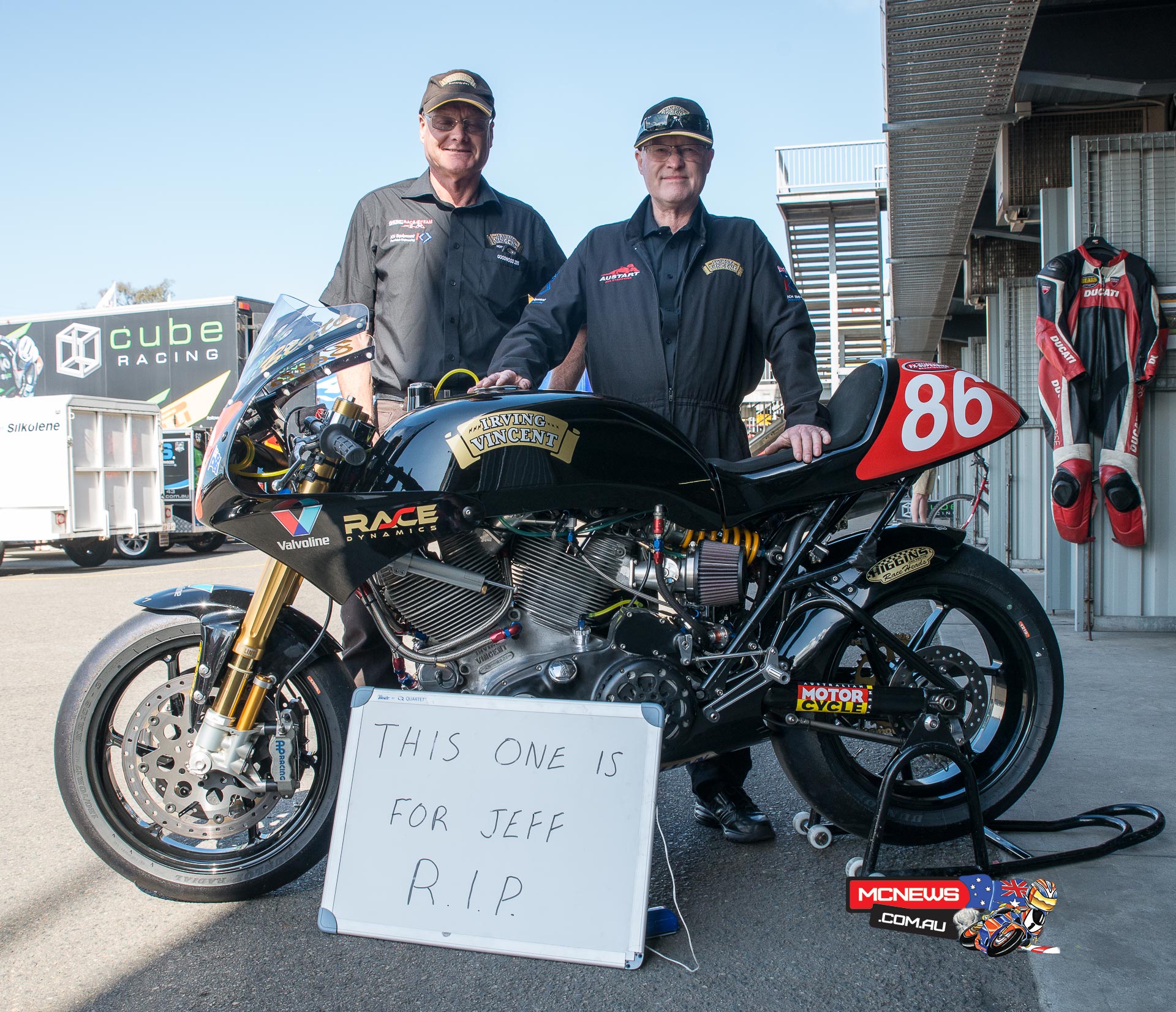 Ken Horner and Barry Horner pictured here with an earlier Irving Vincent at SMP in 2015
So Ken, Barry, why is now the right time to take the Irving Vincent back to Daytona?
“Well, we looked at doing it last year, and we thought the job was only small, but it’s turned into a big job. Halfway through the year, what we were planning for this year (2025) just wasn’t practical, so we decided to put it off until Daytona 2026. We’ve been at Daytona before, in 2008, with Craig (McMartin) over there for that one year.”
With that legacy, what does Daytona mean to you personally and the Irving Vincent project as a whole?
“Well, how long has it been there… 18 years by the time we go back there. We did plan to go back, I guess.”
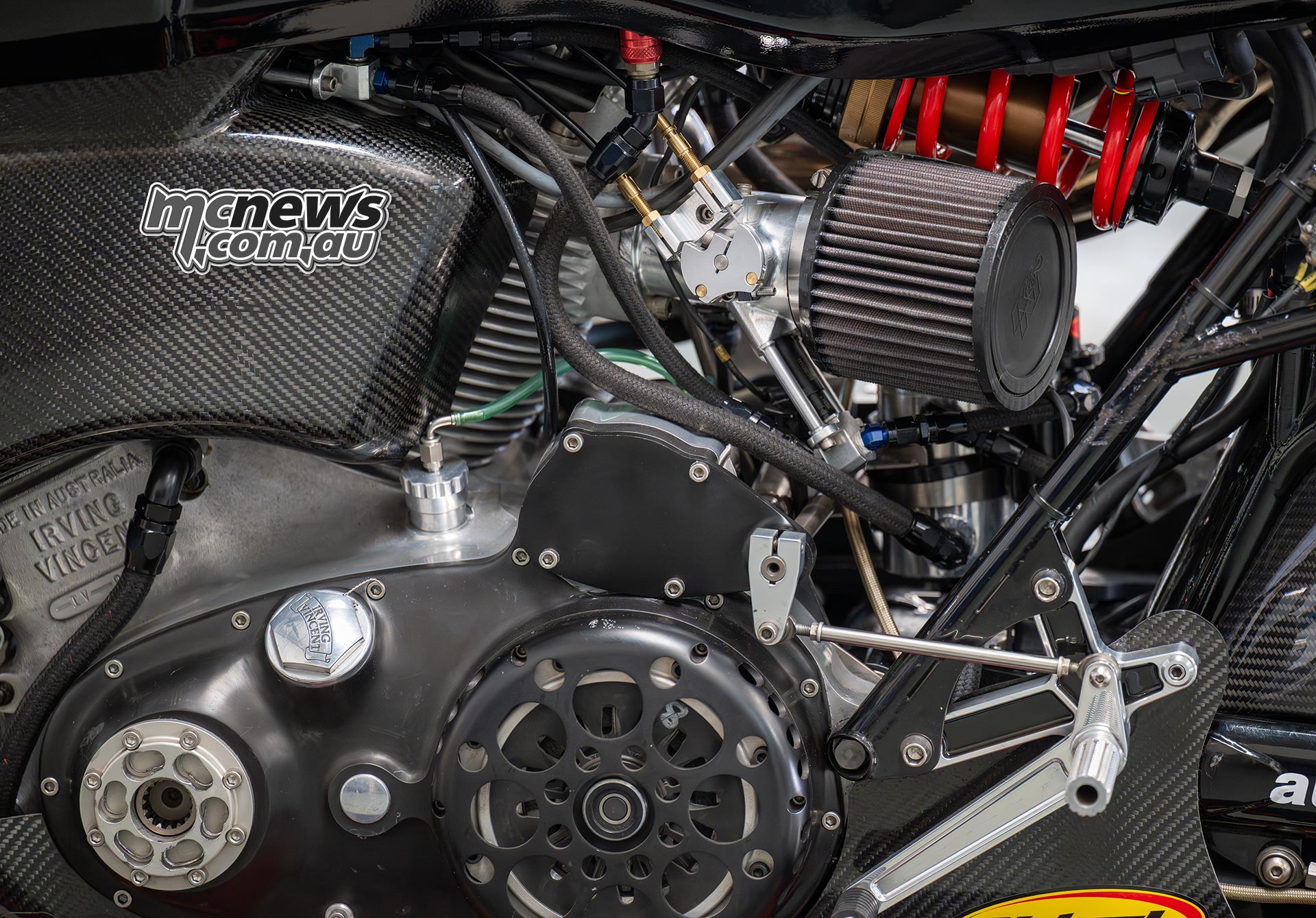 Irving Vincent Super Hooligan
So it’s an 18th birthday bash…
“Something like that. Yeah, we’re 18 years older now. Yeah, but you know, I think what the global financial crisis hit after we did that first one, then it all turned to shit after that. Yeah, what happened was that the AMA was the controlling body, then there were some changes, massive infighting and all sorts of things like that. So the Daytona event that was didn’t continue as it once did, and they all went their separate ways and ran their own events.
“Yeah, as you said on the first question there about the reason to do it this time, remember, we were going to do Goodwood. We got knocked back for Goodwood, you know, last year. We get knocked back because after the first time we did it, we supposedly won by too much, you know.
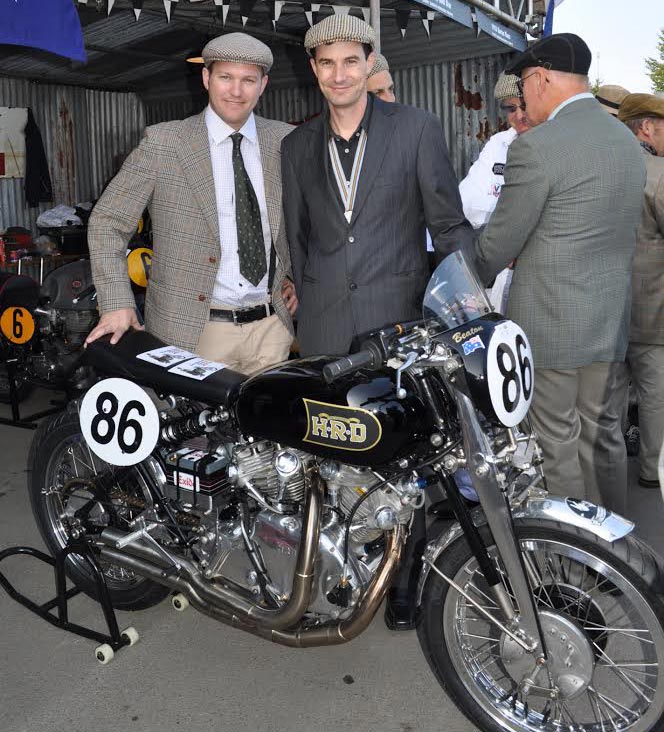 Goodwood Revival 2014 – Beau Beaton and Craig McMartin
“It’s been a problem. So anyway, they appeared to want us over in America for the baggers, you know, have an air-cooled bike there. So we thought we’d go where we are wanted. We went over last year’s COTA race in September to see what it looked like.
“And having Herfos over there, obviously leading the baggers and winning, as we know, made it attractive to go and do the USA. We said, well, it’s better to go where you are wanted than trying to fight to go where you’re not wanted, so we did and got a very good reception from them over there.”
When you think back to Irving Vincent’s debut at Daytona, what’s the first memory that comes to mind?
“Shock, horror. First time over there, going through the tunnel…
“My God, you’ve never been there before, and you see when you’re driving up there the first time, and you look at it, my God, what is this place, you know? It’s supposed to be the world’s greatest racetrack.
“I think it’s got a sign out the front there, ‘World Center of Racing’. You get there and think, Jesus, it’s a bit, you know, it’s a bit second-hand compared to some of our tracks. But look, we made good of it…”
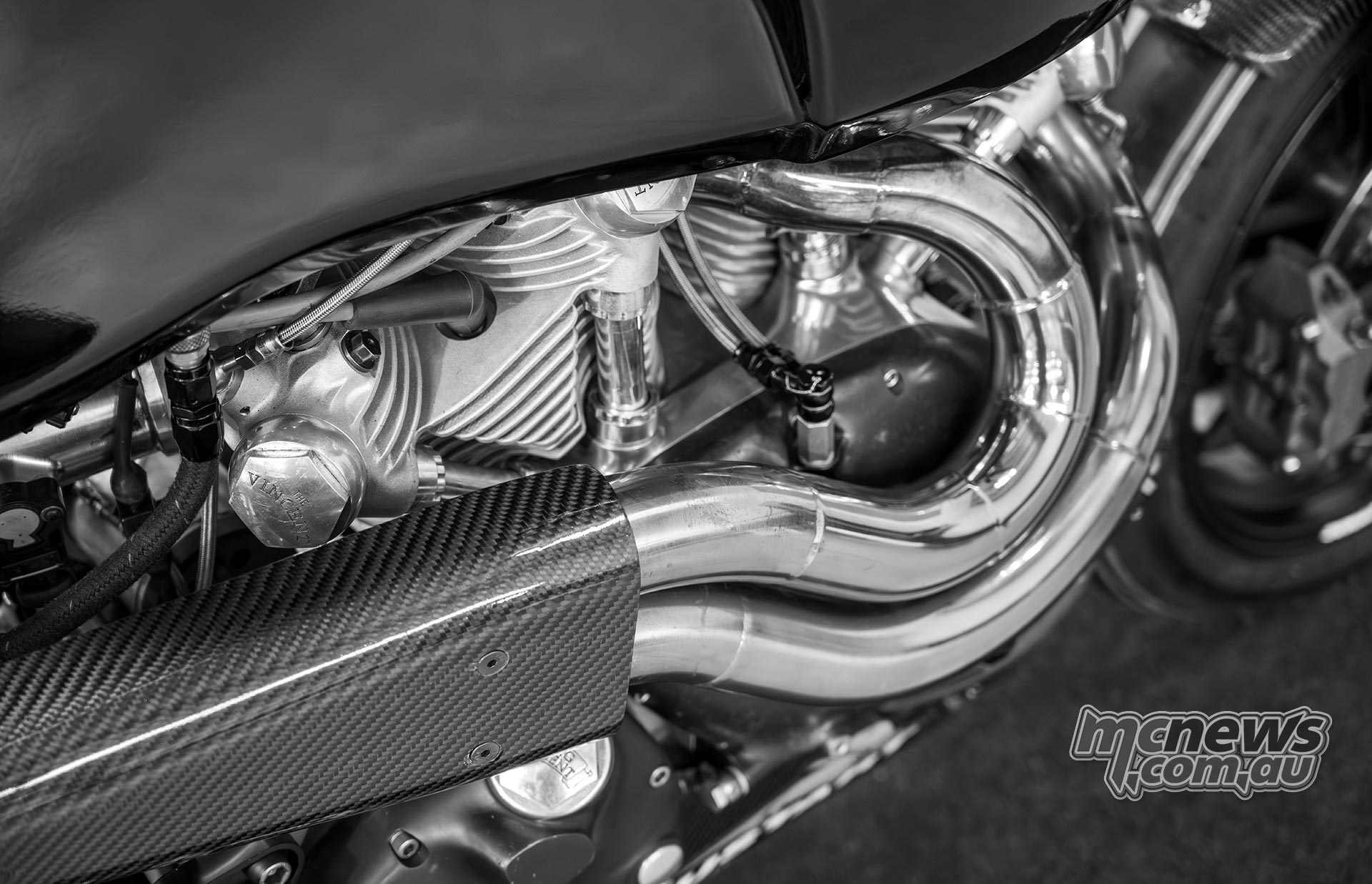 The air-cooled Irving Vincent
And what’s the most unexpected challenge you faced during that original trip? Something only the team would know, perhaps.
“Well, we’d never experienced anything like that. We were pretty confident from what we’ve been doing here that we’d be able to head there and go, “oh, we’re probably not as quick as we need to be.”
“So we had to do a fair amount of work, and most of our biggest gains came from gearing it up. We were too low geared, but we didn’t think we were. We just went up with the gearing, and then we did a second gearing change, and it still pulled the rpm home. So we thought, well, we’re obviously going quicker. We had been going to go the other way, but it just kept pulling taller gearing.”
How many teeth did you get down to on the back then?
“We went from 40 to 38. 38, yeah. The bike still pulled the same RPM.”
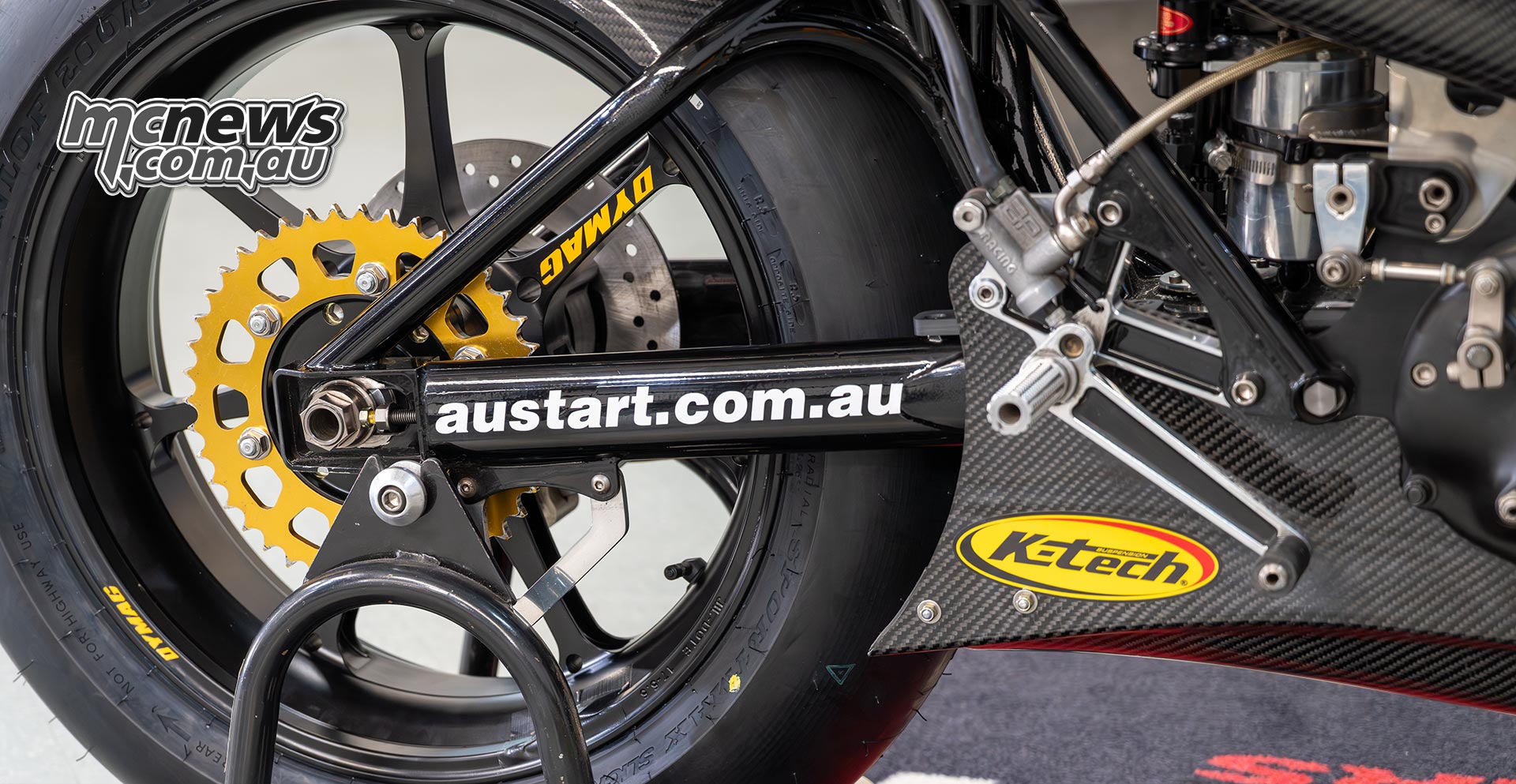 At Daytona last time out, they ran a 38-tooth rear in combination with the 21 front. They did have a chain on then too…
And on the front…?
“21. 21, yeah. You never change the front spocket on our bike. Yeah, that’s it. That’ll be a surprise to a few.”
How did American teams and fans react to the bike when they saw it for the first time?
“Great. Yeah. You like big things. It was a V Twin, you know, air-cooled. It was just sort of, it’s basically Harley, sort of, but not. They knew we were coming, and they made everything so it was easy.”
If you could redo one element from the original Daytona campaign, what would it be and why?
“Probably the oil breathing situation. We learned a lot over there. We were lucky to get away with it.”
I can imagine. So, do you run reed valves on the cases bleeding into a box?
How do you overcome the blow-by and crankcase pressurisation issue?
“We’ve got electric scavenge pumps in the catch tank, which we have with these ones now. You can’t stop the stuff getting in there, so you’ve got to get it out back to where it belongs.”
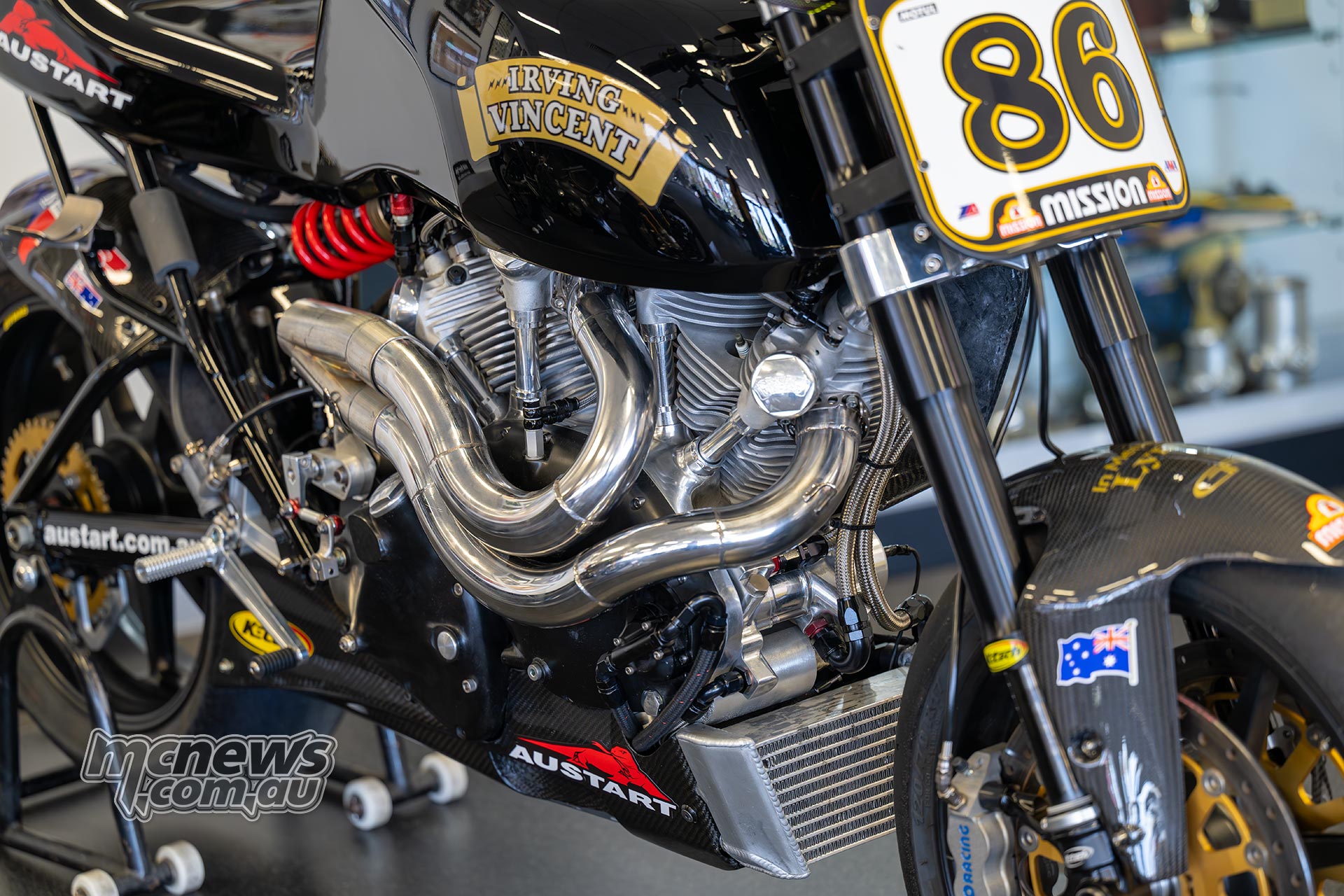 Irving Vincent Super Hooligan
Just one pump or two?
“Yeah, only one. It’s pre-circulated, but it’s going to come out no matter what you’ve done. We’ve been doing this long enough; just return it. They do it on V8 supercars, so it’s just getting your head around it. Actually, we did the same at Goodwood.
“But yeah, that’s not the banking where you’re on full throttle in top gear for 35 seconds every lap at Daytona. We were incredibly lucky to get away with that. Like we were pumping, filling that catch tank up. Yeah. And we had nappies wrapped around it…
“We wrapped it up in nappies and cable-tied them all on. And they come back pissing bloody dripping oil, and we just hid it from them, you know, we got rid of that before they came around or the bike got scrutineered again…”
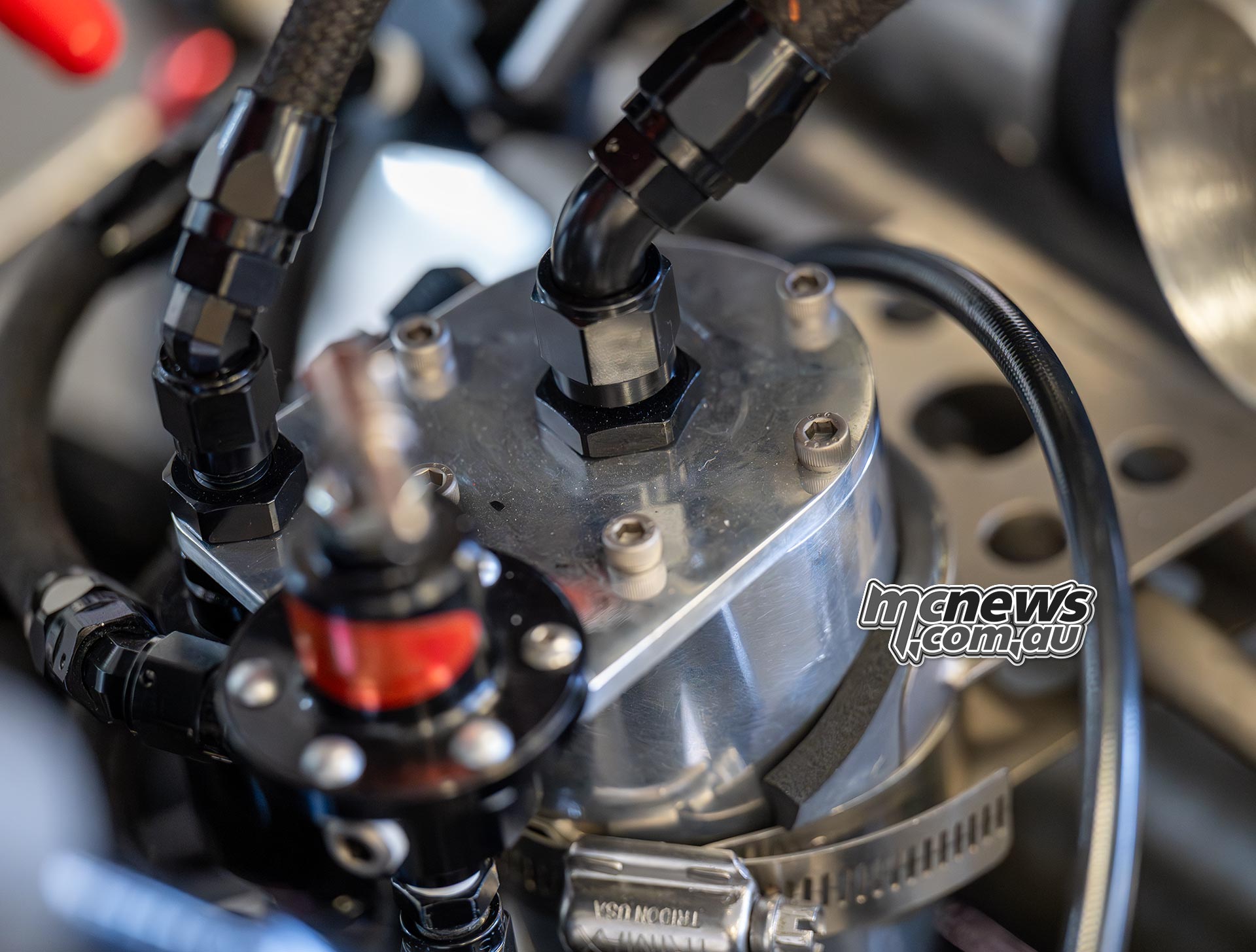 Scavenger set up on the today’s Irving Vincent
How different is today’s Irving Vincent from the original machine?
“In some ways, not much, but what we’ve learnt, we’ve put inside, you know. The basic engine’s the same. It’s just a little bit more about what we’ve been able to develop and pull out to help reliability.
“Which is good. But mind you, we didn’t have any engine issues over in the US. Daytona. We didn’t have to play with that at all. So it was more handling and setup.”
Is there one upgrade or redesign that you’re particularly proud of heading into the 2026 Daytona, particularly?
“I don’t know. We just learnt from what we’ve done in the last 20-odd years. I think it’s all in that package. Just various little refinements. Yeah, you’ve got, you know, you’re running on petrol over there, so you’ve got a…”
Because you run on methanol to help cool it here…?
“In certain classes, you run on methanol, yeah. It’s a much nicer, much friendlier fuel on an air-cooled engine. So we know what to expect over there, and that’s the biggest issue.
“That’s why you’ll see it with the big air scoop on the left-hand side there, and it’s working very effectively after we tested it at Eastern Creek with Beau. Yeah, you know, we obviously know more about setup and suspension, and we are running the K-Tech now.
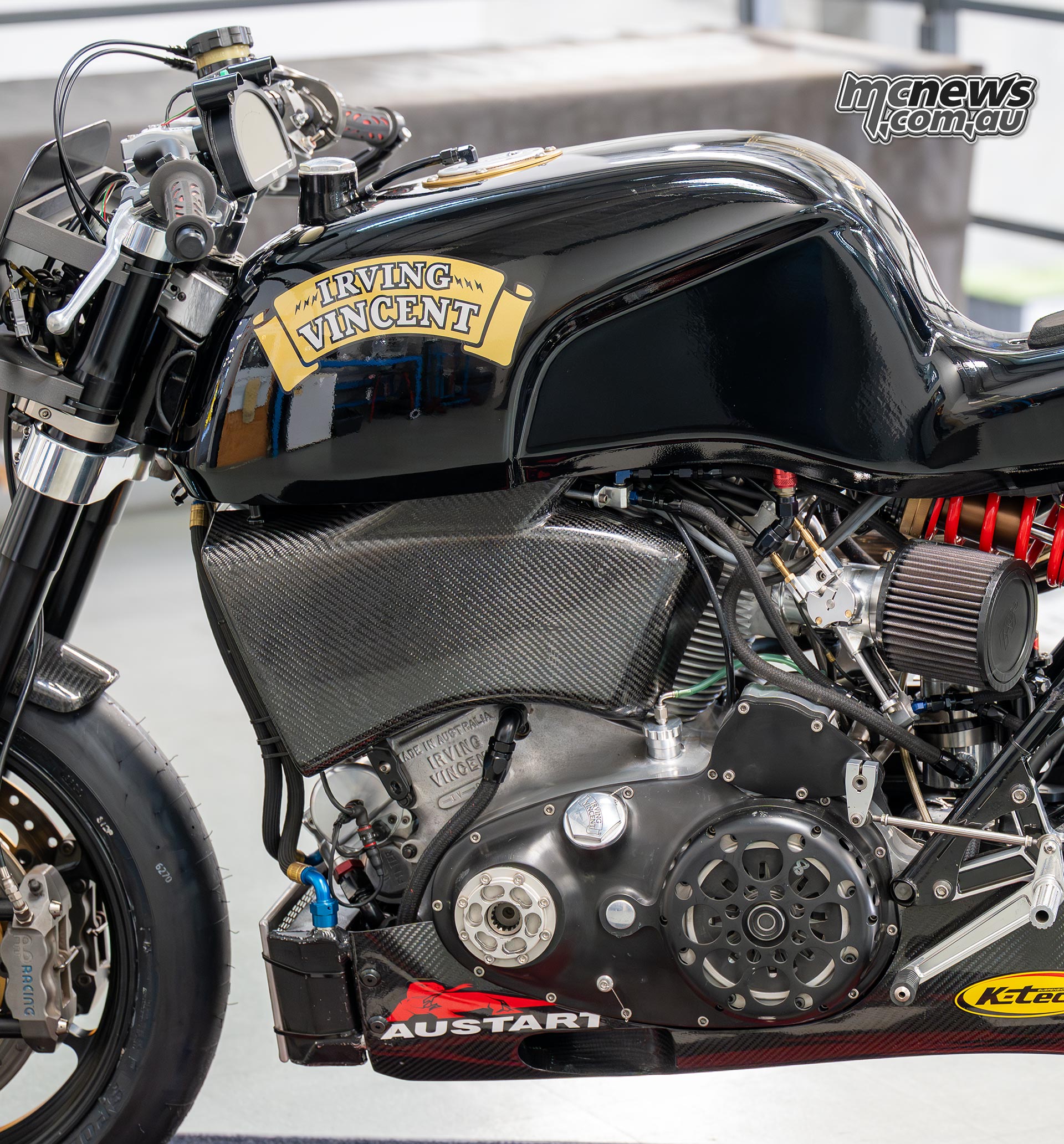 Large air scoop fitted to the bike on the left hand side in the aim of improving cooling
“That’s all regulated to what you can and can’t do. This isn’t an open-book class. They’re pretty pedantic about what you are allowed to run, like specific components have to be homologated. And I’m going through a little bit of brake homologation at the moment.
“I’m just waiting for an answer because we run AP brakes, and they question that. Basically, the hooligan class is street bikes that were never meant to be raced.
“But there’s very much an open book for air-cooled bikes. So we looked at them and thought, well, yeah, we fit the rules, and we’ve spoken to them over there. I want to get that all settled before they leave the country. I need it in writing that they’re approved to go racing before they go in the container.”
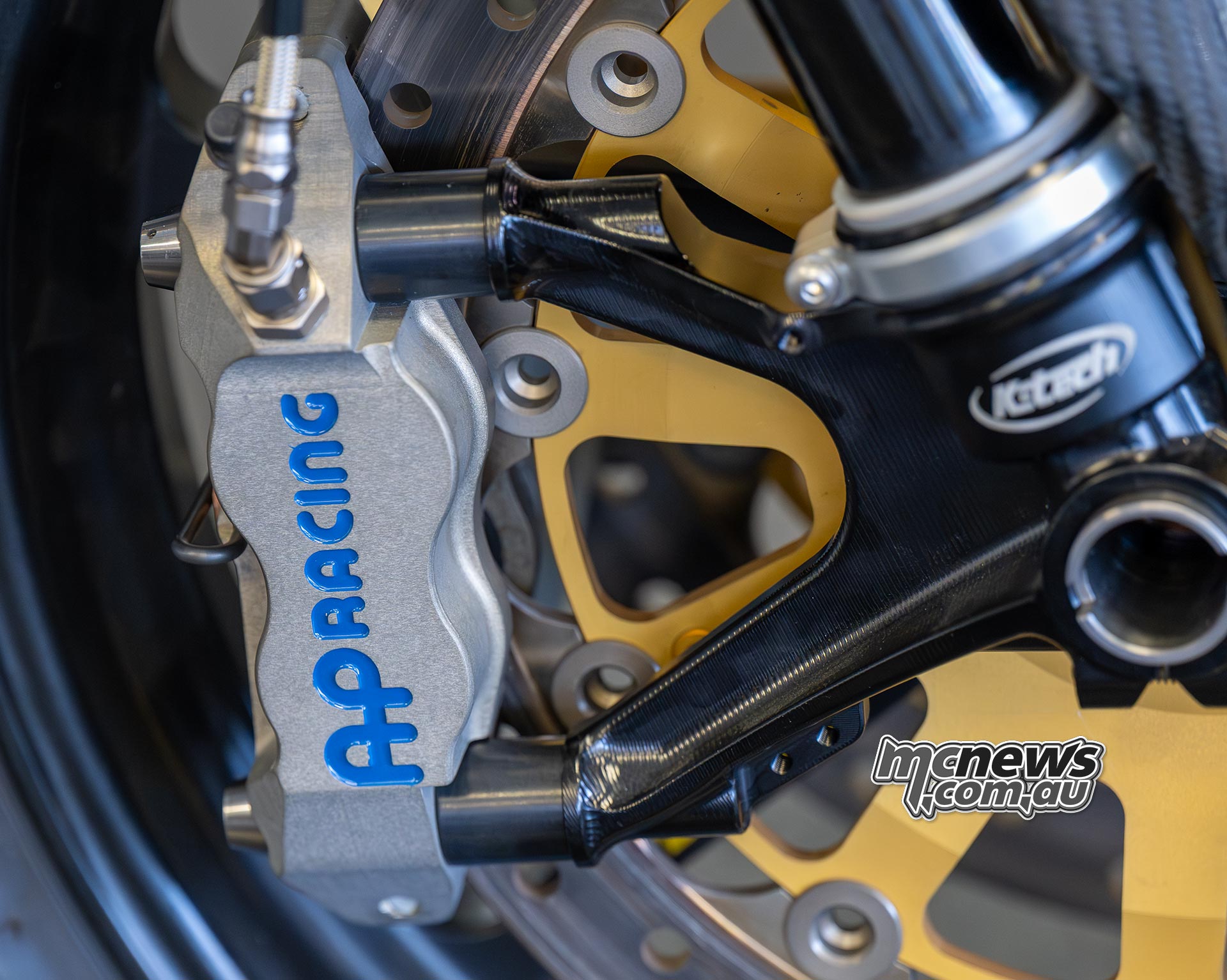 AP Racing brakes on the Irving Vincent bound for Daytona
When will you have to put them in the container?
“February, yes, it’s still a little way away.”
Is there a single component inside the engine that you consider a work of art?
“We make everything. So it’s everything really. The cylinder heads, the crankshafts, everything’s worked incredibly well for me.
“Yeah, we can tell you where all the bad parts are…
“Because they’re in the engine, because that’s what they were designed with originally. I’d probably go the other way and say, you know, we’ve made it to get the engine where it is performance-wise, and reliability would have to be the cam followers, the roller cam followers, that are a fairly tight squeeze to put in there. And that’s probably made the most significant difference.
“Yeah, that’s what gives this engineering. What we did was get the camshafts, with profiles designed by Eric Gaynor. Eric had worked at Repco Brabham and was also the chief engineer for the Holden Race Team in the early days. He designed the cam for HRT down there. It was always known as Eric’s cam at HRT. And he’s done both camshafts for ours, the two-valve and the four-valve.”
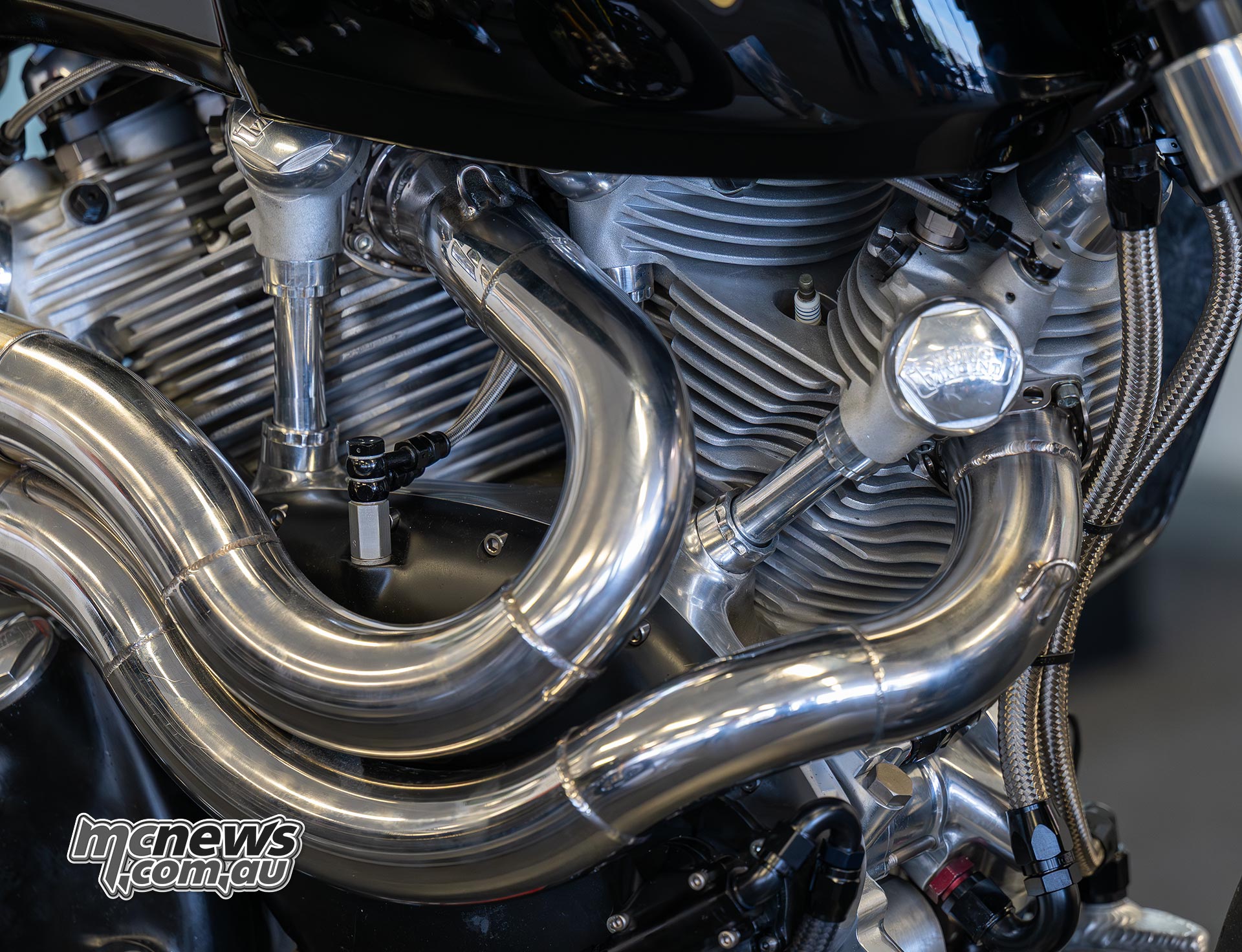 There is also a larger 1760 cc version going with them to Daytona
What’s the secret sauce?
What sort of rough ballpark duration and lift figures are we talking?
“It’s all very much the same. It’s very similar to a Cosworth profile….
“Well, we’ve got about 650 thou of lift, and the cam timing is approximately 58-82, 82-58. Yeah. And that’s about the same as Cosworth F1 engines back in the day. But we only rev to around 7800 rpm.”
And what about this one?
“This is down a bit because of the petrol, and that’s two valve. Look, it could be 7000 rpm. We want to run conservatively, so we will peg it around 7000 rpm on normal fuel for the banking. We have built the engine for torque.”
So, how many newton-metres are we talking…?
“140 foot-pound.”
So that’d be around 200 newton metres then, wouldn’t it?
(I later did the calculation – 190 Nm…)
“Look, so you’ve got about 165 horsepower, and you’ve got 140 foot-pounds of torque.”
How’s the chassis evolved since the original campaign?
“A lot. I mean, with K-Tech, us being K-Tech as well, and what we’ve learnt with K-Tech and just general setup over the years, you know, it’s been ongoing. The actual bike is a very good handler, which you obviously saw in the Island Classic races, and that’s probably…”
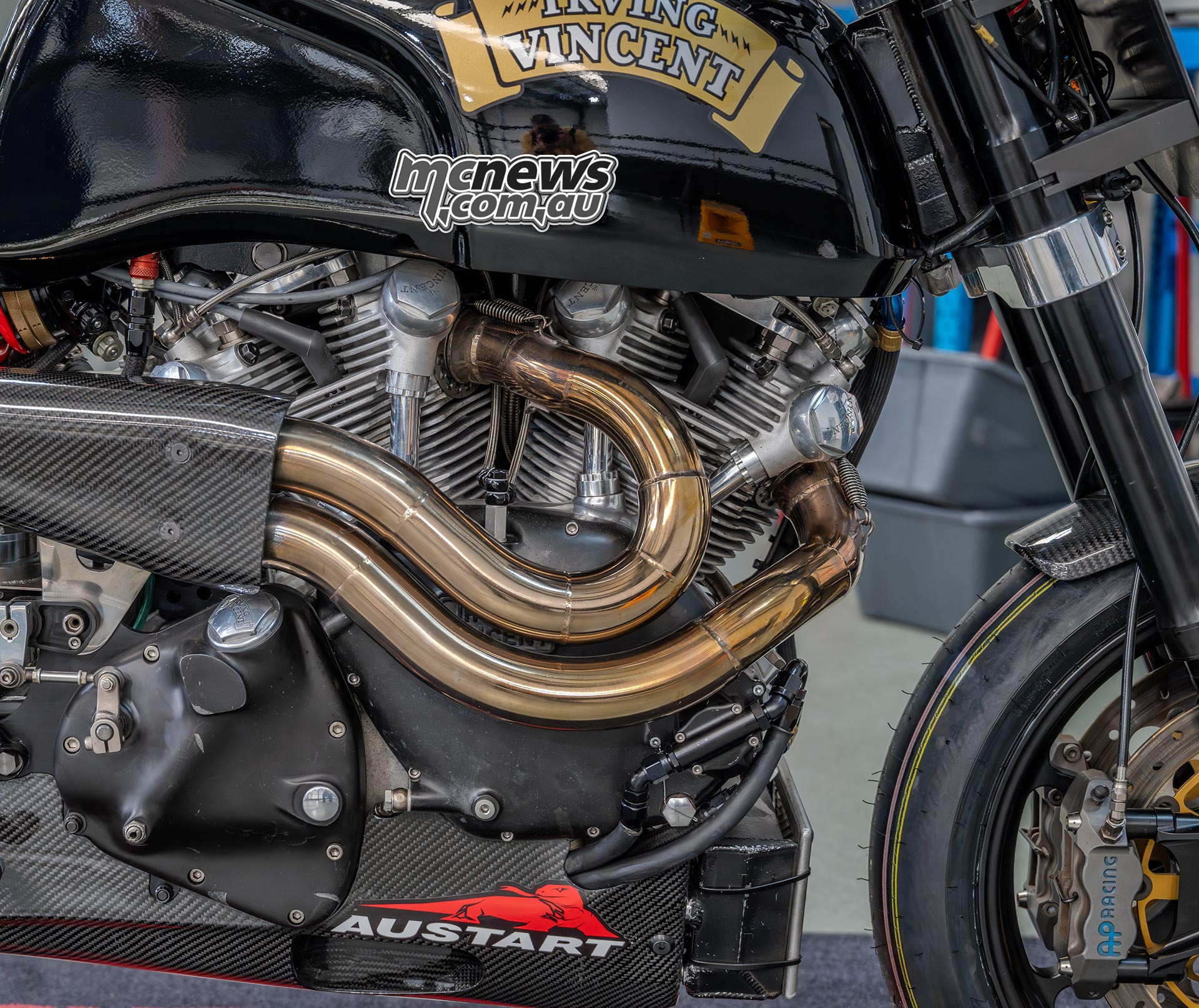 Irving Vincent
Everybody always says that it steers great…
“It’s probably by the way it is with being, you know, a V-twin and just narrow. And it’s still the old design of the original, well, Phil Irving’s design from 1946 of an oil tank stress member and a triangulated swing arm, and there is no frame. The engines are the frame. It’s just a geometry which we’ve modernised.
How much adjustment do you have in the geometry?
Like, can you change the steering geometry?
“Yeah, we’ve got eccentric bearings top and bottom on that.
“You know, different offset triple clamps.”
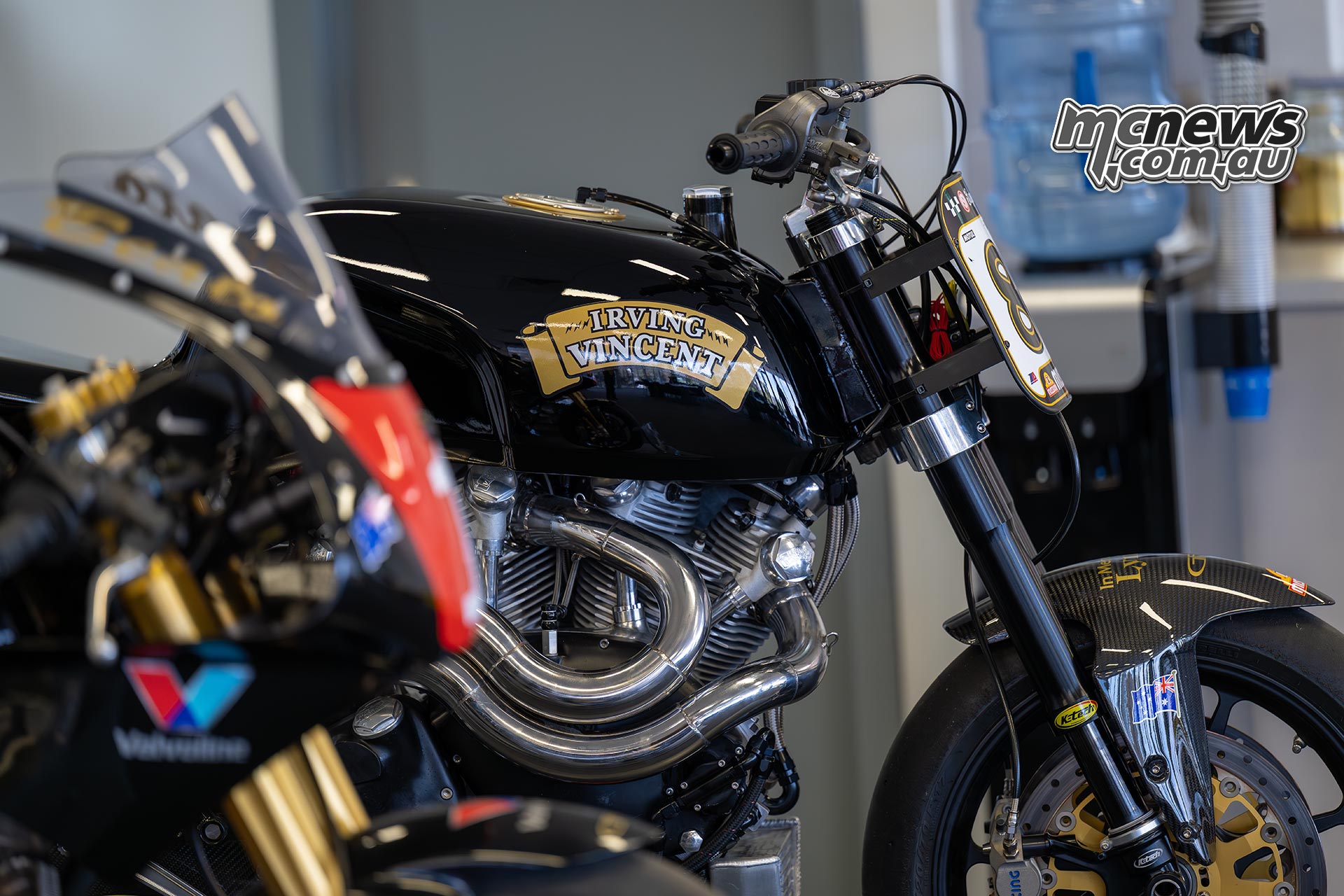 The latest air-cooled Irving Vincent pictured here behind an older generation machine
What materials are used today that perhaps weren’t available during the bike’s original build?
“Well, we’re using cho-moly steel in frame construction and things like that, instead of mild steel, and you know your aluminium is like, well, there’s nothing changed.
“I mean, all this is aircraft-type stuff, and it was around all during the war. But a lot of that stuff that was good during the war is now in modern-day use, you know. It’s all new, I guess. You’ve got a new engine, not a 70-year-old engine.”
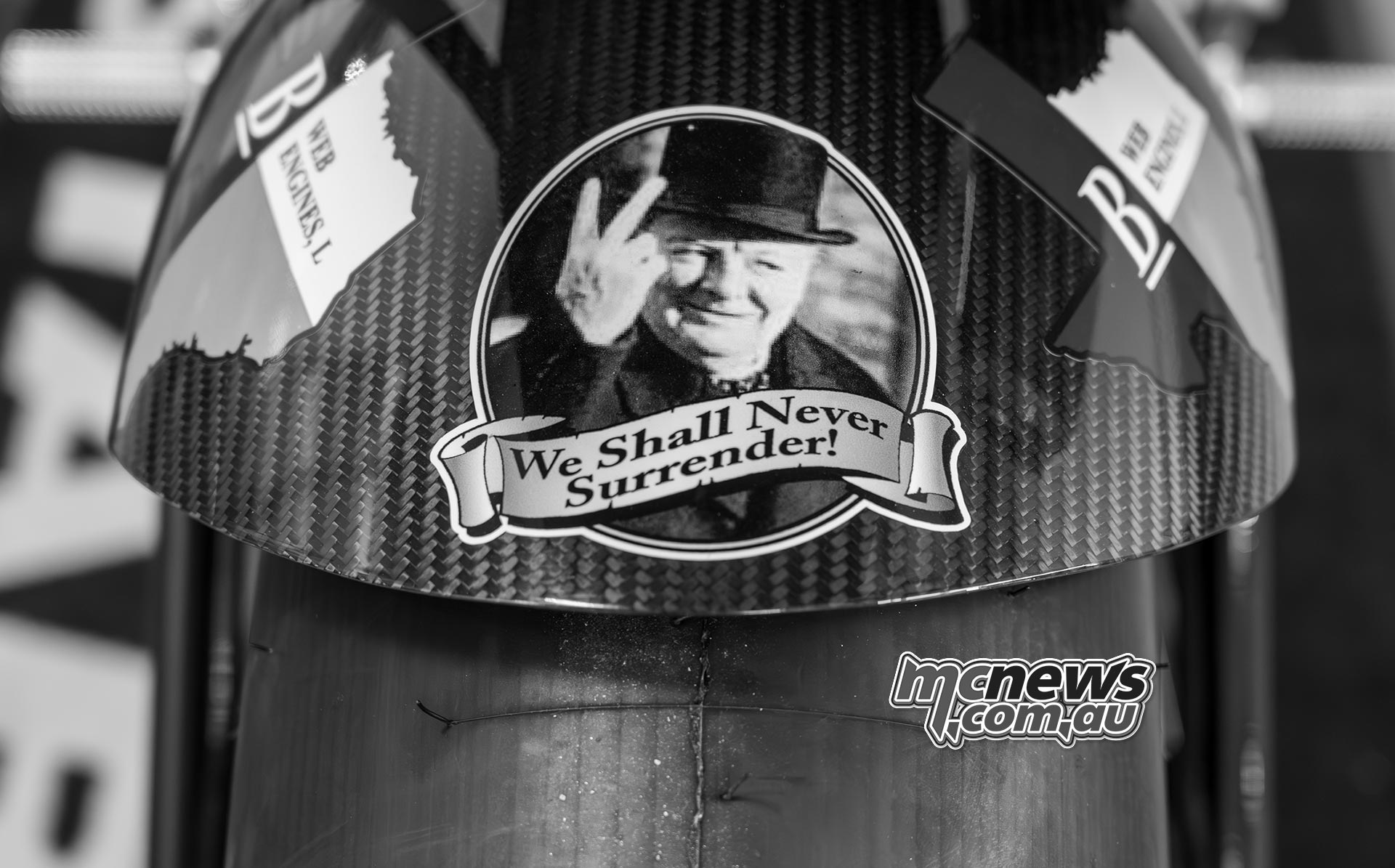 A nod to good ole Winston adorns the Irving Vincent
And how much of the bike is CNC-machined or handmade?
Was everything sort of punched into the computer, or was a lot of crafting done by hand?
“The engine components through the machine tools, the framework and everything else is… you’re looking at them (Ken holds up his hands). And there are no young guns able to use a hacksaw and a file these days. I don’t know whether it’s the physical exertion or the head (laughs).”
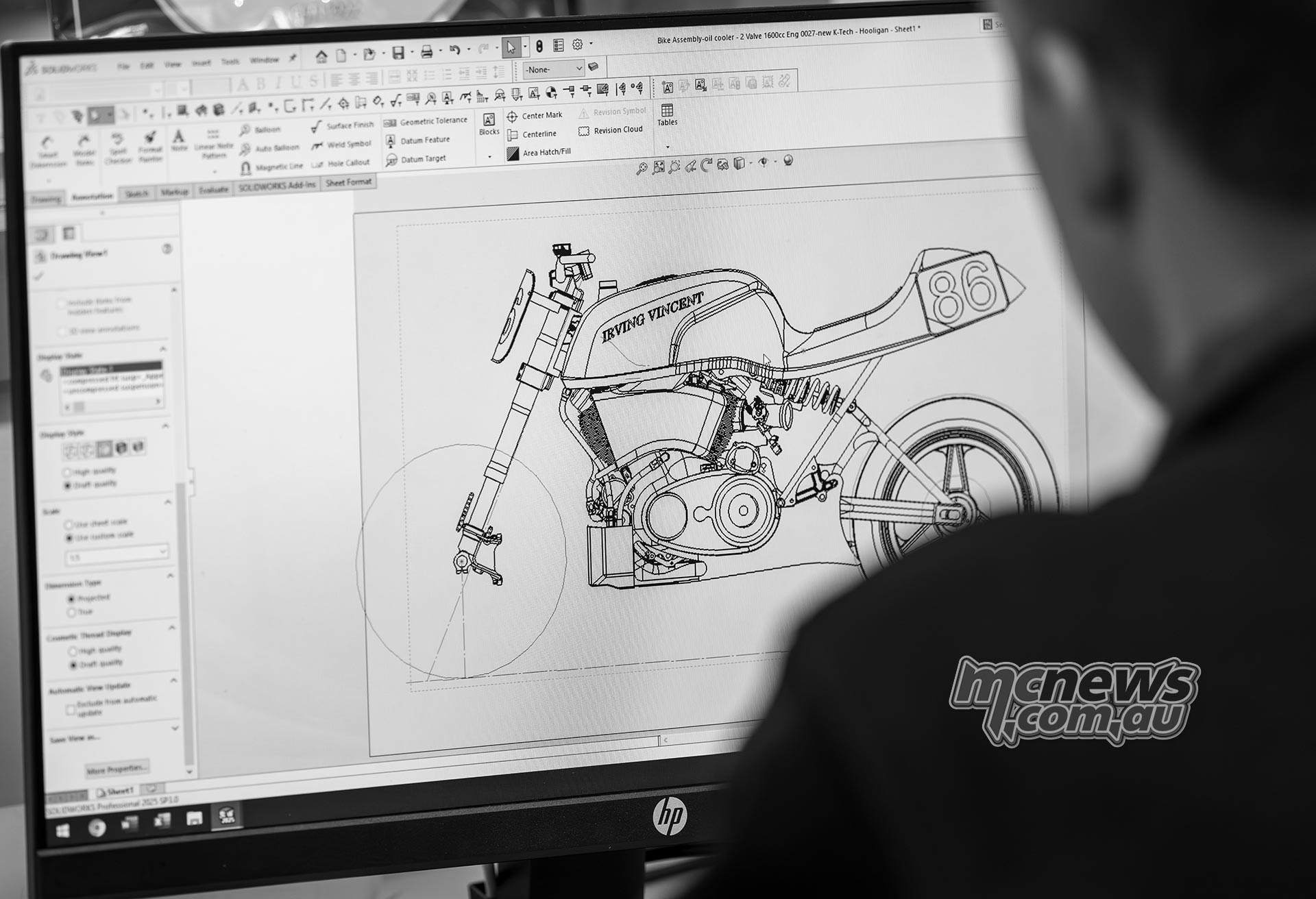 The Irving Vincent is designed and built by KH Engineering in Hallam
And what part of the motorcycle requires the most delicate craftsmanship?
“It’s riding. We can control the rest of it.”
Are there aspects of the bike’s character you’ve deliberately preserved to honour the original design philosophy?
“Obviously, the look of the Vincent engine is still classic. We haven’t taken away from what that is. It’s what’s restricted us from… It’s why there’s things you wouldn’t, if you were to make it from a clean sheet of paper, you wouldn’t do that.
“But we wanted to keep the original look. Like the engine sitting over there, and people sort of, we get questions, oh, where’d you get that engine from? Oh, we made it. ‘Oh, you restored it’? No, we make it. But we made the thing here, you know.
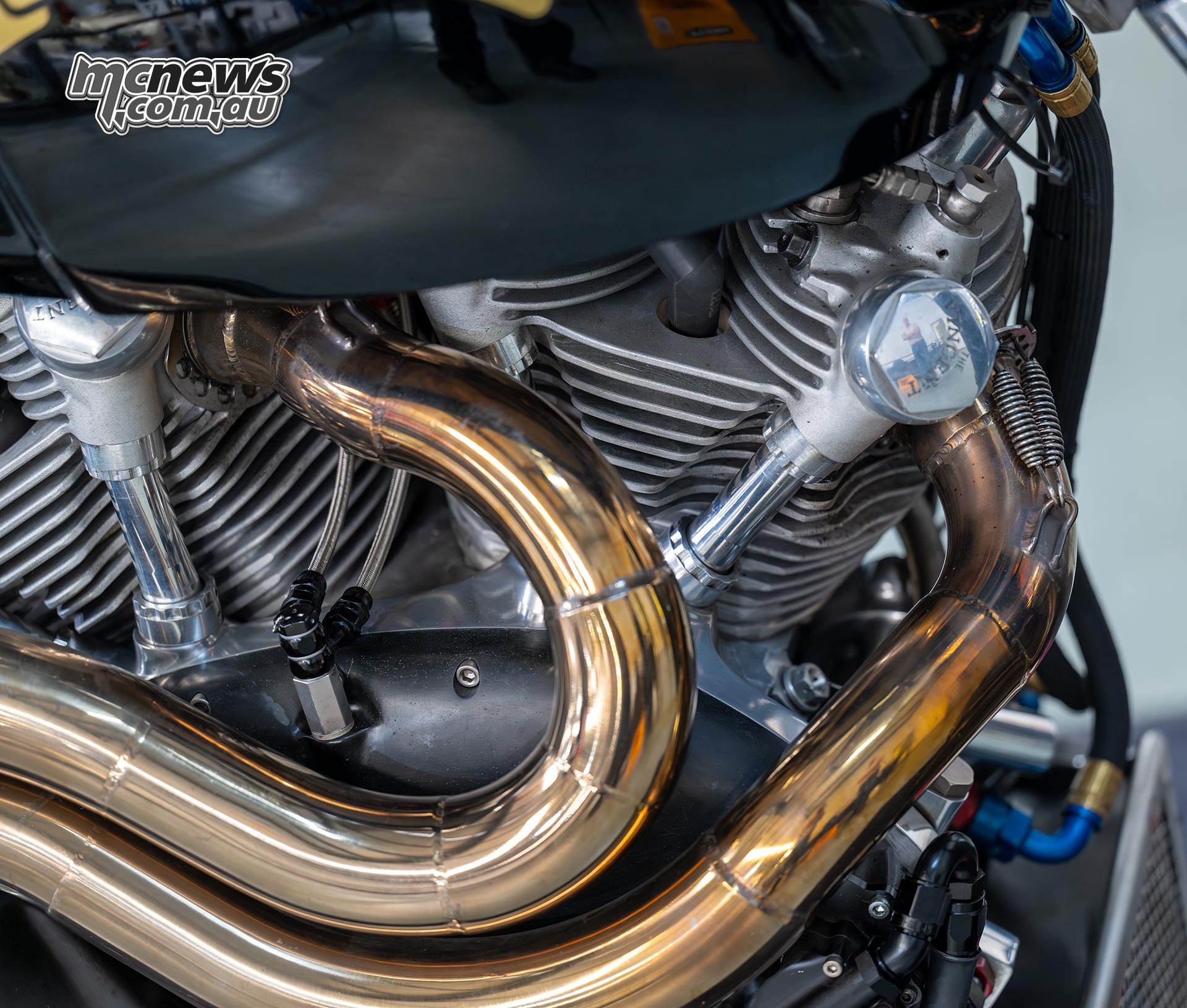 50-degree v-twin and pushrods like the 1946 Vincent Series B Rapide that the architecture harks from
“The original from 70 years ago, it’s got to be the best-looking engine ever produced, what it looks like, you know. We could do it, but you wouldn’t put a water jacket around it, and that’s what it needs if you were really chasing performance and modernity.
“Yeah, it’s got to be a water jacket. You’d have a different valve train, you know, it goes on and on and on. If we were starting from a blank sheet of paper and not trying to stick to the layout of the 1950s original, we would change the vee angle, which would be different for sure.
“But we put up with that, and that’s a challenge. That’s what brings us up there to take it against everyone else with pushrods, you know.
“So you really try to turn pig shit into strawberry jam, you know.”
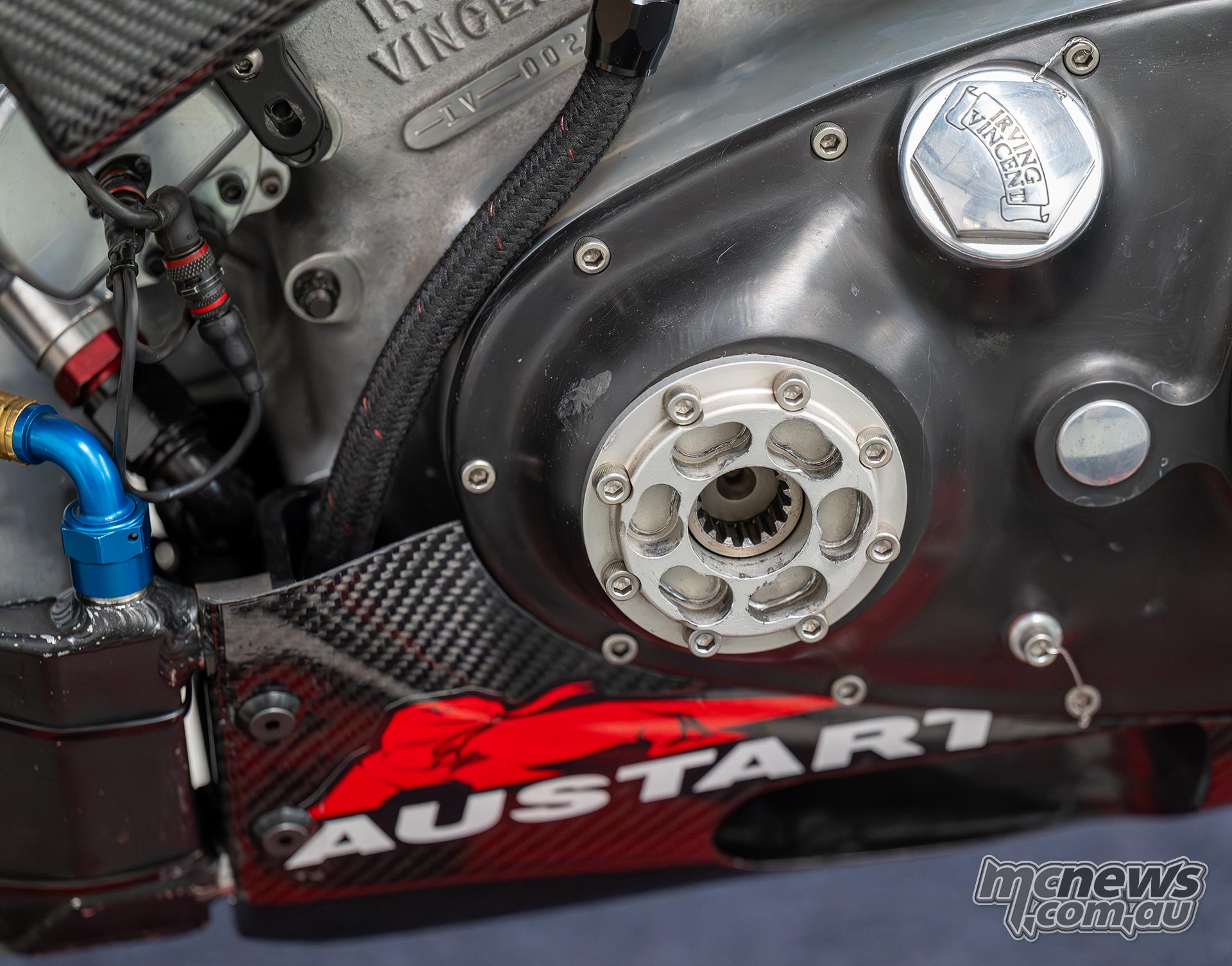 Starter gets inserted there. KHE’s primary business is making air starters for the mining industry and AUSTART also have a presence in America
How much electronic assistance does the Irving Vincent use today?
I see you’ve got the MoTeC dash…
“MoTeC ECU and all the rest of it”
Is there any form of engine brake control done with the butterflies or ignition, or is that just down to the rider…?
“Absolutely bugger all. Nothing’s going to be done. Not for this. No traction control, no nothing.”
“It’s got throttle cables. Yeah. See, that’s the biggest thing. Look, you go to the modern ECUs, 130s and whatever, it all relates to fly-by-wire. But we are straight cable-driven. We don’t even run a slipper clutch.”
So how do the boys deal with engine braking?
We’ve talked about crankcase ventilation being a problem, so I imagine there’s significant compression to deal with…
“Most people say, ‘I can’t believe you haven’t got a slipper clutch,’ but plenty of famous riders have ridden it and said it doesn’t need one.”
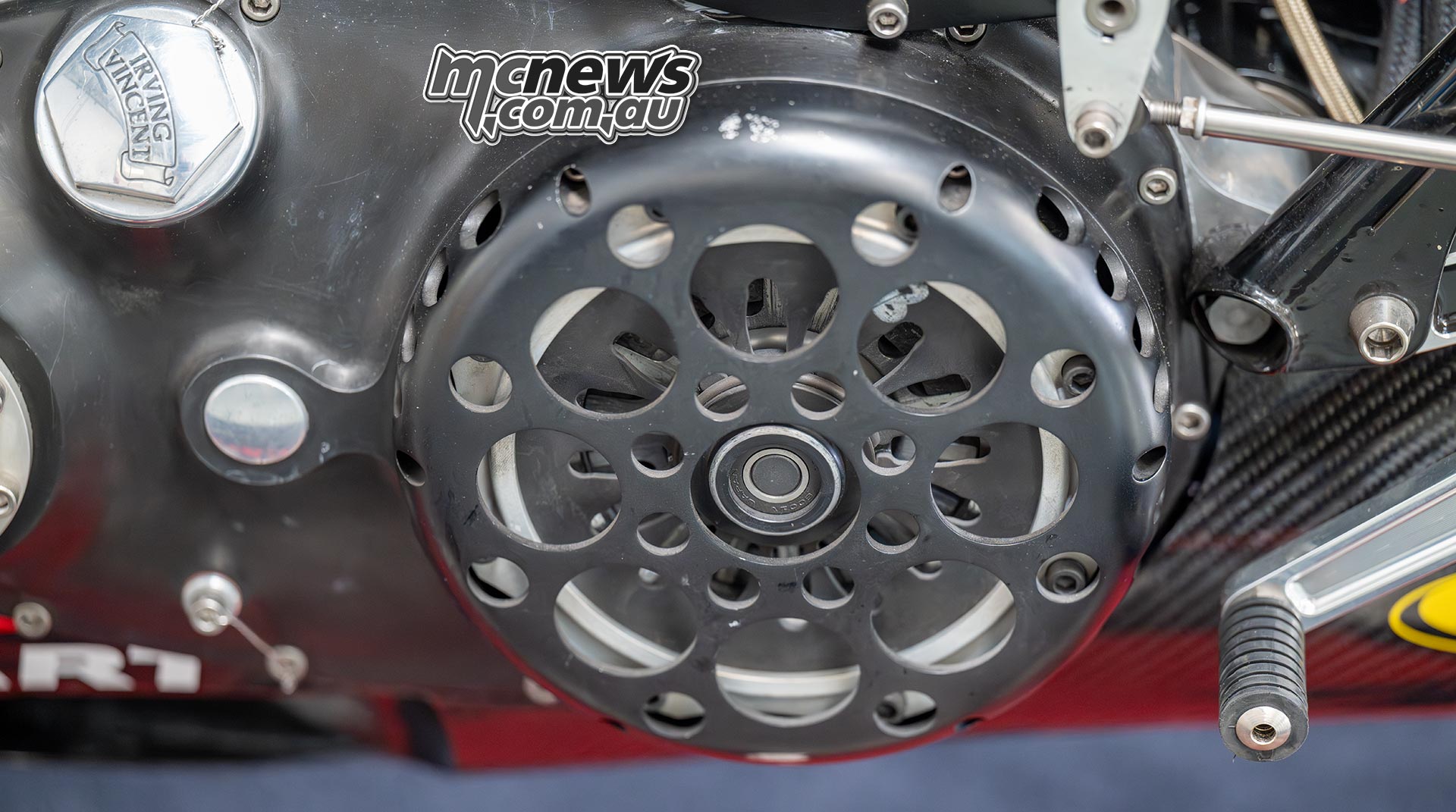 No slipper clutch on the Irving Vincent
So the boys aren’t doing it with themselves with their left hand?
“No, I don’t think so, really.”
I thought with your slugs being that big…?
“Well, sometimes, Shawn Giles rode it one time coming straight off the Superbikes, and we just upped the idle speed to help him a little bit there.
“But Beau’s been brought up with this. In fact, he rides our bikes better than he does a Ducati. It’s just the fact that he’s been brought up with it.
“We’ve kept it that way. We want to keep it that way.
“We might put some potentiometers on the shocks as a practical thing, and just a few things to see where things are.
“But look, the thing’s always worked at the Island Classic there. He’s gone around the outside of Jeremy McWilliams, you know, when he’s down there, and he can’t believe how good it is.”
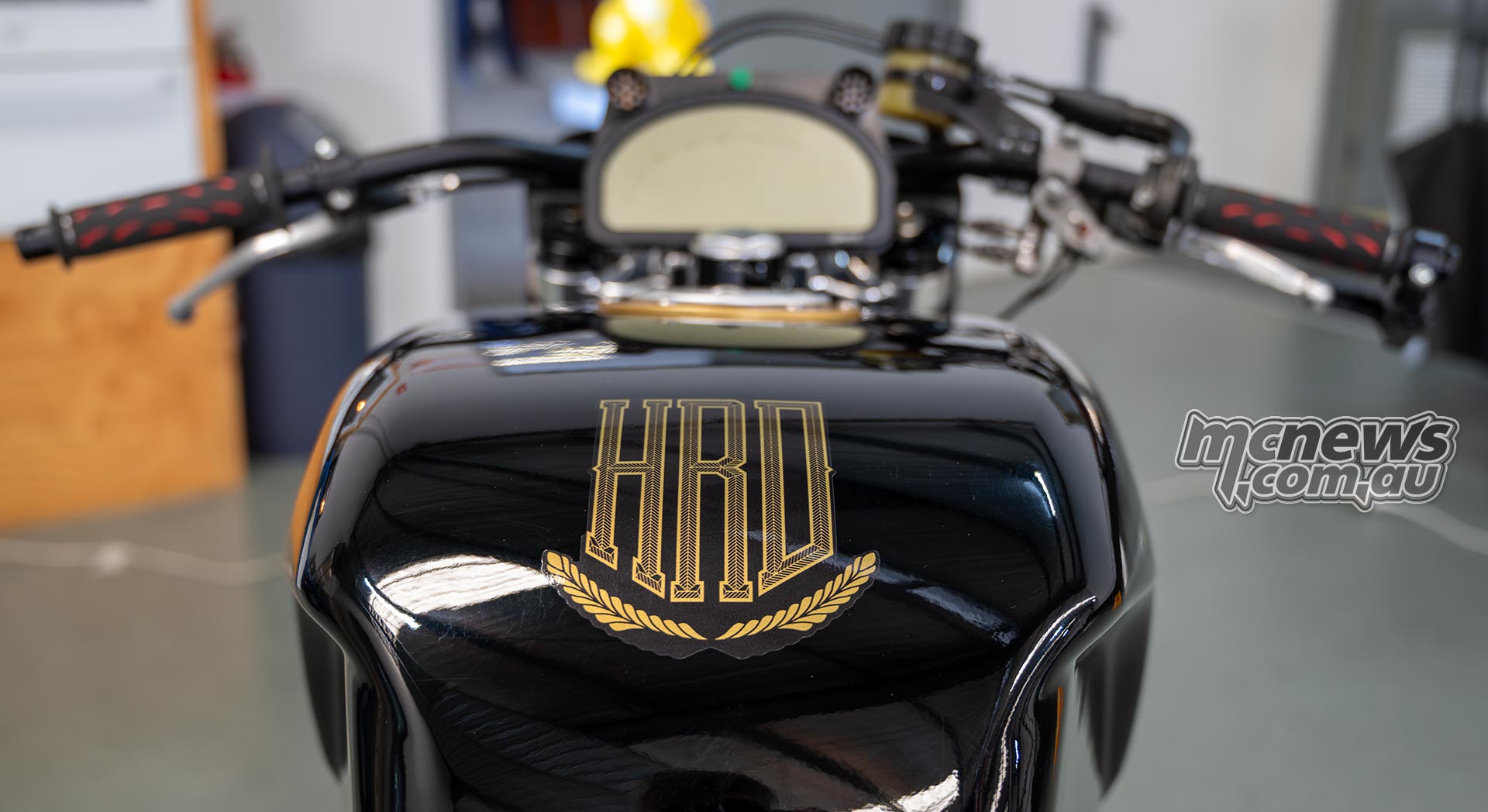 The cockpit of the two-valve air-cooled Irving Vincent Beau will race at Daytona
“What’s the component you worry about most at 300k’s in banking?
“The big lump in the middle. Yeah, the heat. I think the heat has a lot to do with it. Yeah, heat’s my biggest concern.”
And methanol would have fixed that, wouldn’t it?
“Yeah, because we’ve got to run regulations. Regulation petrol, VP, it’s like 103 octane. Yeah, and we’re running an oil cooler.”
And the octane in America is measured very differently from the way we measure octane here…
“It’s the VP race fuel, though. That’s the important thing. We can get consistency. Yeah, we can tune it to that here.”
If someone jumped from a modern superbike, perhaps one of the young guys now, onto your bike, what would surprise them first?
“They’d hate it. Probably the gearbox too. You know, you’ve got to be sympathetic, I suppose. Throttle cables, no electronics.”
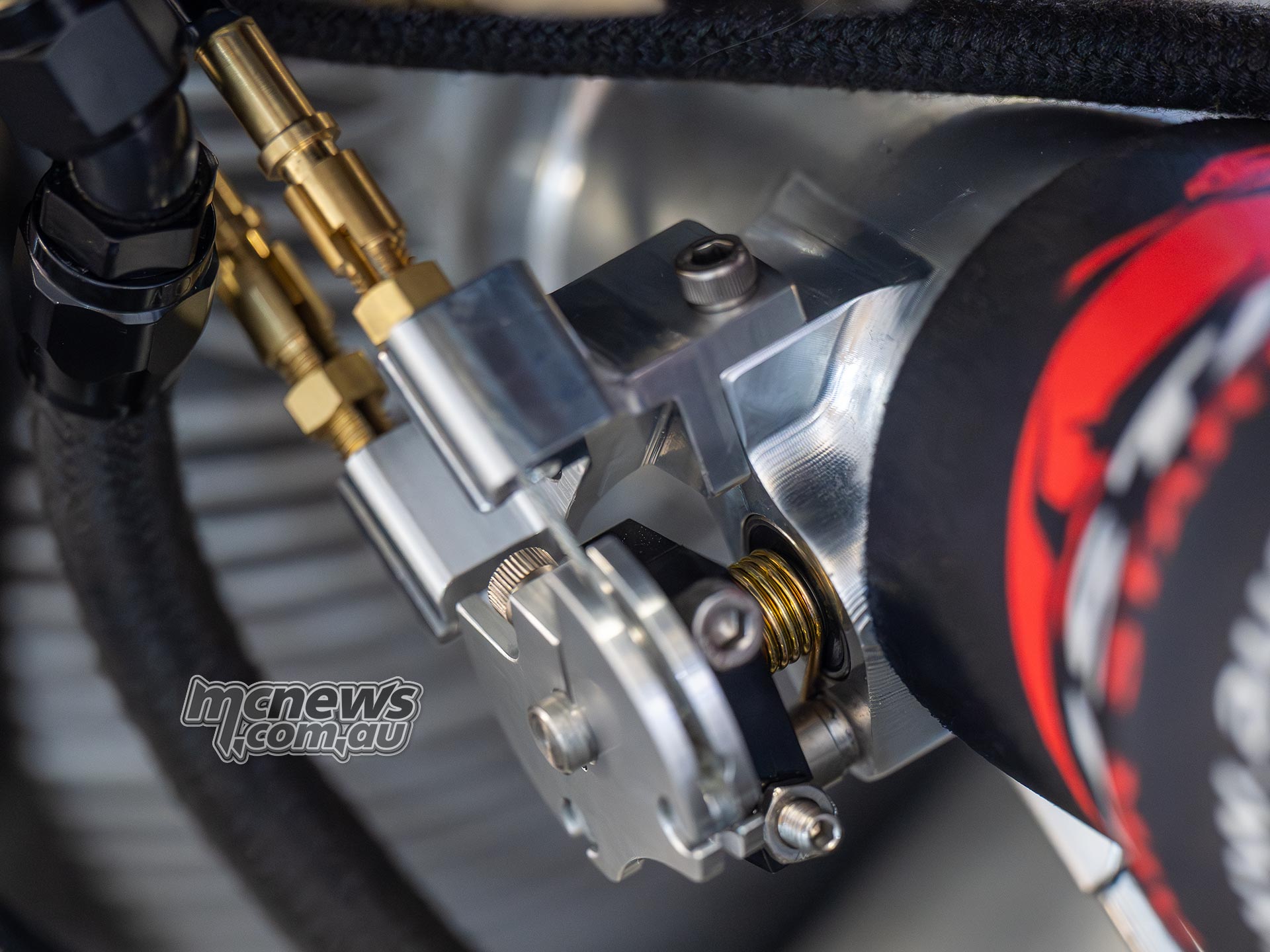 Irving Vincent Super Hooligan
Is there a quick-shifter?
“Well, we’re going to put one on it. We’ve tried it once before, and we didn’t have it set right. Yeah, but we’d like one. It’s all there to do.”
It’s an easy way to wreck a gearbox if it’s not set up right…
“Yeah, we’ve gone down that road. We didn’t do any damage, but we thought we were going to. It was going to end up in tears if we kept going.”
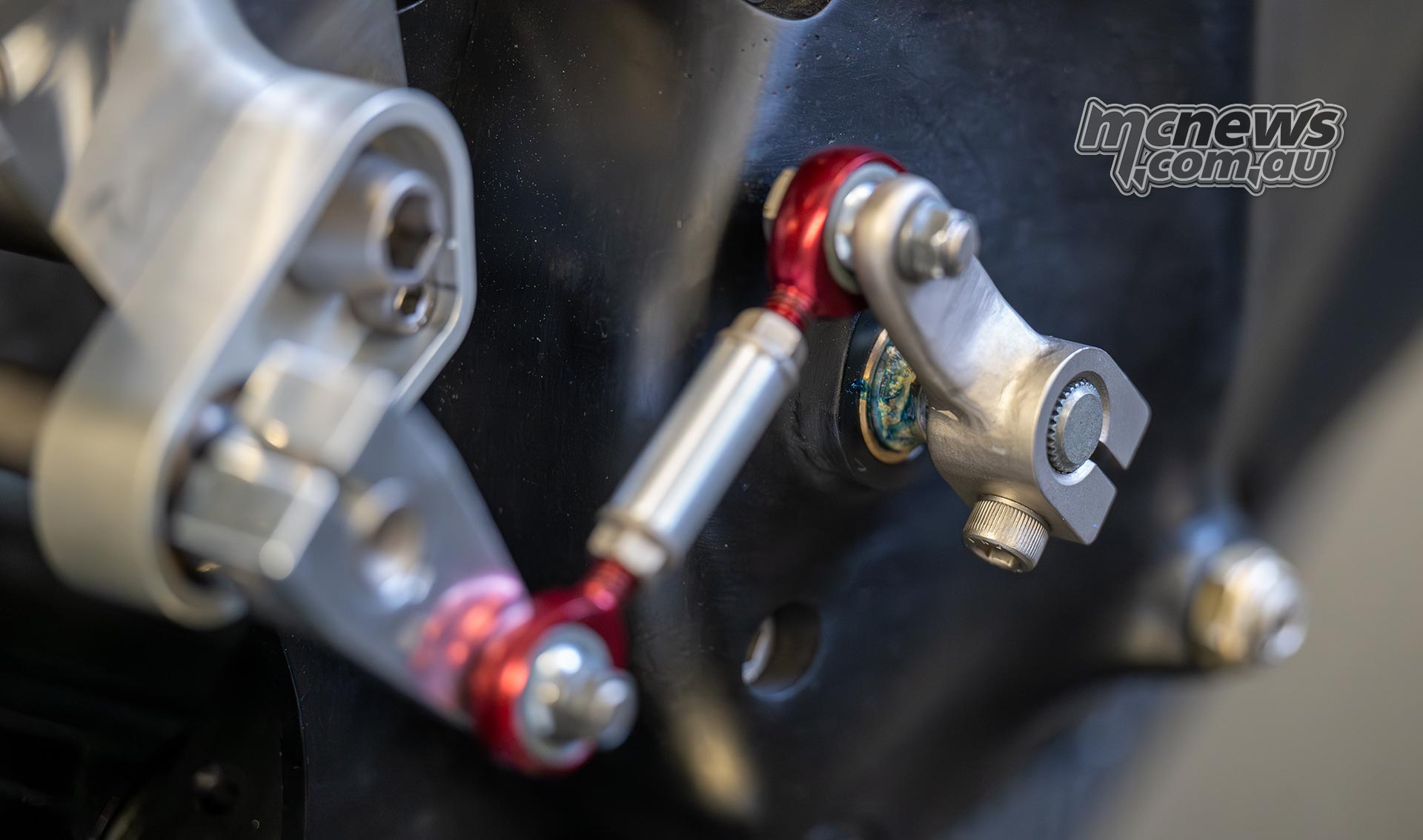 No quick-shifter set up yet…
Why is Beau the right man for the job?
“He’s been with us since 2009, when he won down at the island.
“What happened was that Craig was supposed to ride at the Moto GP, and Ducati had sort of said, you know, we’re running the big expo, you’ve got to look after the expo, you can’t do that. And Beau was sort of under Craig’s wing, being taught, you know, as Beau could ride anyway.
“And it was more the point Craig made: I can’t ride, but Beau will be able to do it. And he said, if I tell him not to drop it, he won’t. So we took him to Broadford for a bit of a run one morning, and he went well, bloody well. He was sort of around the lap record time. Job done. We went down the island and in three starts, he had three wins, which upset some of the establishment. So the older crew got the shits a bit.”
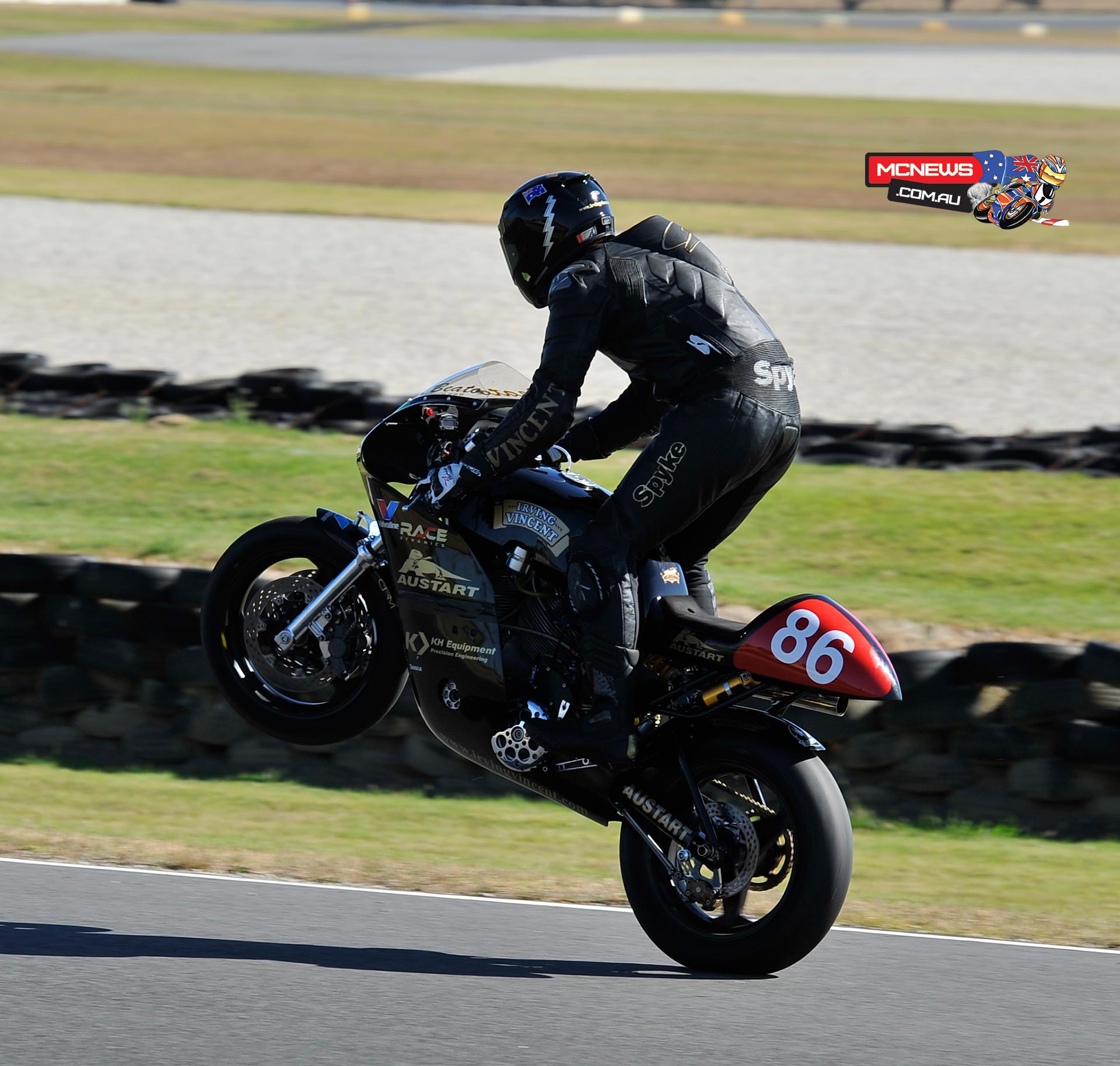 Island Classic 2014 – Beau Beaton
What keeps the Irving Project alive after all these years?
“Passion, the challenge. We keep creating challenges like that; that’s what we’re doing for Daytona.”
What do you think is the most widely understood aspect of the bike in the project as a whole?
“That depends on whether it’s from our angle or someone else’s angle. With the front-runners, sometimes you get a few saying ‘that thing shouldn’t be there’, yeah. But they don’t understand what we put into it. I think it’s what a lot of people don’t understand, is the amount of hours, and it’s just not machine hours, it’s not sort of hand hours, it’s head hours as well (Ken points to his noggin), you know.
“Yeah, they don’t understand what goes into the thought. Like, you spend more time thinking about how you’re going to do something than you do actually doing it. Otherwise, you’d go buy a V4R, put it on the track, and do it now. Well, we’ve done that. We’ve done that with Craig, and the challenge is not there. It’s good to do, but the challenge is that we still come back to this.”
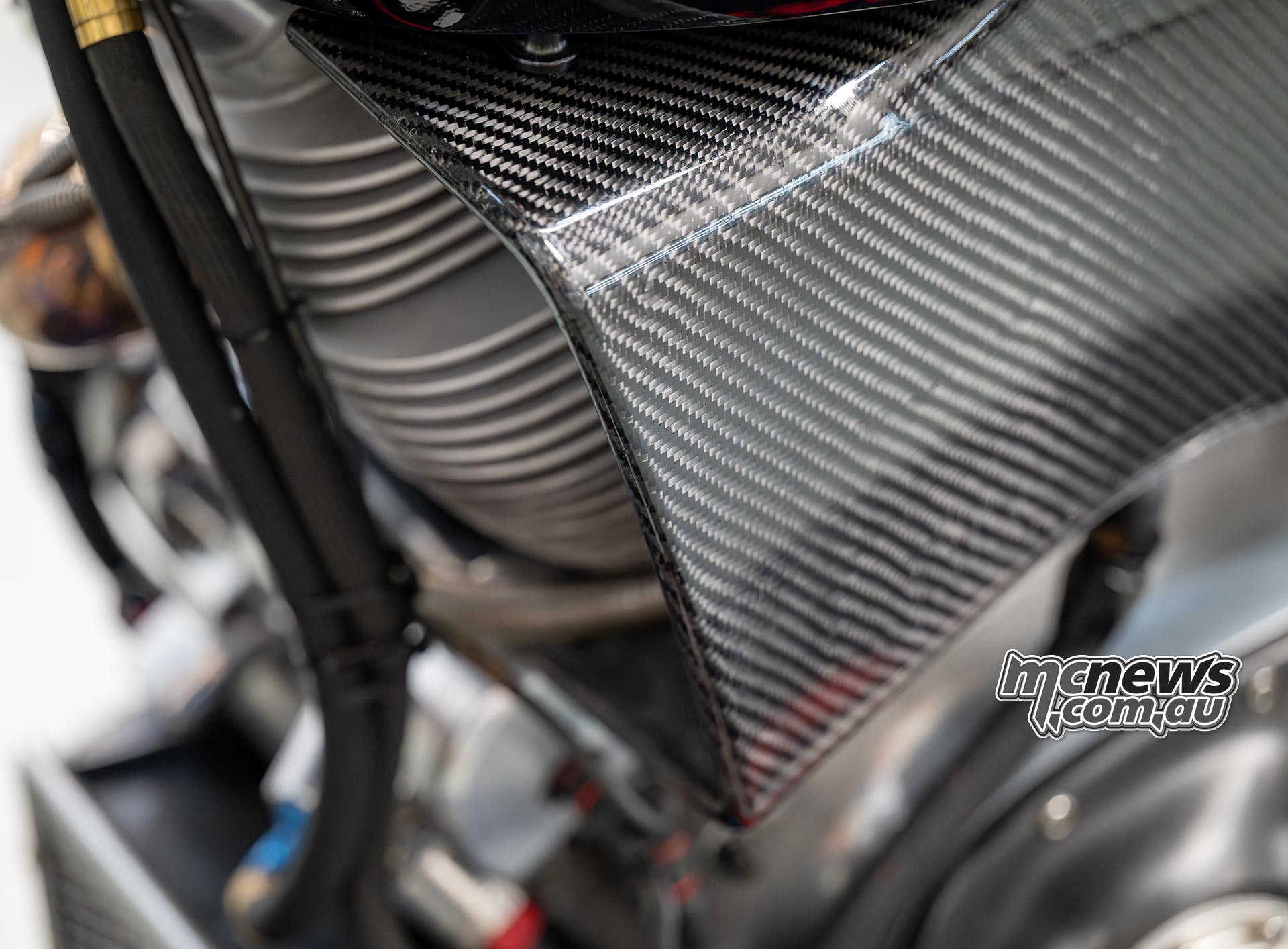 A close up of the new ducting designed to help the Irving Vincent keep its cool
Do you ever think about how Irving Vincent will be remembered decades from now, perhaps after you boys have passed the mortal coil, perhaps, and where does it get handed on to after the water boys are no more?
“That’s a good question. The biggest problem with all that sort of stuff is that it becomes more valuable when you’re not here. Yeah, well, that’s a part of the art. That’s a part of the art.
“Well, I’ve got a lot of the Repco Brabham patterns here that Alan Hamilton rescued that would have ended up in the fire, and Hammo bought them about four years ago, this is before the pandemic, and he said, ‘Well, I can’t let them end up in the fire,’
“So Alan said to me, ‘Well, we’ll own them together. But it’s what I said to Alan. I said, “We’ve got to make sure that we’ve rescued them this time, but we’ve got to make sure that in the next life, they’re not going to end up in the fire”.
“We haven’t been able to achieve that, and this is probably in the same situation. Because Alan’s not here any more. Life goes on. Yeah, as we realise it later on. But yeah, it’s a good question, but it’s still to be decided.
“Yeah, it’s always, and I’m saying it constantly, when you look back on some of these things, the intent is there, but they end up in the wrong spot. Yeah, who’s going to do it? Who’s going to continue it to what we do?
“You know, that’s the thing. It could go the wrong way, easily. Most things sort of go wrong when they get handed on. I mean, we kind of have just seen it with Gary Rogers, you know, with all the stuff down there. What’s going to happen down there?
“The question is, people are like, what’s going to happen with GRM? Gary’s not there. Once that passion goes, it’s difficult. The younger generation probably hasn’t got what we’ve got.”
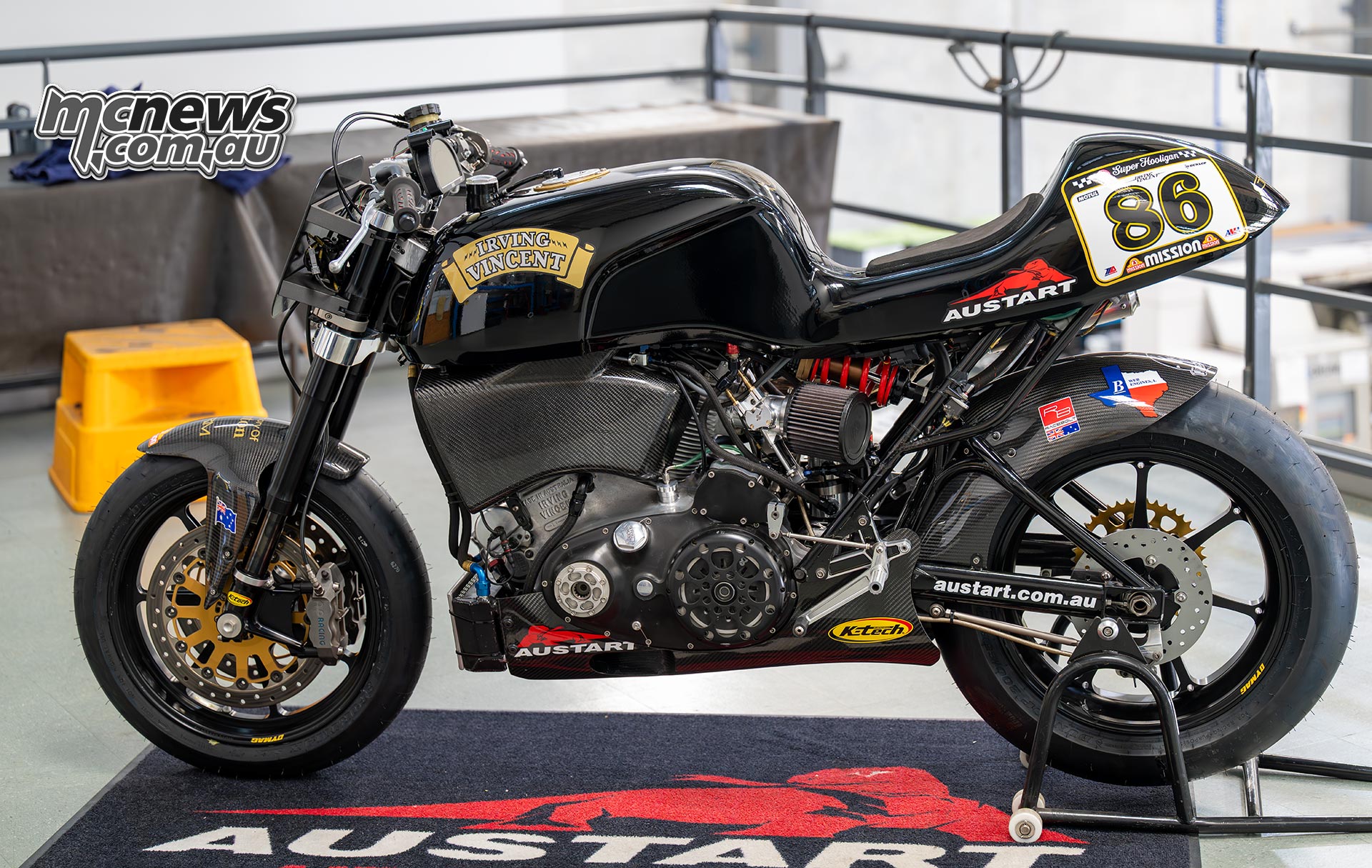 The air-cooled 1620 cc Irving-Vincent that will race in the Super Hooligan category at Daytona 2026
If Irving Vincent were a person, how would you describe his or her personality?
“Difficult. Well, challenging. Yeah, but it repeats itself, too. It’s consistent.
“Yeah, like engine development and stuff, we always struggle to get extra. It’s hard to get, but you know where the figure is and when it’s good.
“They repeat themselves in the dyno. You know what’s wrong. You know what the thing should do before you pull a lever. The preparation’s all done here, and you get to the track. The idea is to go to the track and just put fuel in it.
“That’s when it’s a good weekend, what we do. And that’s what we intend to do for Daytona. It’s not so much testing and testing and testing at the track; it’s all done here, and to make sure it doesn’t go wrong when we get there.”
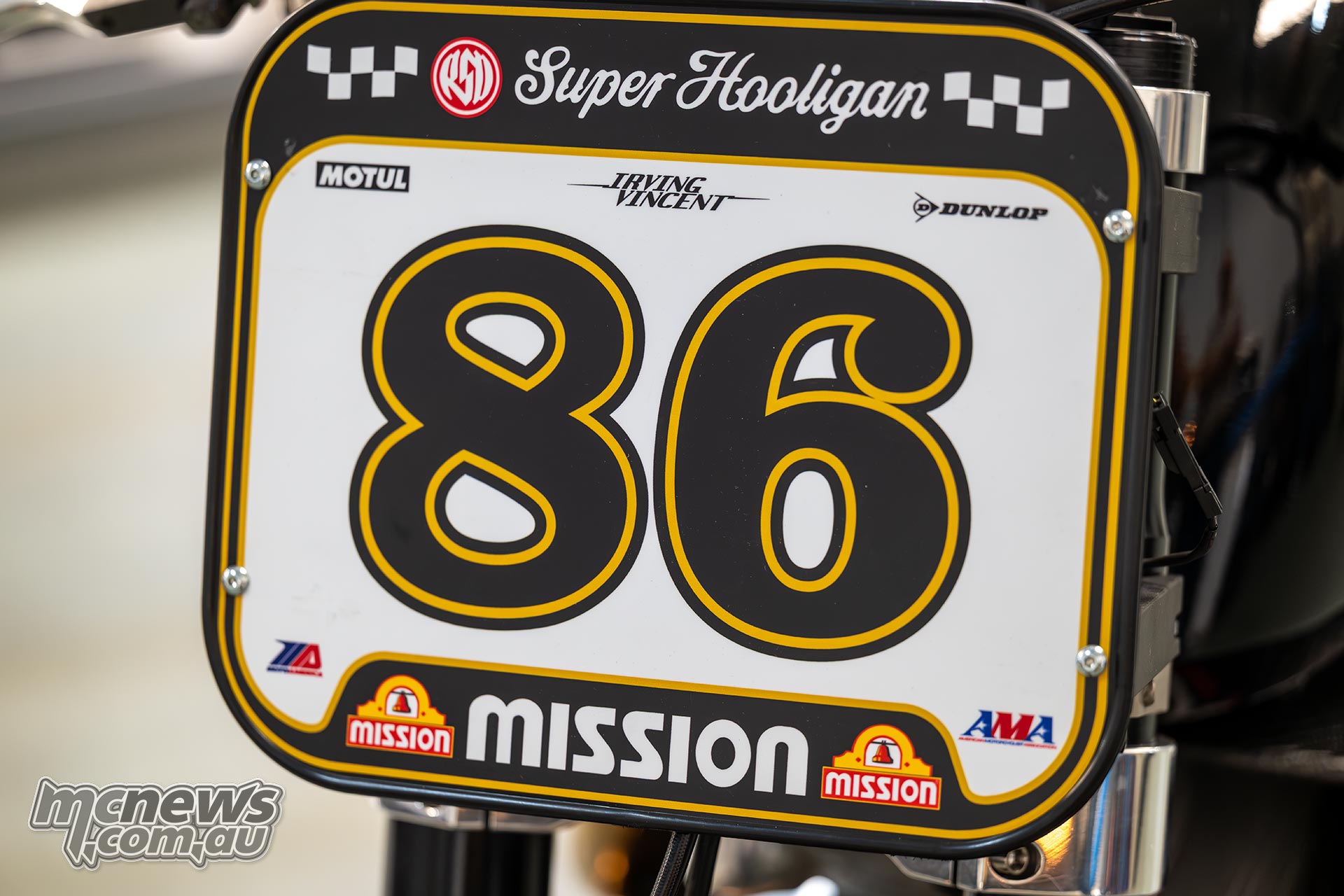 The mission in 2026 is the Mission Super Hooligans category at Daytona
The Irving Vincent has never been about chasing mainstream convention; it has always been about proving what Australian ingenuity can achieve. As the team prepares for Daytona, there are still countless unknowns, but one certainty: whatever happens at Daytona, a new and unforgettable chapter will be written in the Irving Vincent legacy for a machine that is already a big part of Australian motorcycling folklore…



 English (US) ·