
 1 hour ago
3
1 hour ago
3
ARTICLE AD BOX
Moto3 set for Yamaha control-bike era from 2028
Moto3 is heading for its biggest technical reset since the end of the 125 GP two-stroke era, with Yamaha confirmed as the exclusive motorcycle supplier for the FIM Moto3 World Championship from 2028 through 2033.
The new project, announced jointly by Yamaha and MotoGP at Assen, will see the current 250 cc single-cylinder four-stroke Moto3 formula replaced by a Yamaha-produced control motorcycle based around the company’s proven CP2 production platform.
That should not be confused with a warmed-over road bike or a simple Yamaha R7 control class. Yamaha and MotoGP are describing the new machine as a racing prototype, extensively re-engineered for Grand Prix competition, with the stated target of delivering a superior power-to-weight ratio compared with current Moto3 machinery.
 Yamaha’s future Moto3 control bike is teased ahead of a full public reveal scheduled for 2027.
A new backbone for the junior GP class
The change marks a major shift in the philosophy of Grand Prix racing’s entry-level World Championship category.
Moto3, as we know it today, was introduced in 2012 as the four-stroke replacement for the 125 cc GP two-strokes. Those beautiful little 125s had been part of Grand Prix racing from the foundation of the World Championship in 1949, and for decades formed the base of the international road racing ladder, including right here in Australia.
The present Moto3 formula is still very much in that lightweight GP tradition. The current bikes are tiny, purpose-built racing machines powered by 250 cc single-cylinder four-stroke engines. They produce around 60 horsepower, are limited by the control electronics, and run at a combined motorcycle-and-rider minimum weight of 152 kg.
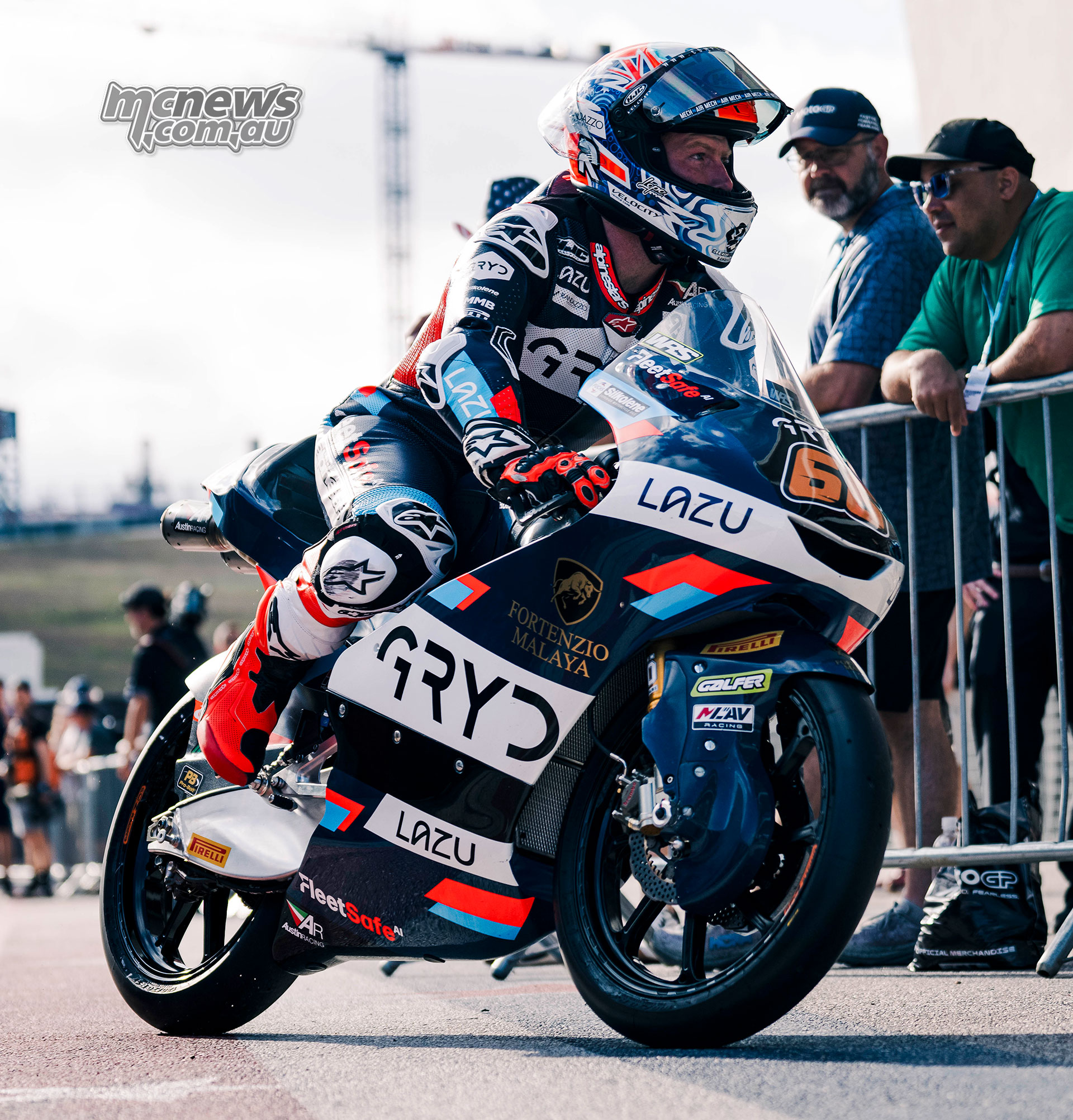 Joel Kelso on the 2026 specification Honda Moto3 machine
While the original Moto3 technical framework was built around a 14,000 rpm ceiling, current references point to a 13,500 rpm limiter target. Either way, the defining character has remained the same: small, light, highly strung motorcycles that reward corner speed, precision, slipstream management and racecraft.
In recent years, Honda and KTM have been the main competitive suppliers in Moto3, with the class operating under cost-control measures that include regulated engine and rolling-chassis pricing. Even so, Moto3 has remained an expensive category by junior racing standards, and that cost has been one reason the formula has not been widely adopted by domestic championships around the world.
Current Moto3 engines are cost-capped at €12,000, but are generally supplied as part of a season-long lease package pegged at around €80,000 per rider. That covers six engines per season, including maintenance. In recent years, teams have been heavily subsidised by series organisers, generally reducing the effective lease charge to around €10,000 per rider.
Complete rolling chassis, however, can still cost close to €100,000 each. Under the current structure, Moto3 is therefore not necessarily the cheaper rung on the Grand Prix ladder compared with Moto2, where annual engine lease costs have more recently been pegged at around €60,000, but competitive chassis packages can still cost more than €100,000 each.
CP2 roots, not R7 rules
The Yamaha CP2 engine family is already well known to production riders. The 689 cc parallel twin powers a broad spread of Yamaha middleweights, from the YZF-R7 and MT-07 through to the XSR700 and Ténéré 700.
 Yamaha has not yet confirmed the final capacity or specification of its new Moto3 engine, only that the prototype will be based on the CP2 production platform.
In road-going R7 form, the CP2 engine produces around 75 horsepower at less than 9000 rpm, with its 270-degree crank giving it a very different character to the current Moto3 single-cylinder engines. It is a torquey, flexible, relatively low-stress platform compared with the tiny, high-revving 250 cc singles currently used in the class.
Yamaha already supplies the R7 as the control motorcycle for the FIM Women’s Circuit Racing World Championship, where the bike remains comparatively close to its road-going base. The new Moto3 project, however, is being pitched as something considerably more serious.
There is no official word yet on the capacity that will be used, nor any details on final power, weight, chassis layout, suspension specification, electronics, tyre package or pricing. Yamaha and MotoGP have confirmed the CP2 production platform as the starting point, but have not confirmed that the new Moto3 bike will use the full 689 cc road-going displacement. We expect that capacity to potentially be lowered as far as 500 cc
To better the power-to-weight ratio of a current Moto3 bike, Yamaha’s new machine will need to be a much racier and lighter proposition than a road-derived R7. This is not expected to be a production bike with fairings and slicks, but a Grand Prix racing motorcycle designed around a more accessible and durable engine architecture.
Yamaha’s future Moto3 control bike is teased ahead of a full public reveal scheduled for 2027.Why a full-size Moto3 bike matters
One of the most interesting parts of the official statement is the reference to a “full-size motorcycle” better suited to the physical characteristics and riding style of the next generation of riders.
Current Moto3 bikes are exceptionally small. That has long suited very young and very light riders, but the sport has also had to contend with the growing reality that many riders are physically larger by the time they reach the World Championship ladder. The 152 kg combined motorcycle/rider minimum has helped reduce the advantage for lighter riders, but it has not changed the fundamental size and character of the motorcycles.
A larger control bike based around a twin-cylinder Yamaha platform should change the way Moto3 prepares riders for the next steps in their careers.
Moto2 is already a full-size Grand Prix class that uses Triumph 765 cc three-cylinder engines, while MotoGP is heading into its next technical era starting in 2027. A new Moto3 bike with more torque, a more substantial chassis and a closer physical relationship to the machinery riders will encounter later in their careers could make the transition through the Grand Prix ranks more logical.
The trade-off is that Moto3’s traditional identity may change. The current class is famous for huge slipstreaming packs, late braking, high corner speed and ultra-tight finishes. A larger, torquier machine could alter that dynamic. The challenge for Yamaha and MotoGP will be to deliver a motorcycle that better prepares riders for the future without losing the intense racing that has made Moto3 such a valuable part of Grand Prix weekends.
The cost question is the real story
While the technical shift will attract most of the attention, cost control is likely to be the real driver behind this project.
The 125 GP class once formed the backbone of junior road racing around the world, but by the end of that era the global relevance of small two-stroke racing motorcycles was fading. Moto3 replaced it with a more modern four-stroke prototype formula, but the category never became a truly affordable global domestic racing platform.
That has been particularly clear outside Europe. In Australia, the Supersport 300 category has served ASBK well because it is production-based, relatively accessible and easy for young riders and teams to understand. Full Moto3, by contrast, has remained a much more specialised and expensive exercise.
The new Yamaha platform appears designed to solve that problem from the top down.
 The new-look Moto3 category will move to a Yamaha-supplied control motorcycle from 2028 through 2033.
MotoGP and Yamaha have confirmed that, from 2029, the FIM Moto3 Junior World Championship within the MotoJunior paddock is expected to adopt a slightly lower-specification version of the same machine. Discussions are also underway with additional regional championships interested in joining the platform.
That is potentially the most important part of the whole announcement. This is not just about changing the bikes on the Moto3 grid. It is about creating a common global pathway, where young riders can progress through domestic, regional and international categories on motorcycles that share the same broad architecture.
For Australia, the question will be whether a future regional or domestic version can be delivered at a price point that makes sense relative to Supersport 300, Yamaha R3 Cup, Oceania Junior Cup, and other existing development categories. If the cost is right, a CP2-based Moto3 control platform could give young riders a more direct technical stepping stone toward Grand Prix racing than anything currently available in the domestic paddock.
What Yamaha and MotoGP are saying
MotoGP Chief Sporting Officer Carlos Ezpeleta said the project is about more than deciding which bike Moto3 riders will use.
Ezpeleta described the plan as a global platform for young riders, with MotoGP aiming to increase accessibility and better position Moto3 as the entry-level class of the World Championship.
Yamaha Motor Racing Managing Director Paolo Pavesio made a similar point, saying the objective was “not simply to build a motorcycle”, but to create a platform capable of supporting riders, teams and championships for many years.
This is not being framed as a narrow supply deal. It is being framed as a new technical and commercial foundation for junior Grand Prix racing.
What remains unknown
For now, the unanswered questions are substantial.
Yamaha has not confirmed the engine capacity, power output, minimum weight, chassis specification, price, engine-life targets or rebuild structure. There is no confirmed information on tyres, brakes, suspension, electronics, spares pricing or how the lower-specification Moto3 Junior version will differ from the World Championship motorcycle.
There is also no official detail on how existing Moto3 teams will transition away from their current Honda and KTM machinery, or whether Yamaha will supply a complete motorcycle package with all major components tightly controlled.
What is clear is the direction of travel. Moto3 is moving away from tiny, high-revving, multi-manufacturer prototype singles and toward a single-supplier, full-size, CP2-derived Yamaha racing platform.
Our take on it
This is one of the most significant changes to the junior Grand Prix pathway since Moto3 replaced 125 GP in 2012.
It also has the potential to be more consequential than that earlier change, because the ambition here extends beyond the World Championship paddock. MotoGP and Yamaha are openly targeting a broader development ecosystem, with JuniorGP and regional championships expected to form part of the same structure.
The upside is obvious: lower costs, greater parity, less technical arms-racing, and a clearer route for young riders from national racing to Grand Prix competition.
The downside is also obvious: Moto3 will lose some of its technical variety, and the Honda-versus-KTM rivalry that has defined the category in recent years will disappear from the front line of the junior GP class.
Whether the racing improves, suffers, or simply changes character will depend on the final specification. If Yamaha gets the power, weight, aerodynamics and tyre package right, the new Moto3 could give young riders a better training tool without killing the close racing that has made the class so compelling.
The prototype is due to be shown publicly in 2027, with testing activity expected before then. The new era begins in earnest in 2028, but the bigger local question is how long it might take before the platform filters down to Australian race tracks.
With Yamaha such a significant backer of ASBK, there is an obvious argument that Australia could be well placed to embrace the new structure if a cost-effective regional or domestic version becomes available. It would be a natural fit on paper, particularly if MotoGP and Yamaha are serious about creating a global development ladder rather than simply replacing the machinery used in the World Championship.
That said, ASBK has not always been quick to adopt global category trends, and has often preferred to tread its own path, sometimes persisting with classes long after other domestic championships have moved on. This Yamaha Moto3 project could present an opportunity to reframe the roots of Australian road racing, aligning our junior pathway more closely with Europe and other key regions, and giving young local riders a more natural stepping stone towards the international stage.




 English (US) ·