
.png) 7 months ago
126
7 months ago
126
ARTICLE AD BOX
2025 Honda Goldwing Review
Right, let’s get this out of the way first. Yes, it is big, and yes, size does matter. But it’s nowhere near as cumbersome as you might imagine. I even found myself lane-splitting through heavy traffic without too much drama.
 Honda’s Gold Wing has long stood as the pinnacle of motorcycling luxury
A legacy that continues as the iconic touring bike celebrates its 50th anniversary.
In fact, for many riders, the 390 kg Gold Wing will actually feel easier to manage in a parking lot than some big adventure bikes.
How so?
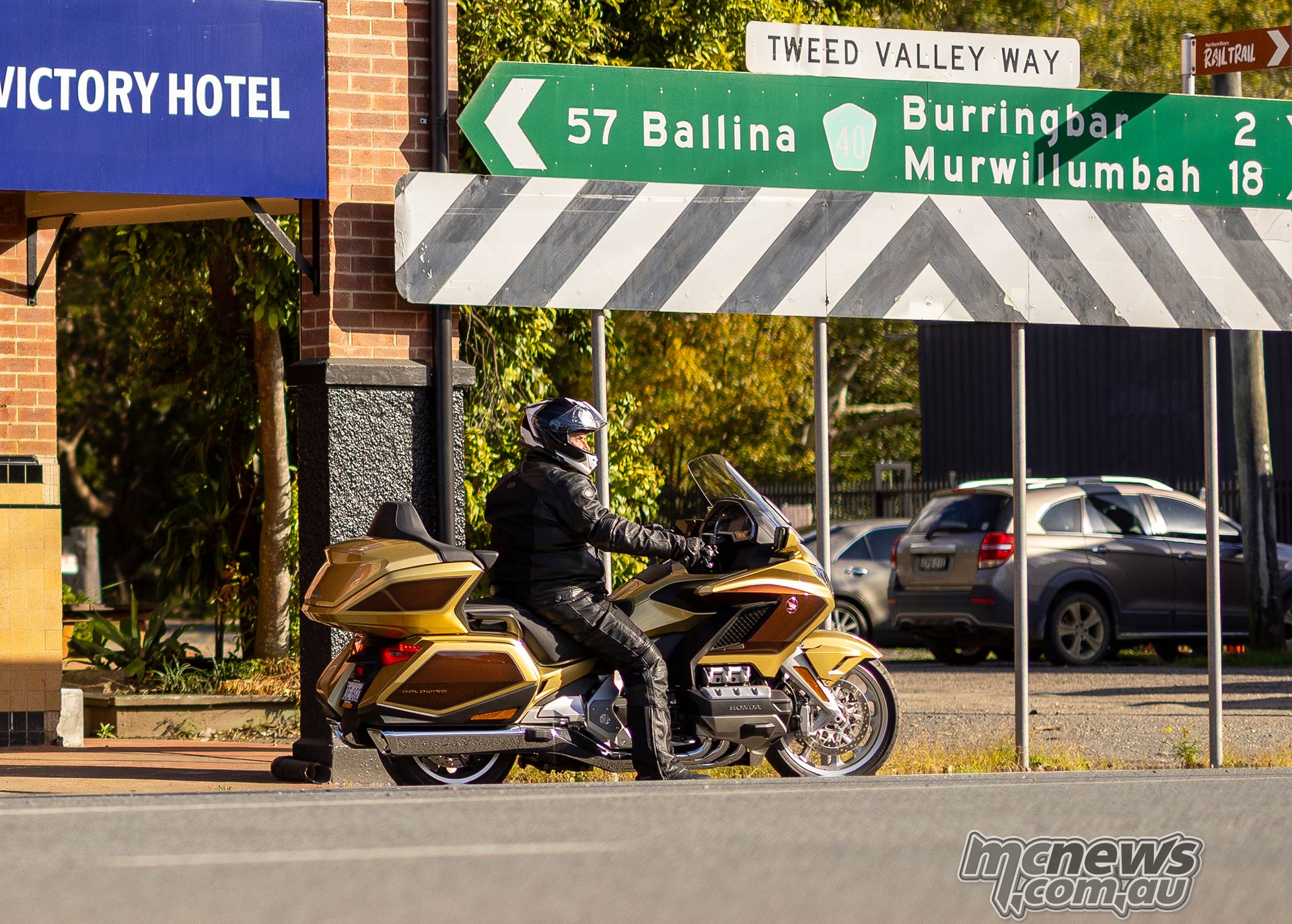 Very low 740 mm seat height helps to make the Wing very manageable
A seat height of just 740 mm, one of the lowest centres of gravity you’ll find on two wheels, and Honda’s brilliantly useful ‘Walking Speed Mode’ all combine to make it an absolute doddle to paddle in or out of a sketchy parking spot.
You can simply crawl forwards or backwards slowly using the up and downshift paddles on the left bar. To operate the system, the DCT box must be in neutral. The ‘Walking Speed Mode’ system is then activated via a button on the left switch-block while a brake is also applied. From there, the downshift paddle is held down to walk the bike slowly backwards, or the upshift paddle is used to proceed slowly forward. This makes parking lot manoeuvring largely stress-free. To deactivate, apply a brake and press the ‘Walking Speed Mode’ button again. A parking brake lever is nestled into the fairing just in front of your left knee.
 For the 2025 model year, the Gold Wing adds wireless compatibility to its Apple CarPlay and Android Auto systems
Hill Start Assist functionality is also on call and activated by a quick squeeze of the brake lever when the bike is stationary, in gear, with the throttle closed and side-stand up. The system will then hold the brakes on for around three seconds.
How hard is it to get on the centre-stand?
Pretty easy. Apply pressure with your right foot to the tip of the centre-stand while holding onto the left bar and grab-rail, then simultaneously pull up and back.
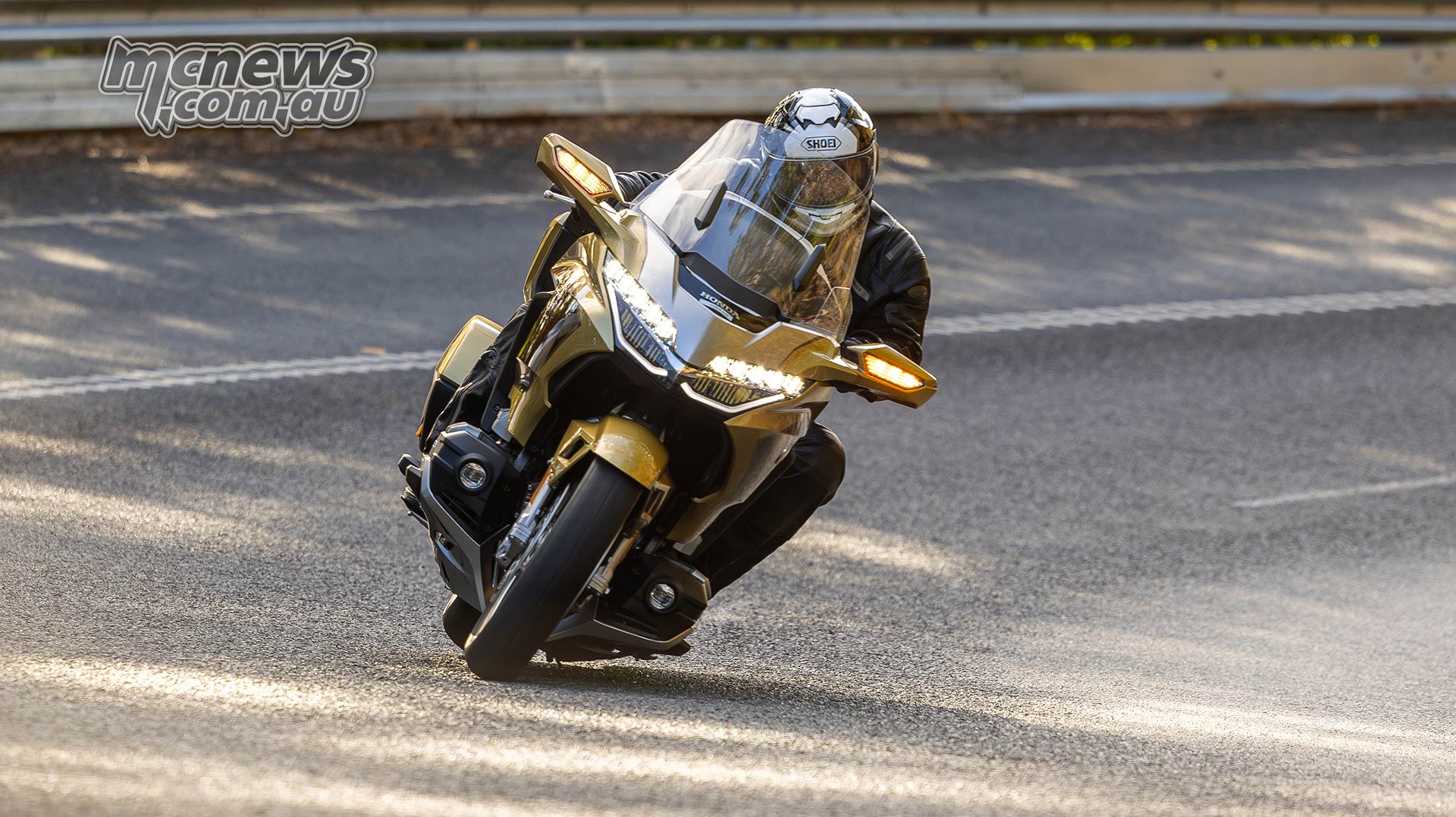 Key features include double-wishbone front suspension and the legendary flat six-cylinder engine
Surely it steers like a bus?
The Wing has always steered nicely, and it takes little effort at the bars to initiate a turn or swing it from side to side. This is a trait also shared by most of its full-dress touring brethren.
From the Gold Wing to BMW’s big K 1600 GTL through to the variety of Big Twin American Touring models, they all actually steer quite nicely and with very little effort needed through the bars. The BMW is at the sportiest end of that scale, both dynamically and in regards to outright engine performance, while the Gold Wing treads the middle ground. The latest Harley touring variants hold their own and have their own unique endearments. They are all truly fantastic motorcycles that would be a pleasure to own, but there is no doubt that the Gold Wing is the most comfortable for endless thousand-kilometre days on the highway. It’s a bit special.
 The 2025 Honda Goldwing is available in Australia now
When photographer iKap picked me up from Coolangatta Airport for the shoot ahead of my 2000-kilometre sojourn south, I jumped on the back for a few kilometres and, honestly, I could have stayed there all day. By far the most comfortable pillion setup I’ve ever experienced, I almost reached for a seatbelt. It’s the only bike I’d ride pillion on without hating life. That alone should earn it some kind of engineering award.
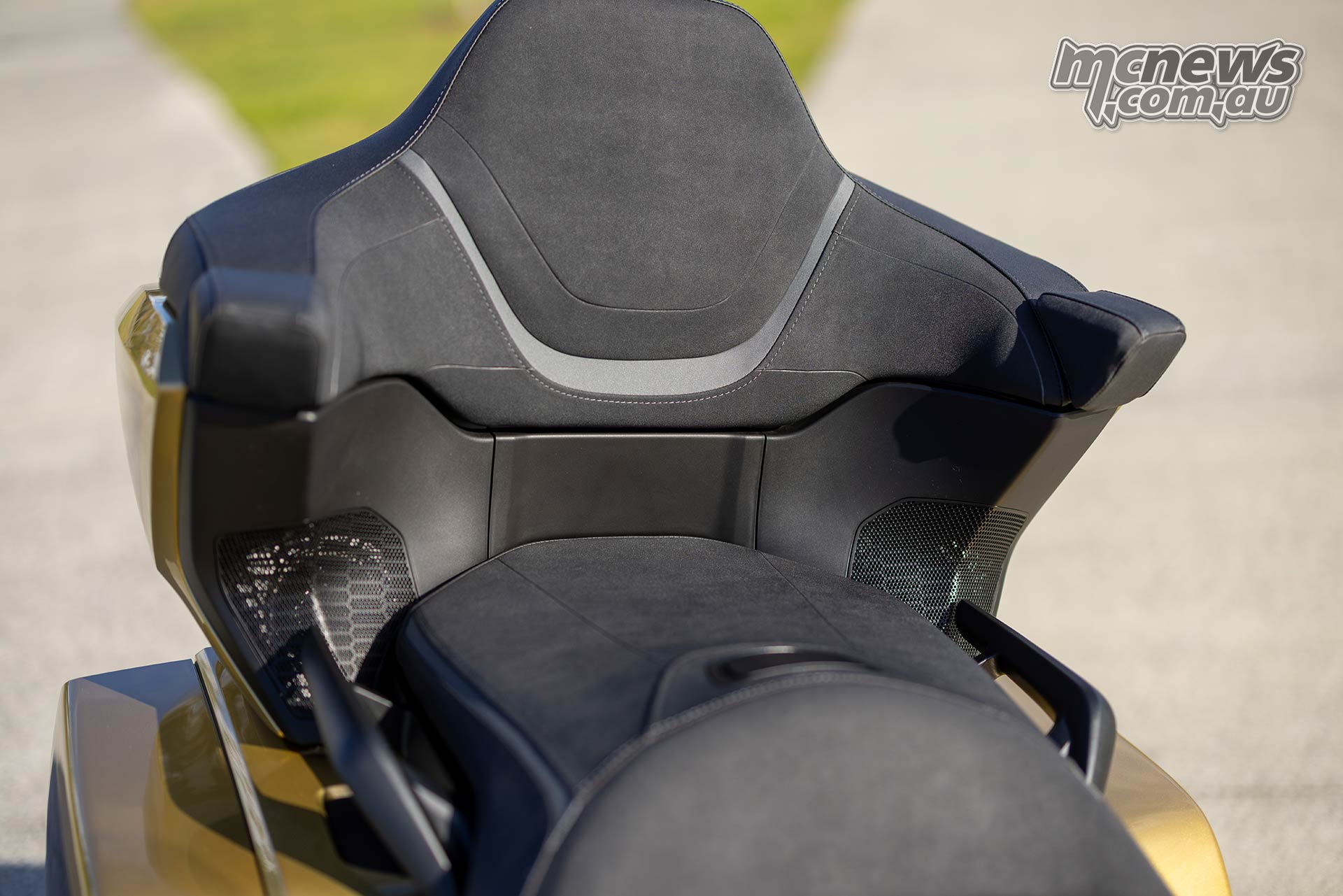 Passenger provisions don’t come much better than this…
The Gold Wing’s 1833 cc flat-six is a well-proven gem. The silky smooth flat-six is turning around 2000 rpm in seventh gear (yes, seven) at 100 km/h. I felt zero discernible vibrations at any speed emanating from anywhere on the bike. It really is turbine smooth and 100 per cent fit for purpose.
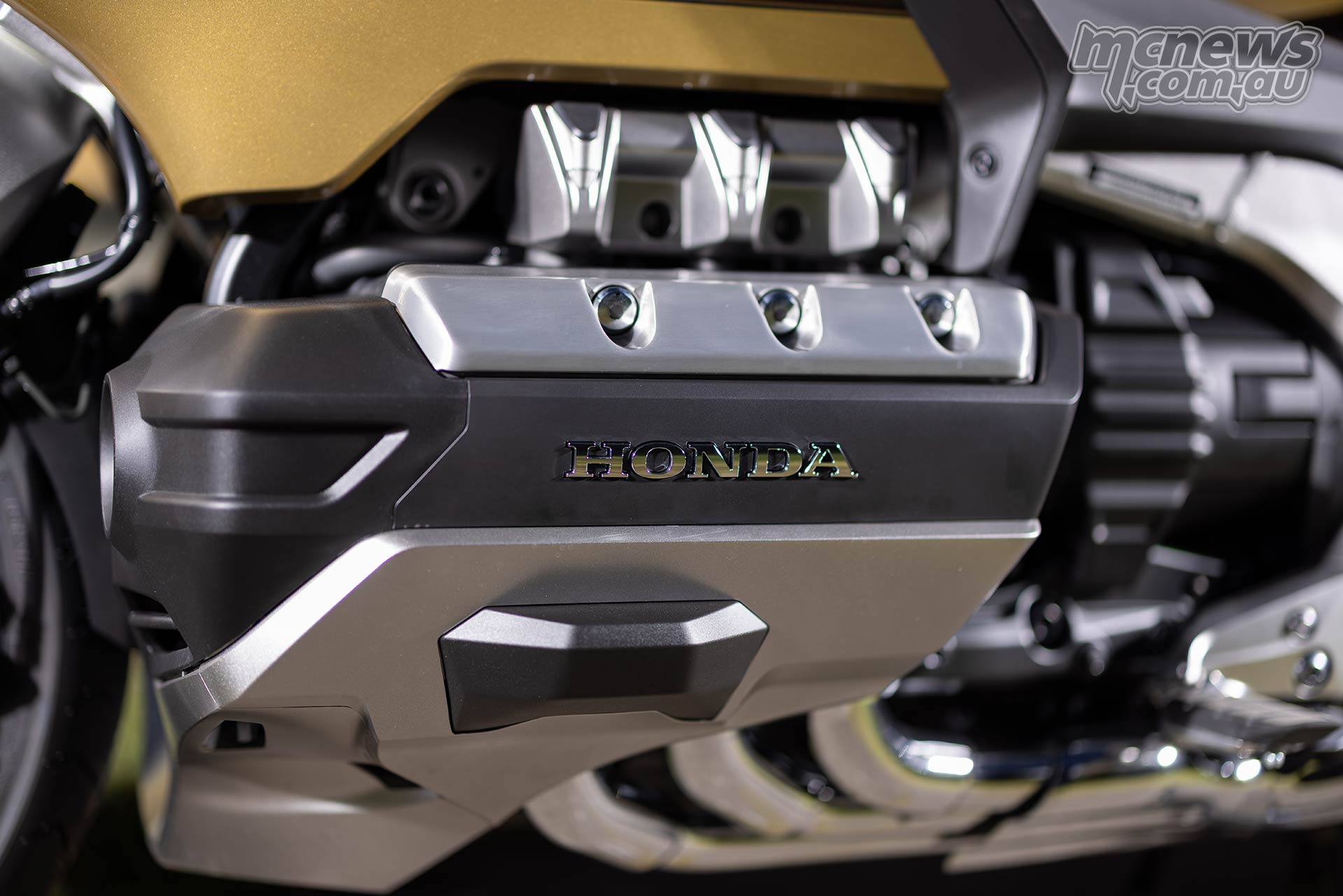 1833 cc liquid-cooled 4-stroke 24 valve SOHC flat-six
It sounds mint too. Somewhat reminiscent of the six-pack R/T Charger I once had. For our American readers, whom I just made squint, I refer to an Australian E49 Charger with a 4.3 litre six fed by triple dual-throat Webers, not your V8 six-packs.
A finger-follower rocker-arm system is used on the intake side and a roller rocker-arm system on the exhaust. There are four valves per cylinder, with the intakes measuring 27 mm and the exhausts 24 mm. The cylinders are square with both the bore and stroke measuring 73 mm. Fuel is delivered via a single 50 mm throttle body.
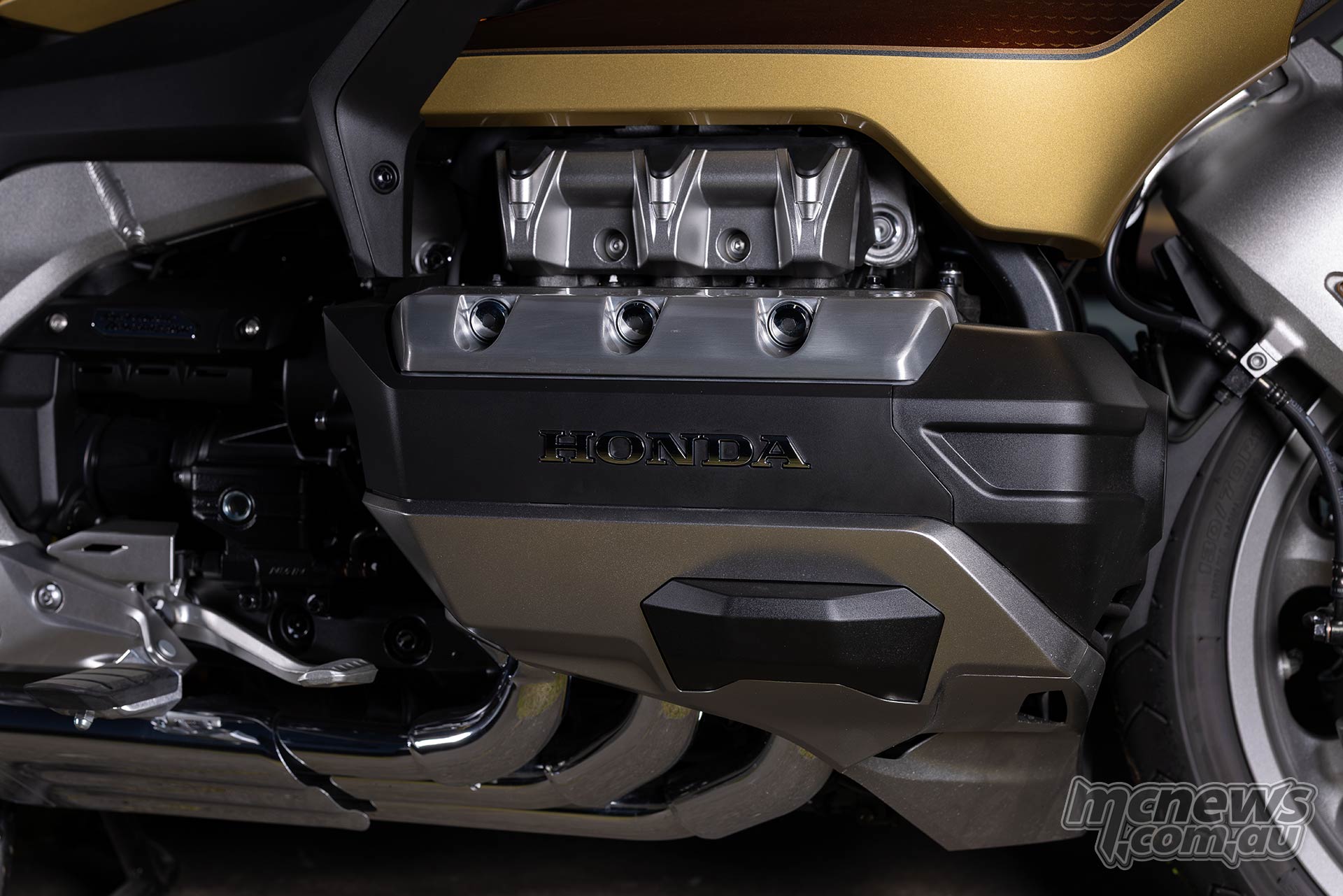 170 Nm at 4500 rpm and 125 horsepower at 5500 rpm
With its single overhead cam per bank so easily accessed, valve clearance checks should be a pretty simple affair. However, these are required every 24,000 kilometres, which seems a little excessive. The interval for standard services is every 12,000 kilometres.
Shaft drive means no belt or chain maintenance is required, and final drive oil changes only require around 150 ml of oil. The engine takes 5.6 litres of 10-30 oil. DCT aside, the drivetrain is all pretty simple and straightforward.
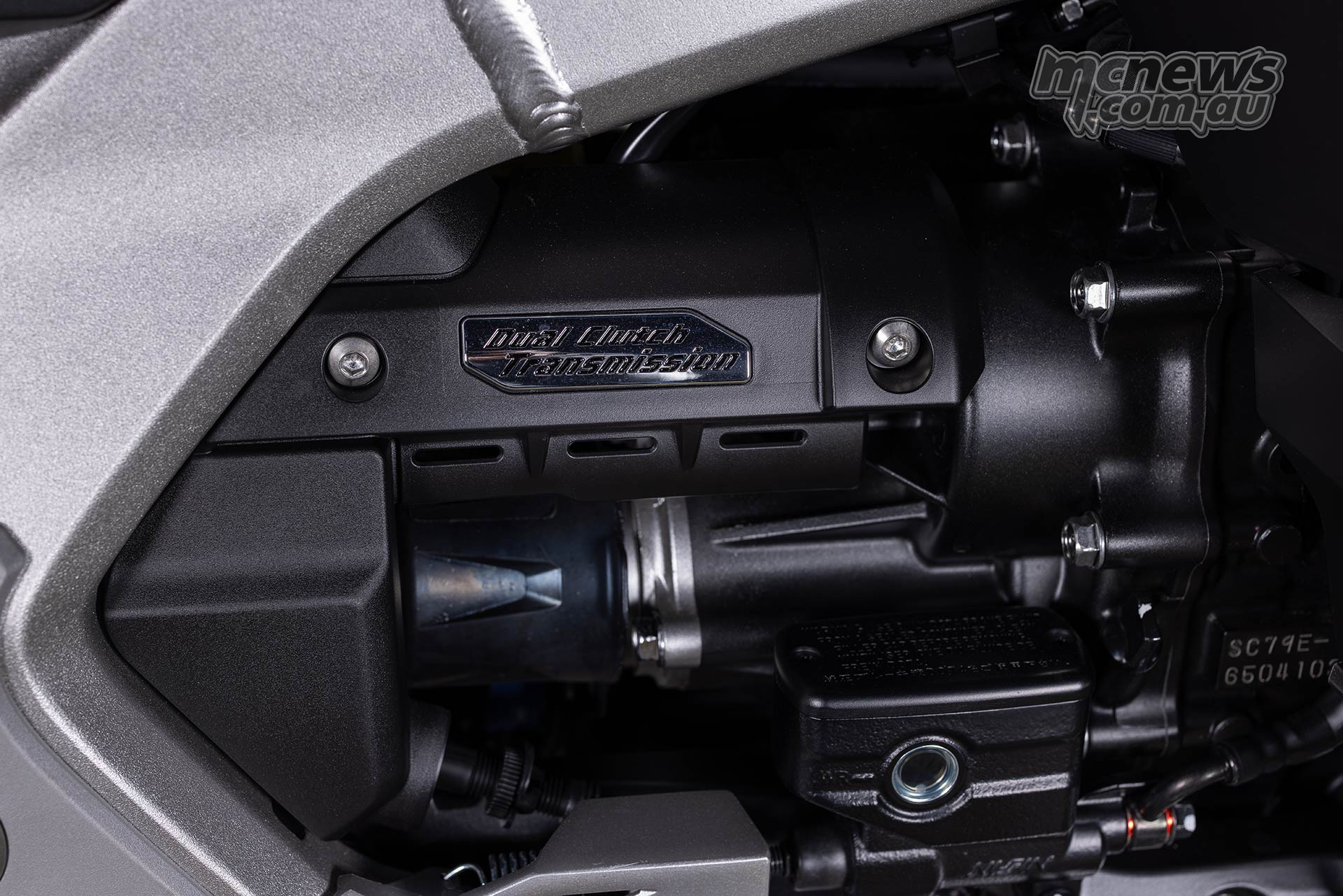 DCT has seven speeds and shuffles through them quite nicely indeed.
The Dual Clutch Transmission box works its way through its seven ratios quite beautifully. Every now and then, it might not be 100 per cent perfect, but it’s close enough to have me completely satisfied. The DCT box really is a match made in heaven for this bike and is 100 per cent my preferred cog-swapping option on the Wing. Only a few times, when in the fairly leisurely Tour mode, did I override the automatic functionality with a few quick down-changes via the paddles when a more aggressive mood took me.
 Easy to park, easy to pick up off the sidestand thanks to low seat height and c of g
Overall, I found Tour mode my preferred option as the Sport mode was just a bit too frenetic for my liking, with the throttle response overly sharp and gears being held too long. It has its place, but in reality, that is for about one per cent of your riding time. Economy and Rain modes are also available, but I didn’t bother with either. The engine positively rips around the tacho with urgency when you want to get up it.
The rear suspension damping characteristics also change to suit the riding mode selected. Only the rear suspension pre-load is electronically adjustable, and those changes can only be made when the bike is stationary.
The composure of the suspension is really quite impressive, and its resistance to g-outs on large bumps is quite remarkable considering it only has just over 100 mm of suspension travel at each end. Ground clearance is a pretty reasonable 130 mm.
 Ground clearance is actually pretty good and the Gold Wing is fun to hustle
I actually enjoy the challenge of punting a big bagger at a reasonable clip while not scraping a single thing. I only scraped once during my 2000 kilometres with the bike, and that was during the photo shoot. I was disappointed in myself.
The brakes work very well, but if you want to stop quickly, you are always aware that you have close to 400 kilograms of motorcycle to slow down. You can’t get around physics. Thus, you ride with that in mind. The front rotors are 320 mm and clamped by Nissin six-piston calipers. The rear is an equally massive 316 mm, complete with a three-piston caliper.
 320mm x 4.5mm dual hydraulic disc with six-piston calipers, floating rotors and sintered metal pads
Interestingly, the combined braking system changes the brake balance according to the riding mode selected. In reality, you are never going to want to be the last of the late brakers on a Gold Wing. Or any other massive touring motorcycle, for that matter. But yes, of course, sometimes you do…
In models without the airbag, there is a storage compartment in the tank along with a USB-C data and power port, but on airbag models, like the Tour Premium I rode, the USB-C port is in the top-case along with a nook to hold your phone securely.
 Apple CarPlay and Android Auto are now wireless
In a change for this 2025 model, Apple CarPlay is now also able to be used wirelessly. An additional USB charging port can be found in the left pannier. There is also a comprehensive rider-passenger intercom facility that can be configured via the instrumentation.
A Bluetooth headset is required to use Apple CarPlay or Android Auto functionality. This is not always convenient, as if the power runs out on your Bluetooth headset, then you lose your map functionality. It shouldn’t be this way.
I plugged in my iPhone Pro Max running the latest iOS 26 Developer Beta and had no problems getting my headset and phone all up and running in conjunction with CarPlay.
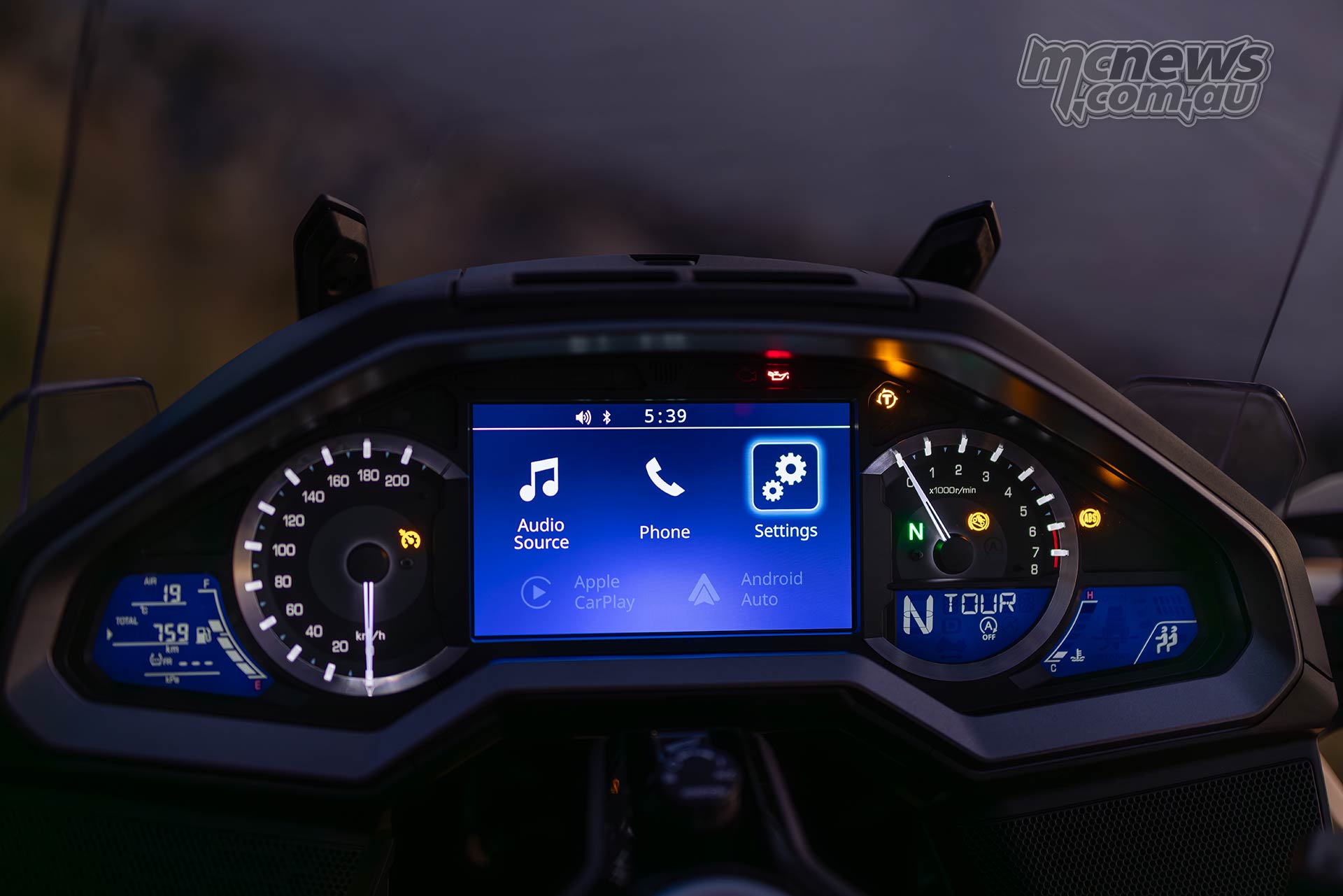 I still prefer analogue gauges for speed and revs on most bikes
When stopping for fuel or overnighters, it all connected itself up seamlessly again when I got back on the bike. I have found previous iterations of this system on both earlier Gold Wings and Africa Twins quite susceptible to annoying disconnects that require you to unplug the phone and plug it in again to re-establish CarPlay. That never happened once with this latest model. Winning.
While I can’t vouch for Android Auto, the functionality afforded by CarPlay was both comprehensive and straightforward. From both Apple and Google Maps, Podcasts, to the reading out of incoming text messages, it all worked well, as did dictating my text message replies while riding via the Shoei ComLink system integrated into my Shoei GT-Air 3 helmet. I even dictated some test notes via text messages to my partner that I could then refer to later after the ride. I must find a voice memo app that works with CarPlay, if you can point me in the right direction there please leave a note using the feedback functionality at the bottom of this page. Ta.
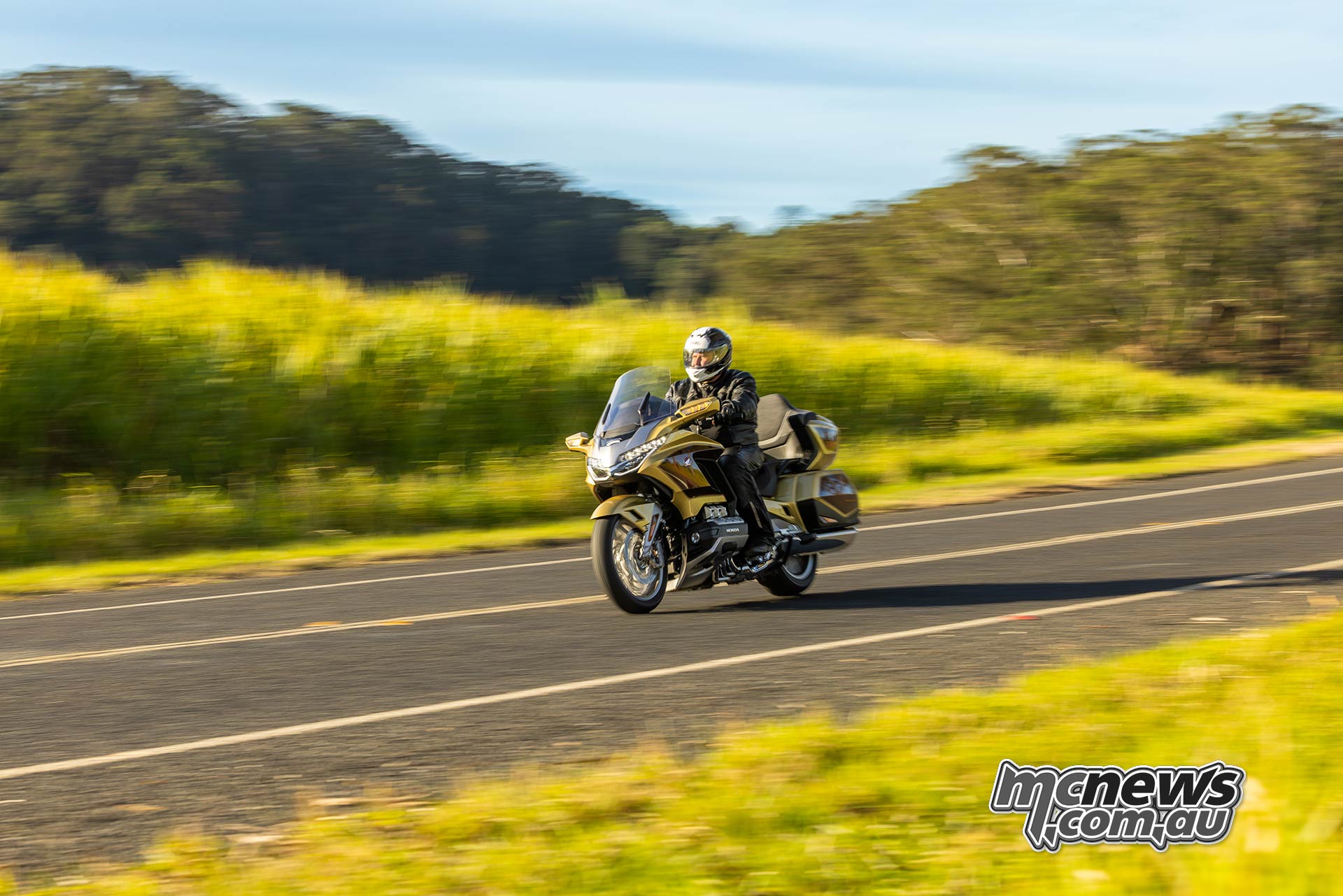 The latest Gold Wing Tour retails for around 50K
Using the synchronised contact list, I looked up my old Navy mate who now resides in Tanilba Bay and selected his address for Apple Maps to navigate my way to. The system then offered to send Paul updates with my ETA. All this was done while riding and without reading any manual beforehand. Yes, I am somewhat of a digital native, but I am also now on the wrong side of 50 and have little patience, so I really appreciate it when things just work.
For those who really prefer the more analogue approach, Honda still offers a big set of buttons on the centre console to drive most functionality. There is even AM and FM radio reception piped to the improved for 2025 speaker system.
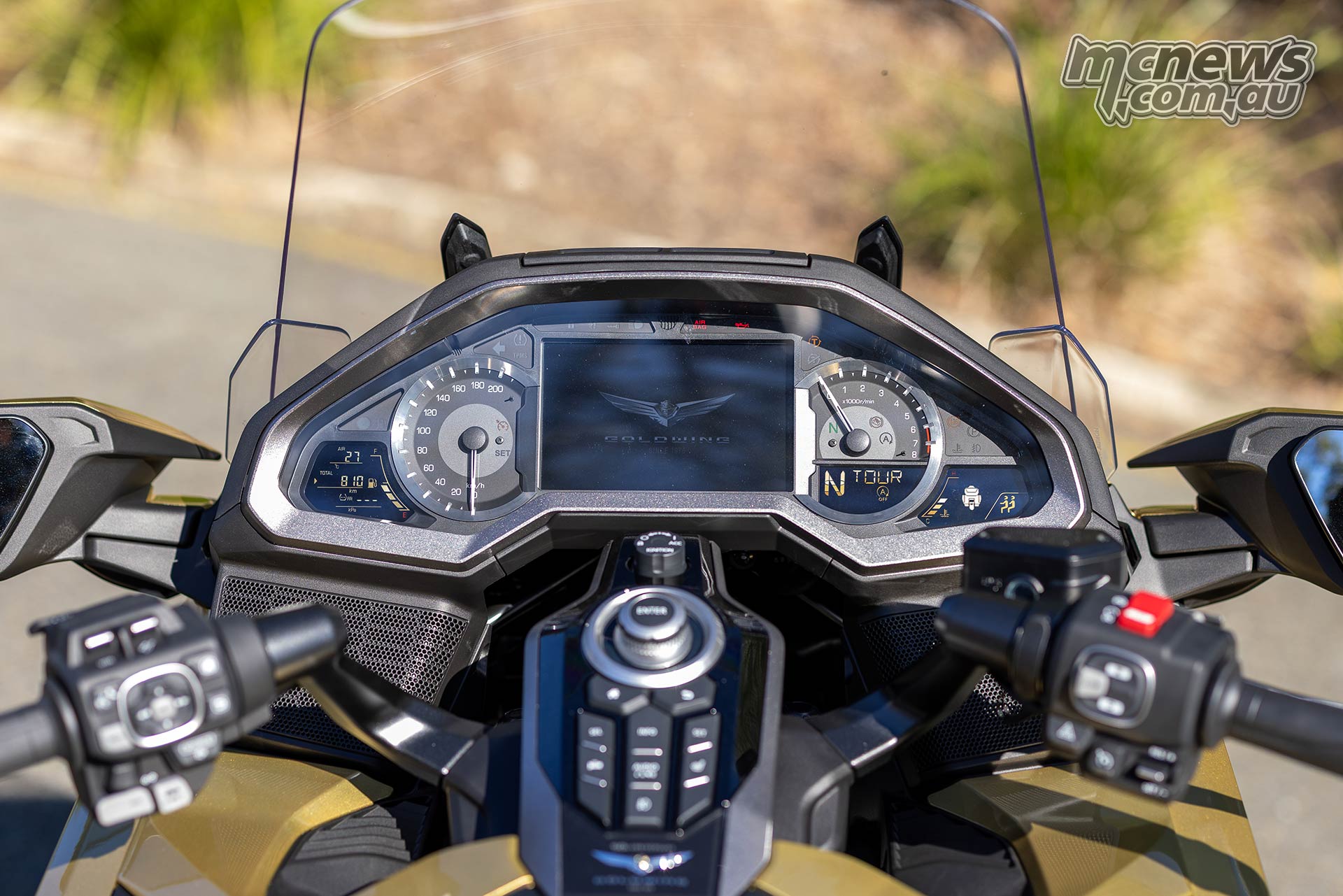 Butttons, and more buttons…
My brain is often way too busy multitasking all manner of things to be empty enough to enjoy music, but a few big days astride the Wing rekindled my love for music in a way I haven’t felt since I was a kid. The personalised music station served up by Apple Music’s algorithms did its best work while I was on the Gold Wing. I’m sure more than a few drivers thought I was either tripping or going into some kind of fit, but honestly, I couldn’t have cared less. It was as if Siri was also enjoying the ride, as once off the bike, she has not been quite as satisfying.
The large windscreen can be adjusted on the fly via the left switch-block. I rarely had it in the fully up position and generally favoured it around halfway. With me being a fairly average 178 cm, that should mean those at either end of the altitude spectrum will find a position amenable to them. When having a crack on a twisty road, I set it to its lowest position for the best vision of the road surface immediately in front of the bike. No frontal, side, or reverse buffeting afflicted my Shoei GT-Air 3 helmet in any of the screen positions.
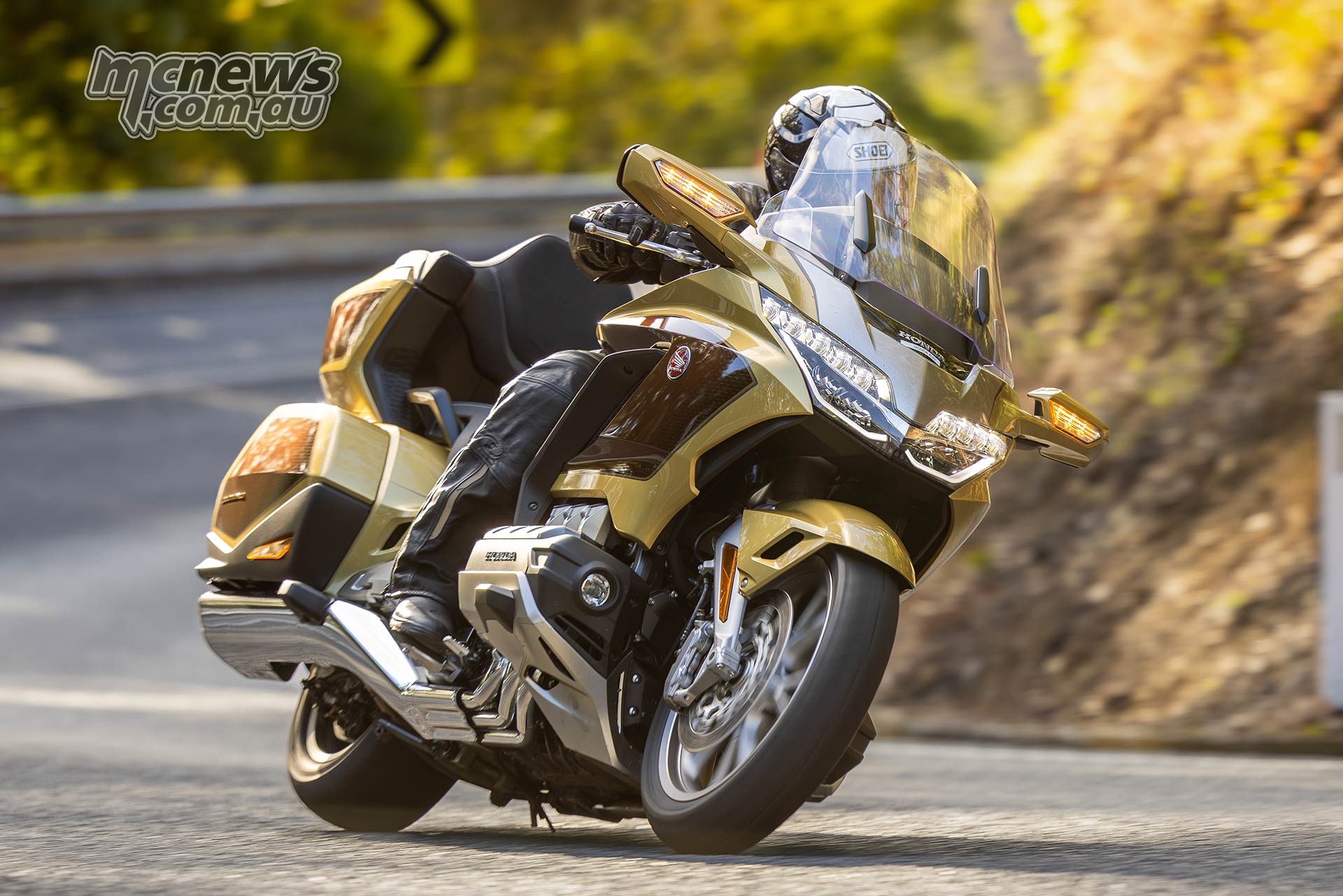 2025 Honda Goldwing Review
The screen retracts to its lowest setting when the ignition switches off. It then rises to the last position it was set to at the end of the previous ride once you get up and moving. To keep the windscreen raised for cleaning, press and hold the windscreen up button while turning off the ignition. They think of everything…
There is also a ventilation slot in the front fairing that can be opened to allow more airflow to the rider when the screen is up. I never used it, but I could imagine some summer scenarios where this might prove handy.
 The handsome lights are good, but you can never have enough illumination when on wildlife watch
Fog lights reside in housings situated low down on the bike just ahead of each cylinder bank. These are a valuable addition to the very handsome standard headlights, but for us who live in the Aussie bush, stronger lights would be appreciated.
 Fog lights are helpful, but could be stronger for outback work
The heated grips have five levels, as do the heated rider and passenger seats. They both work very well, and the passenger can control their own bun toaster via an easily reached thumbwheel situated on the top of the left pannier. On cold mornings, while the bike was warming up, I activated the heated grips and seat while loading my luggage and suiting up.
As I rolled out of a Yass motel on one very cold morning, the Gold Wing alerted me to low pressure in the front 130/70-18 Bridgestone Exedra. I was not alarmed as this is not my first rodeo. Once the tyre got a bit of heat in it a few kilometres down the highway the pressure warning went away and all was right in the world.
I place great value on a reliable tyre pressure monitoring system and, if given the choice, would take TPMS over traction control, and even over ABS, but of course the Wing has both.
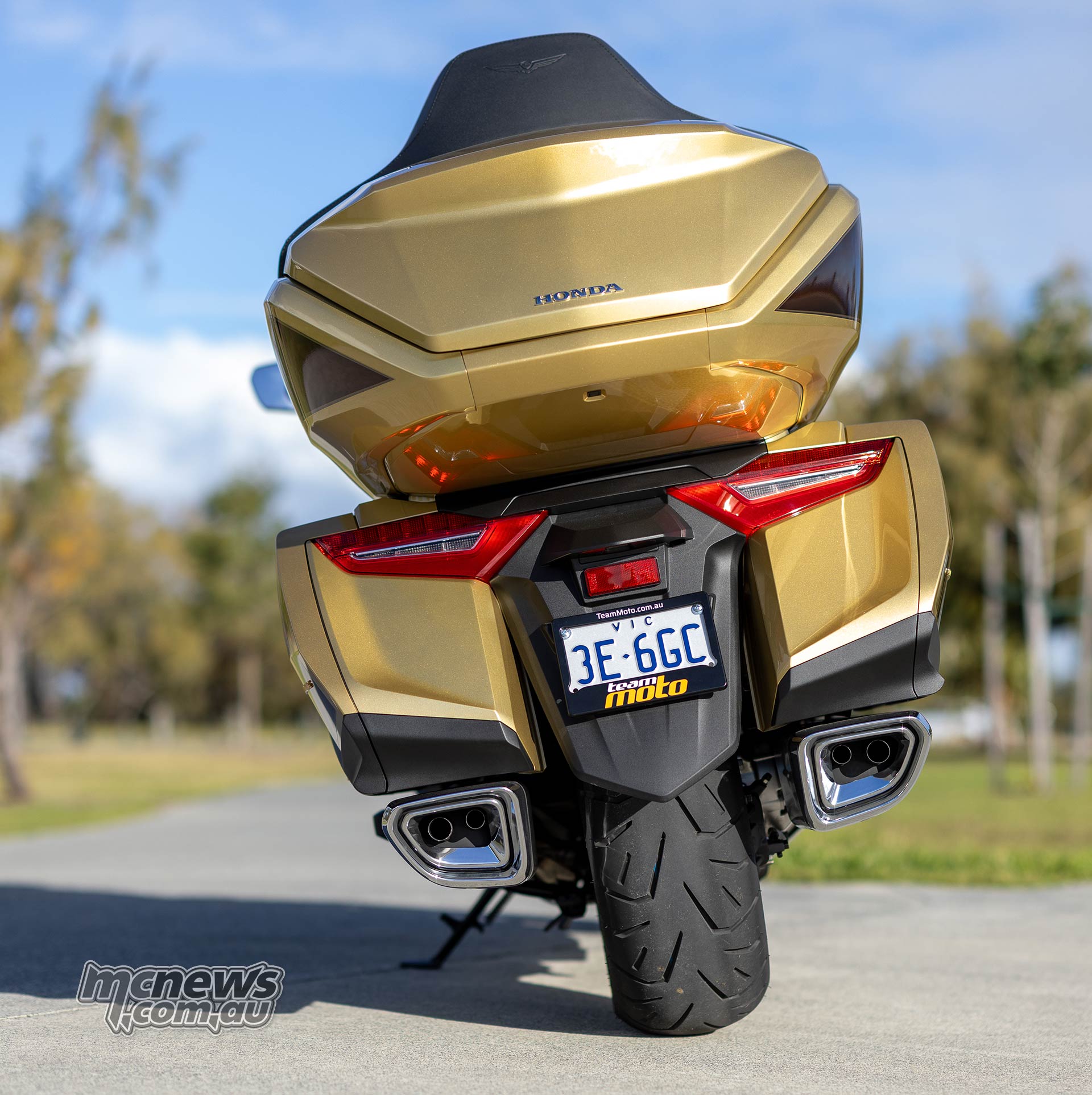 200/55R16 rear hoop and 130/70R18 front
If you want to light up the 200/55-16 rear or go natural terrain motocrossing, the traction control system is also switchable. No stoppies though as the ABS can’t be turned off. As I was on a DCT model, no wheelies were attempted, but I might have been there before on a non-DCT model. That said, I would 100 per cent every time take the DCT variant over the conventional gearbox. Which is a good job, as you can no longer buy a Gold Wing in Australia with a conventional manual box.
Highway cruising will return a touring range of just over 350 kilometres from the 21-litre fuel tank. Surely on a bike this big, they could have squeezed more fuel in there somewhere?
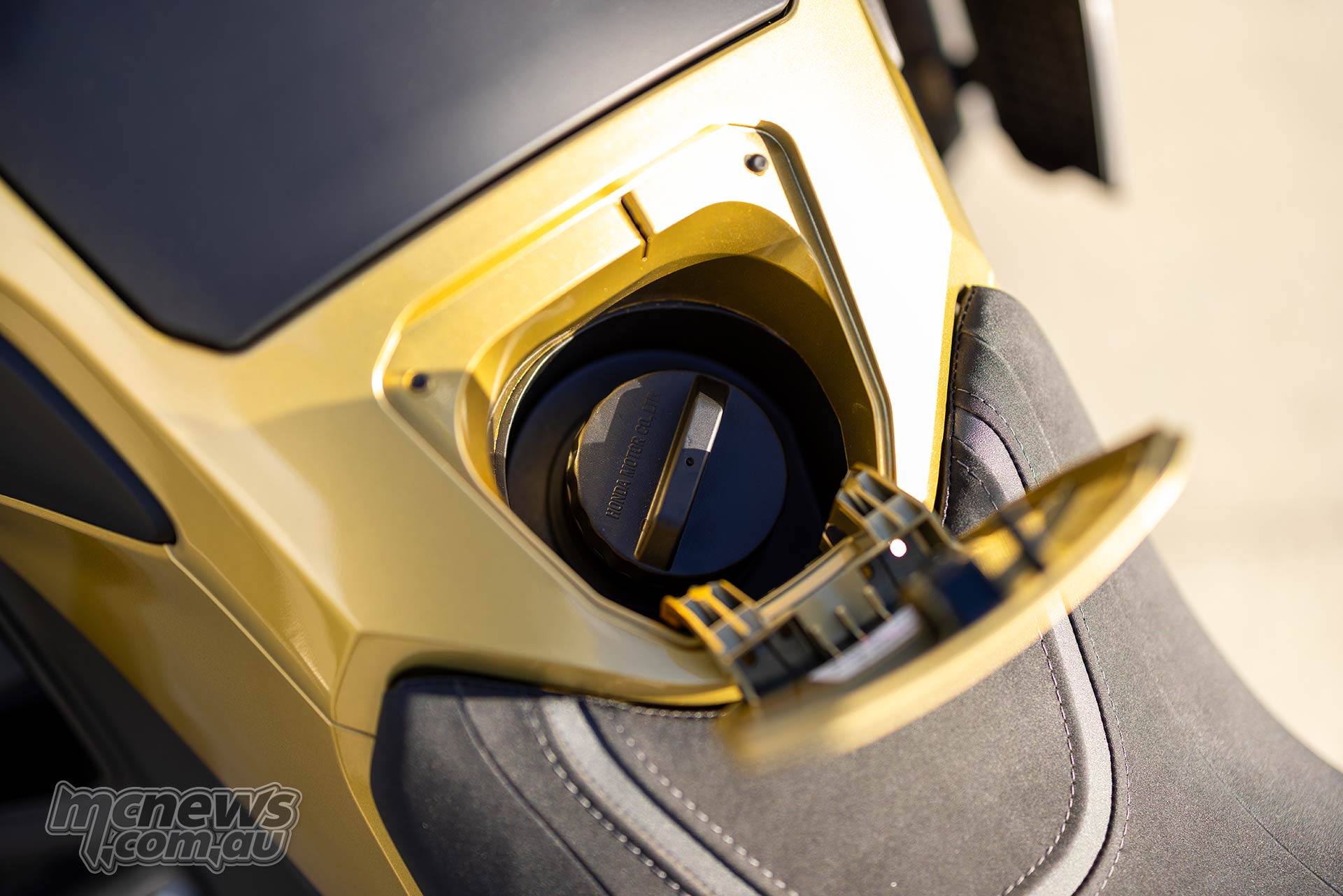 Fuel cap is opened via a lever in the right side pocket of the fairing.
The fuel cap is hidden behind a flap below the airbag stowage that is opened by pressing a lever hidden inside a sizeable storage pocket in the right fairing. My mind went straight to the what-ifs, like what would happen if you rolled into Kununurra and the bulldust had rendered the lever inoperable. Thankfully, there is a workaround should such misfortune befall you.
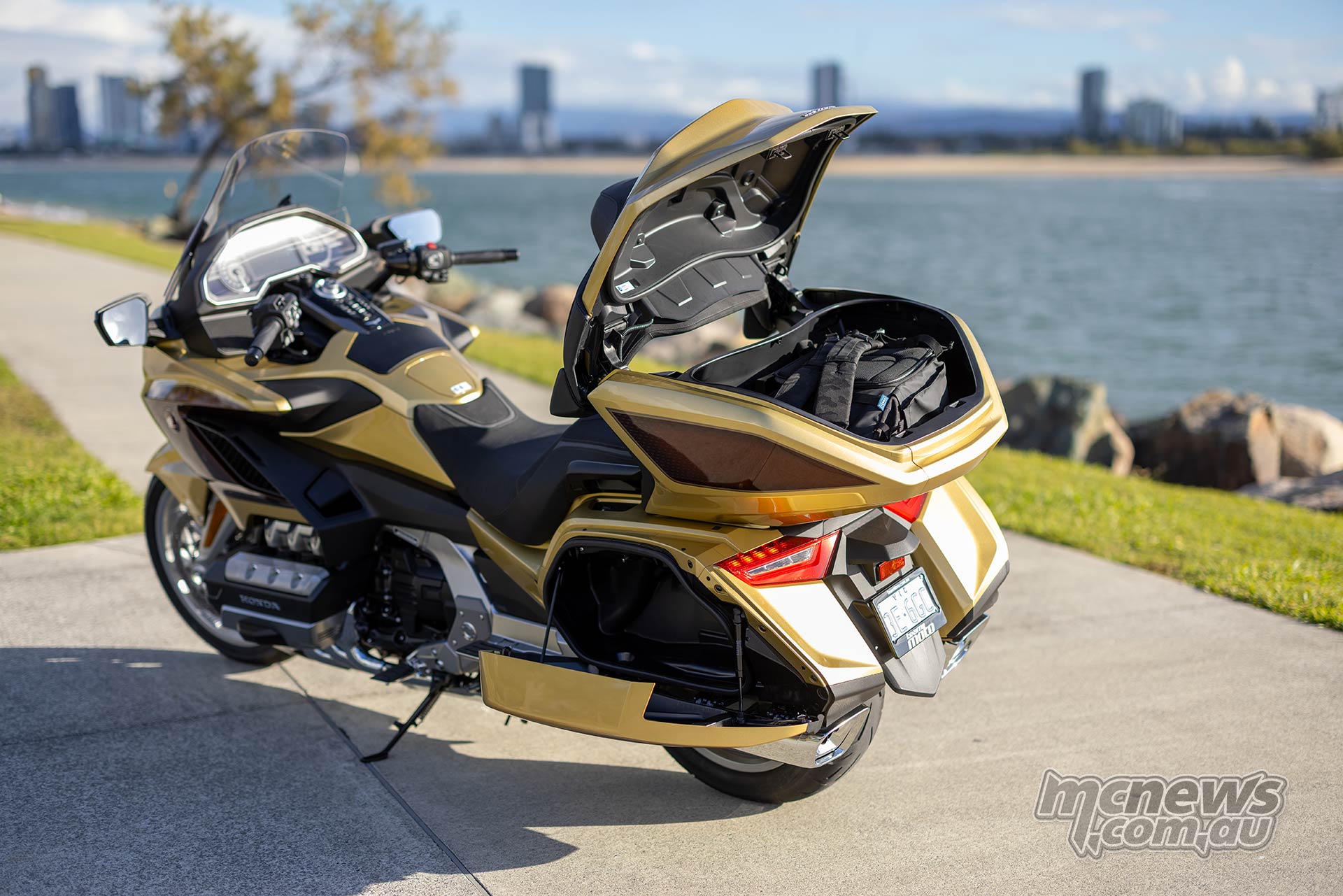 There is over 120 litres of storage as standard
The 61-litre top-box can swallow two helmets, but my Shoei would not fit in either of the 30-litre side panniers due to the somewhat strange internal shape. Honda does provide a helmet hook so you can attach your helmet to the bike when parked up if your top-box is full.
 2025 Honda Goldwing Review
Both the panniers and top-box open at the touch of a button and feature central locking. Should these mechanisms fail, there is also a manual workaround you can Google up via the user manual, but some tools are required.
 It draws a crowd…
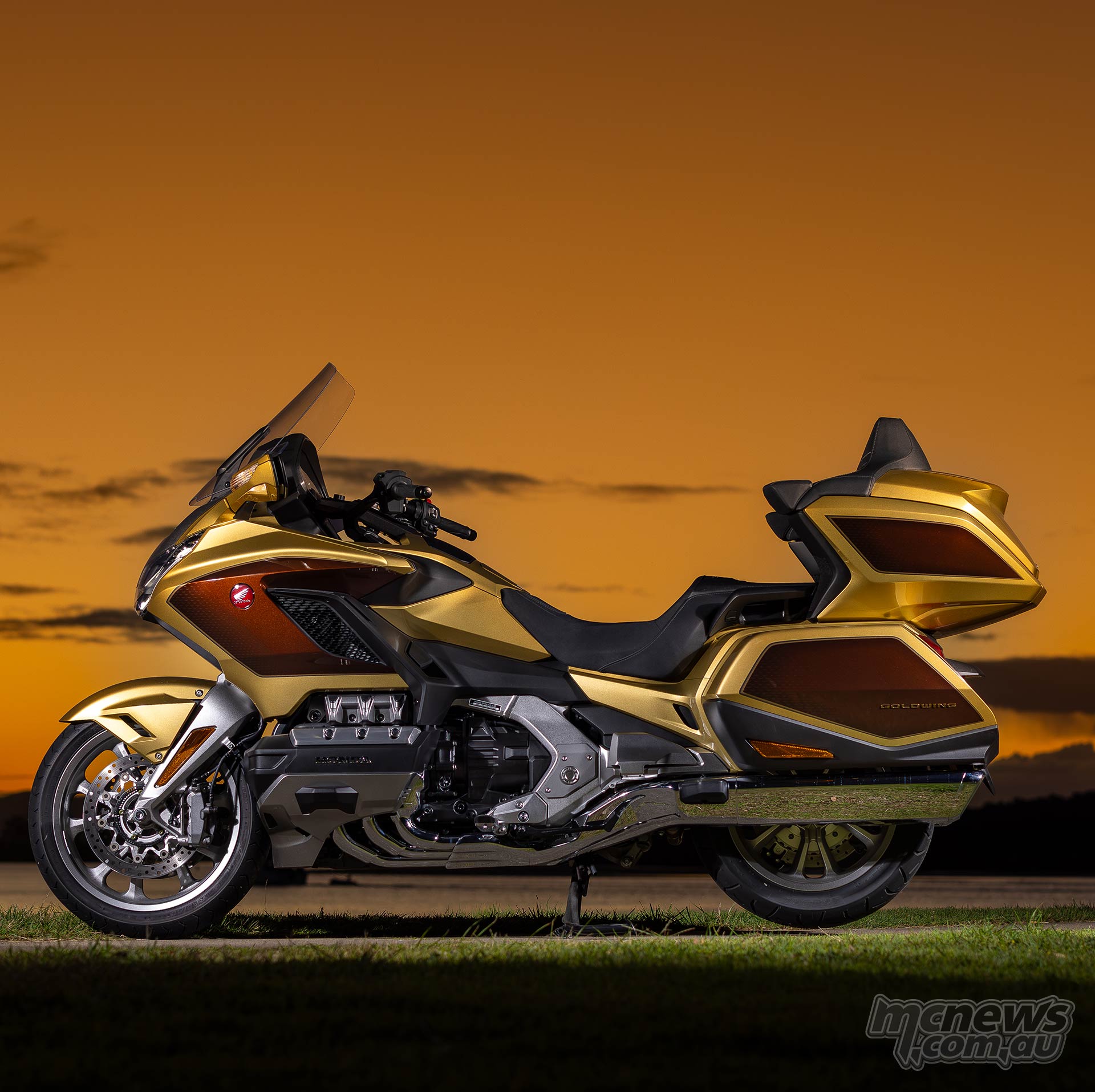
The Wing draws a crowd. Early in the trip, a bunch of blokes outside the Mooball pub wandered over to give it the once-over. While filling up in Yass, a bloke in high-vis fuelled up next to me, took one look, and called it “beautiful.” In this anniversary two-tone paint scheme, she’s definitely a looker with serious presence. As good as iKap’s photos are, you have to see it up close and personal with your own mark one eyeball to really appreciate it.
 2025 Honda Goldwing Review
Without a doubt, this latest Gold Wing is on my dream garage shortlist as one of the true heavy-hitters I’d love to have in my permanent armoury.
Wonder if I could claim the 50K asking price under some sort of mental health rebate… I’d best not go down the NDIS rorting rabbit hole.
Nothing is as comfortable and smooth for big days in the saddle as a Gold Wing, and a couple of thousand kays across a couple of days has taught me one thing: you can’t have a bad day when the sun’s out and you’re on a Gold Wing. It’s definitely more than a bit special in many ways. I already miss it dearly. Siri doesn’t seem to have gotten over it either…
 Please don’t go…
2025 Honda Gold Wing Specifications
| Specifications | |
| Engine Type | Liquid-cooled 4-stroke 24 valve SOHC flat-6 |
| Engine Displacement | 1,833 cc |
| Bore x Stroke (mm) | 73 mm x 73 mm |
| Compression Ratio | 10.5:1 |
| Max. Power Output | 125 hp (93 kW) at 5,500 rpm |
| Max. Torque | 170 Nm at 4,500 rpm |
| Oil Capacity | 5.6 L |
| Starter | Integrated Starter Generator system |
| Carburation | PGM-FI electronic fuel injection |
| Fuel Tank Capacity | 21 L |
| CO2 Emissions WMTC | 124 g/km |
| Fuel Consumption | 5.4 L |
| Battery Capacity | 12V 21.Ah (20HR) |
| Clutch Type | 2x Wet Multiplate Clutch |
| Transmission Type | 7-speed Dual Clutch Transmission with forward and reverse assist |
| Final Drive | Enclosed shaft |
| Frame Type | Aluminium die-cast, twin tube |
| Dimensions (L´W´H) | 2,475 mm x 905 mm x 1,340 mm |
| Wheelbase | 1,695 mm |
| Caster Angle | 30.5° |
| Trail | 109 mm |
| Seat Height | 745 mm |
| Ground Clearance | 130 mm |
| Kerb Weight | 373 kg |
| Turning radius | 3.4 m |
| Suspension Front | Double Wishbone |
| Suspension Rear | Pro Link |
| Wheels Front | 18M/C x MT3.50 |
| Wheels Rear | 16M/C x MT6.00 |
| Tyres Front | 130/70R18 M/C 63H |
| Tyres Rear | 200/55R16 M/C 77H |
| ABS Type | Electronically-controlled combined ABS system |
| Brakes Front | 320mm x 4.5mm dual hydraulic disc with 6-piston calliper, floating rotors and sintered metal pads |
| Brakes Rear | 316mm x 11mm ventilated disc with 3-piston calliper and sintered metal pads |
| Instruments | 7-inch TFT display |
| Headlight | LED |
| Taillight | LED |
| Connectivity | Bluetooth Audio and Apple CarPlay / Android Auto Wireless |
| USB | Yes |
| 12V Socket | Optional |
| Auto Winker Cancel | Yes |
| Security System | HISS |
| Cruise Control | Yes |
| Riding mode | Tour, Sport, Econ and Rain |
| HSTC | Yes |
| Additional Features | Electronically-adjustable screen, Idling Stop, Smart Key, Tyre Pressure Control, heated grips, Hill Start Assist |
| Available | Now |
2025 Honda Goldwing Images

2025-Honda-Gold-Wing-Review-iKap-89

2025-Honda-Gold-Wing-Review-iKap-1-Square

2025-Honda-Gold-Wing-Review-TH-8

2025-Honda-Gold-Wing-Review-iKap-99

2025-Honda-Gold-Wing-Review-TH-4

2025-Honda-Gold-Wing-Review-TH-13

2025-Honda-Gold-Wing-Review-iKap-98

2025-Honda-Gold-Wing-Review-TH-12

2025-Honda-Gold-Wing-Review-iKap-97

2025-Honda-Gold-Wing-Review-TH-11

2025-Honda-Gold-Wing-Review-iKap-92

2025-Honda-Gold-Wing-Review-TH-10

2025-Honda-Gold-Wing-Review-iKap-96

2025-Honda-Gold-Wing-Review-TH-9

2025-Honda-Gold-Wing-Review-iKap-90

2025-Honda-Gold-Wing-Review-TH-7

2025-Honda-Gold-Wing-Review-iKap-93

2025-Honda-Gold-Wing-Review-TH-6

2025-Honda-Gold-Wing-Review-iKap-91

2025-Honda-Gold-Wing-Review-TH-5

2025-Honda-Gold-Wing-Review-iKap-88

2025-Honda-Gold-Wing-Review-TH-3

2025-Honda-Gold-Wing-Review-iKap-87

2025-Honda-Gold-Wing-Review-TH-2

2025-Honda-Gold-Wing-Review-iKap-86

2025-Honda-Gold-Wing-Review-TH-1

2025-Honda-Gold-Wing-Review-iKap-95

2025-Honda-Gold-Wing-Review-iKap-85

2025-Honda-Gold-Wing-Review-iKap-83

2025-Honda-Gold-Wing-Review-iKap-82

2025-Honda-Gold-Wing-Review-iKap-81

2025-Honda-Gold-Wing-Review-iKap-80

2025-Honda-Gold-Wing-Review-iKap-79

2025-Honda-Gold-Wing-Review-iKap-78

2025-Honda-Gold-Wing-Review-iKap-77

2025-Honda-Gold-Wing-Review-iKap-76

2025-Honda-Gold-Wing-Review-iKap-75

2025-Honda-Gold-Wing-Review-iKap-74

2025-Honda-Gold-Wing-Review-iKap-73

2025-Honda-Gold-Wing-Review-iKap-72

2025-Honda-Gold-Wing-Review-iKap-71

2025-Honda-Gold-Wing-Review-iKap-70

2025-Honda-Gold-Wing-Review-iKap-69

2025-Honda-Gold-Wing-Review-iKap-68

2025-Honda-Gold-Wing-Review-iKap-67

2025-Honda-Gold-Wing-Review-iKap-66

2025-Honda-Gold-Wing-Review-iKap-65

2025-Honda-Gold-Wing-Review-iKap-64

2025-Honda-Gold-Wing-Review-iKap-63

2025-Honda-Gold-Wing-Review-iKap-62

2025-Honda-Gold-Wing-Review-iKap-61

2025-Honda-Gold-Wing-Review-iKap-60

2025-Honda-Gold-Wing-Review-iKap-59

2025-Honda-Gold-Wing-Review-iKap-58

2025-Honda-Gold-Wing-Review-iKap-57

2025-Honda-Gold-Wing-Review-iKap-56

2025-Honda-Gold-Wing-Review-iKap-55

2025-Honda-Gold-Wing-Review-iKap-54

2025-Honda-Gold-Wing-Review-iKap-53

2025-Honda-Gold-Wing-Review-iKap-52

2025-Honda-Gold-Wing-Review-iKap-51-Square

2025-Honda-Gold-Wing-Review-iKap-50

2025-Honda-Gold-Wing-Review-iKap-49

2025-Honda-Gold-Wing-Review-iKap-48

2025-Honda-Gold-Wing-Review-iKap-47-Wide

2025-Honda-Gold-Wing-Review-iKap-47-Square

2025-Honda-Gold-Wing-Review-iKap-46-Wide

2025-Honda-Gold-Wing-Review-iKap-46-Square

2025-Honda-Gold-Wing-Review-iKap-45-Square

2025-Honda-Gold-Wing-Review-iKap-44

2025-Honda-Gold-Wing-Review-iKap-43

2025-Honda-Gold-Wing-Review-iKap-42

2025-Honda-Gold-Wing-Review-iKap-41

2025-Honda-Gold-Wing-Review-iKap-40

2025-Honda-Gold-Wing-Review-iKap-39

2025-Honda-Gold-Wing-Review-iKap-38

2025-Honda-Gold-Wing-Review-iKap-38-Square

2025-Honda-Gold-Wing-Review-iKap-37

2025-Honda-Gold-Wing-Review-iKap-36-Wide

2025-Honda-Gold-Wing-Review-iKap-36-Square

2025-Honda-Gold-Wing-Review-iKap-35-Square

2025-Honda-Gold-Wing-Review-iKap-34

2025-Honda-Gold-Wing-Review-iKap-33

2025-Honda-Gold-Wing-Review-iKap-32

2025-Honda-Gold-Wing-Review-iKap-31

2025-Honda-Gold-Wing-Review-iKap-30

2025-Honda-Gold-Wing-Review-iKap-29

2025-Honda-Gold-Wing-Review-iKap-28

2025-Honda-Gold-Wing-Review-iKap-27-Square

2025-Honda-Gold-Wing-Review-iKap-26

2025-Honda-Gold-Wing-Review-iKap-25-Square

2025-Honda-Gold-Wing-Review-iKap-24

2025-Honda-Gold-Wing-Review-iKap-23

2025-Honda-Gold-Wing-Review-iKap-22

2025-Honda-Gold-Wing-Review-iKap-21-Square

2025-Honda-Gold-Wing-Review-iKap-20

2025-Honda-Gold-Wing-Review-iKap-19

2025-Honda-Gold-Wing-Review-iKap-18-Square

2025-Honda-Gold-Wing-Review-iKap-17

2025-Honda-Gold-Wing-Review-iKap-16

2025-Honda-Gold-Wing-Review-iKap-15

2025-Honda-Gold-Wing-Review-iKap-14

2025-Honda-Gold-Wing-Review-iKap-13

2025-Honda-Gold-Wing-Review-iKap-12

2025-Honda-Gold-Wing-Review-iKap-11

2025-Honda-Gold-Wing-Review-iKap-10-Wide

2025-Honda-Gold-Wing-Review-iKap-10-Square

2025-Honda-Gold-Wing-Review-iKap-9

2025-Honda-Gold-Wing-Review-iKap-8

2025-Honda-Gold-Wing-Review-iKap-7

2025-Honda-Gold-Wing-Review-iKap-6

2025-Honda-Gold-Wing-Review-iKap-5

2025-Honda-Gold-Wing-Review-iKap-4

2025-Honda-Gold-Wing-Review-iKap-3

2025-Honda-Gold-Wing-Review-iKap-2

2025-Honda-Gold-Wing-Review-iKap-2-Square

2025-Honda-Gold-Wing-Review-iKap-1-Wide



 English (US) ·