
.png) 7 months ago
77
7 months ago
77
ARTICLE AD BOX
Moto Guzzi V7 Sport Review
The Moto Guzzi V7 Sport is the sort of motorcycle you glance back at every time you park it in your garage at night, not because it is dripping with horsepower or laden with cutting-edge tech, but because it has a charisma that so many modern motorcycles lack.
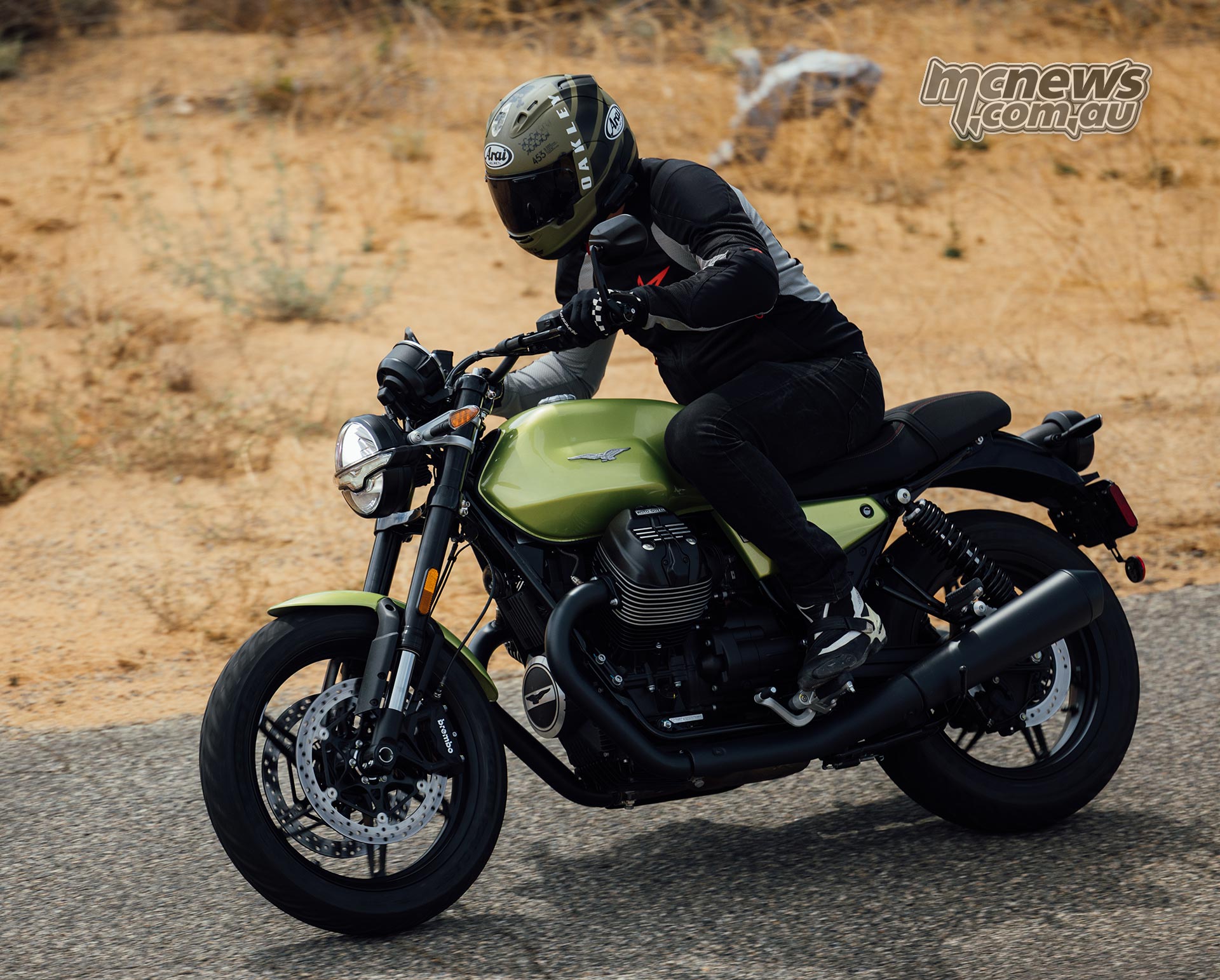 Moto Guzzi V7 Sport in Verde Legnano green
In a modern landscape dominated by middleweights that are becoming increasingly difficult to distinguish, the V7 Sport is like a breath of fresh Italian air. It’s distinctive, soulful, and unapologetically stylish.
The V7 is a motorcycle with heritage in its blood. Moto Guzzi has been building transversely mounted V-twins in its achingly beautiful Mandello del Lario setting for over a century. This model has now been running uninterrupted for 57 years.
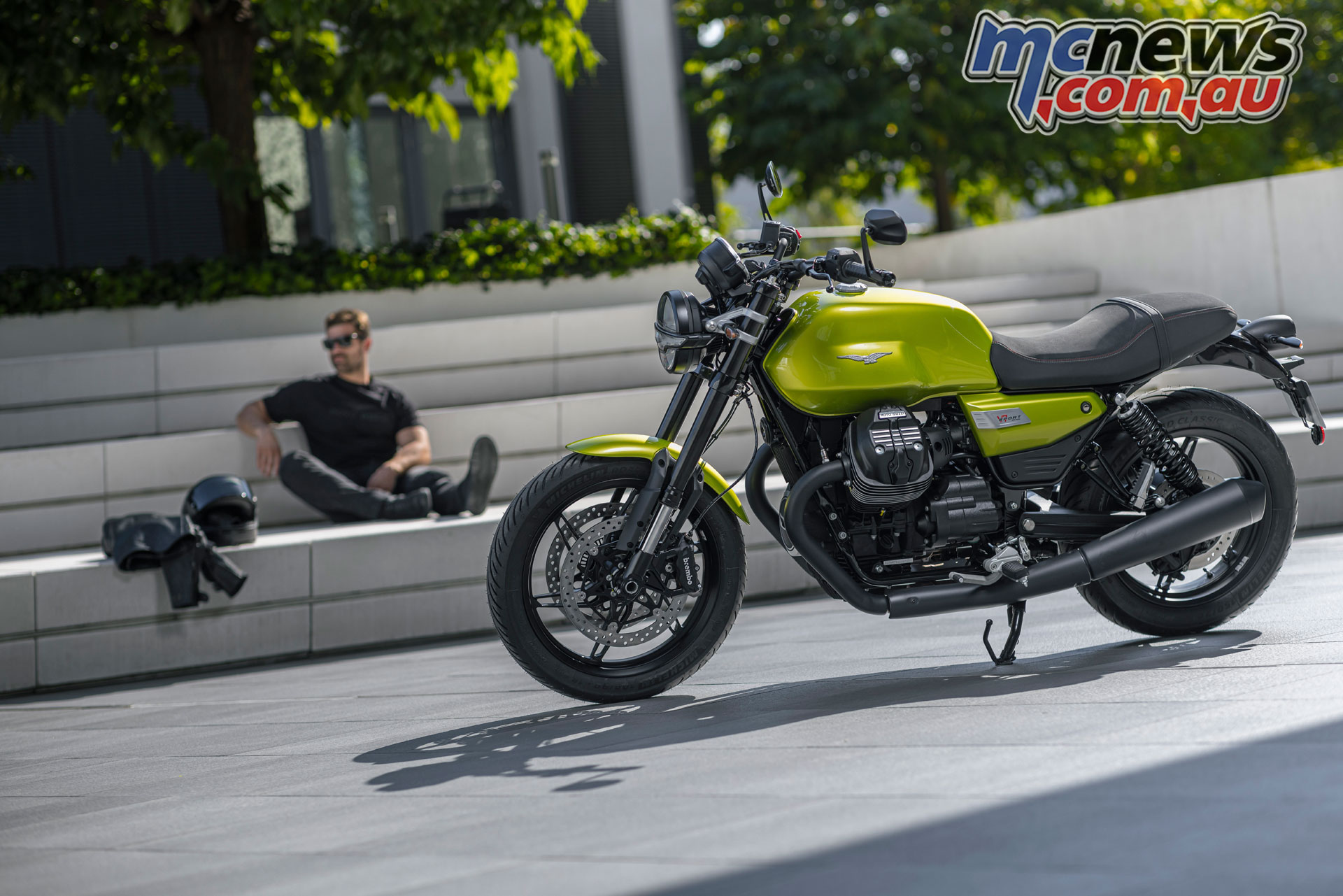 The Moto Guzzi V7 Sport cuts a handsome figure from any angle
It’s hard to characterise a V7, and I think that’s how Moto Guzzi likes it. It’s a trifle small with a seat height of 780 mm. The seat is narrow but well-padded, the cockpit compact, while the handlebar position nudges you forward into a stance that hints at some sporting pretensions.
There’s a sense of proportion here that makes the V7 Sport approachable to riders of many sizes. However, taller riders will doubtless find themselves wishing for a little more room to stretch out, as the bend in the knee for me with an 815 mm inseam was bearable for no more than 45 minutes at a time.
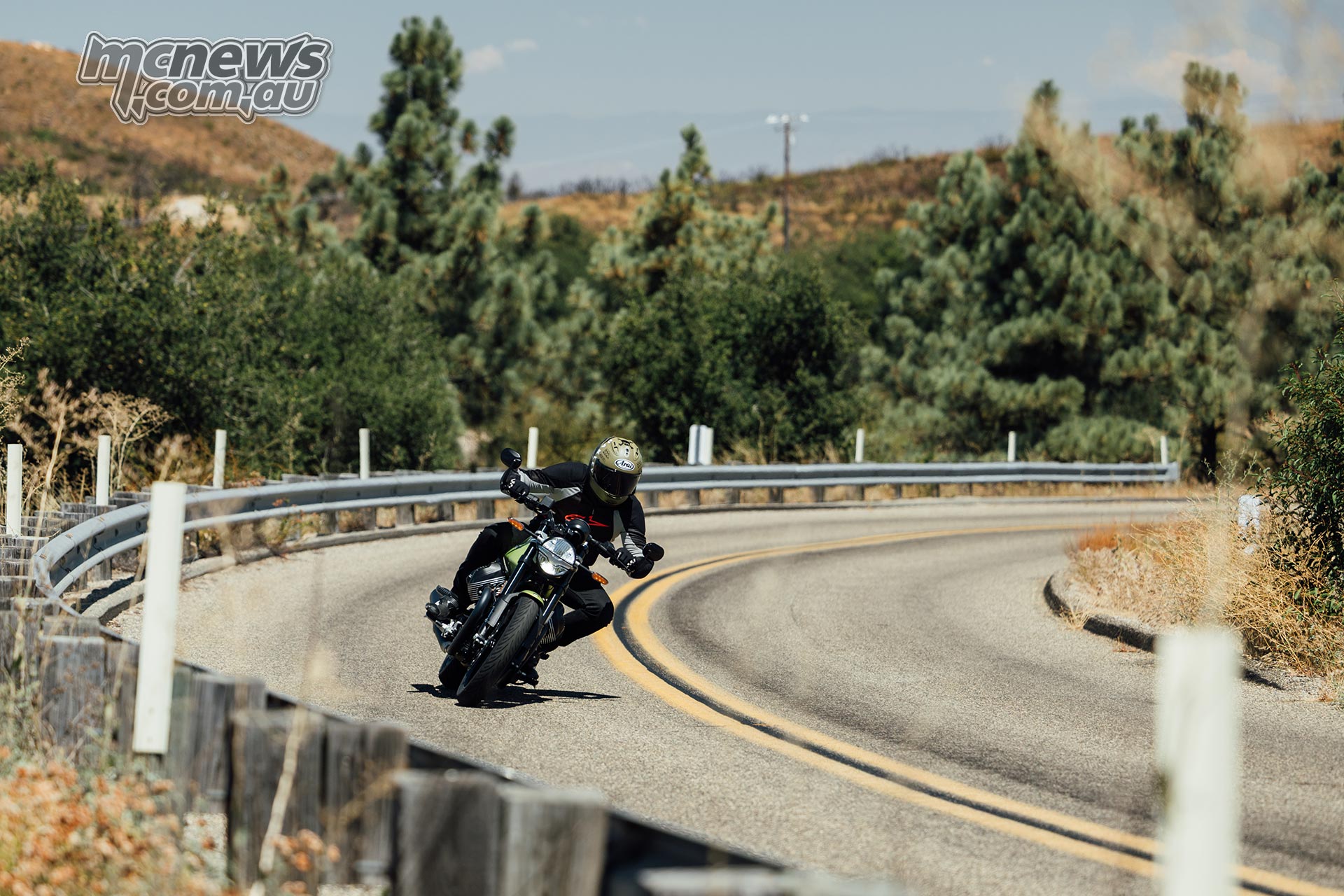 The V7 Sport is also a particularly approachable machine, partially thanks to a low seat height
Thumb the starter, and the transverse 90-degree V-twin comes to life with that signature sideways rock and a muted burble from the twin pipes. I love the “transverse rock”, it gives the V7 (or any Moto Guzzi, for that matter) a personality that’s instantly recognisable, even when compared to a BMW air-cooled flat twin.
The engine itself is the latest evolution of Moto Guzzi’s 853cc, air-cooled V-twin, producing 67 horsepower at 6900 rpm and 79 Nm of torque at 4400 rpm. It is claimed that 95 per cent of said torque is available from 3500 rpm.
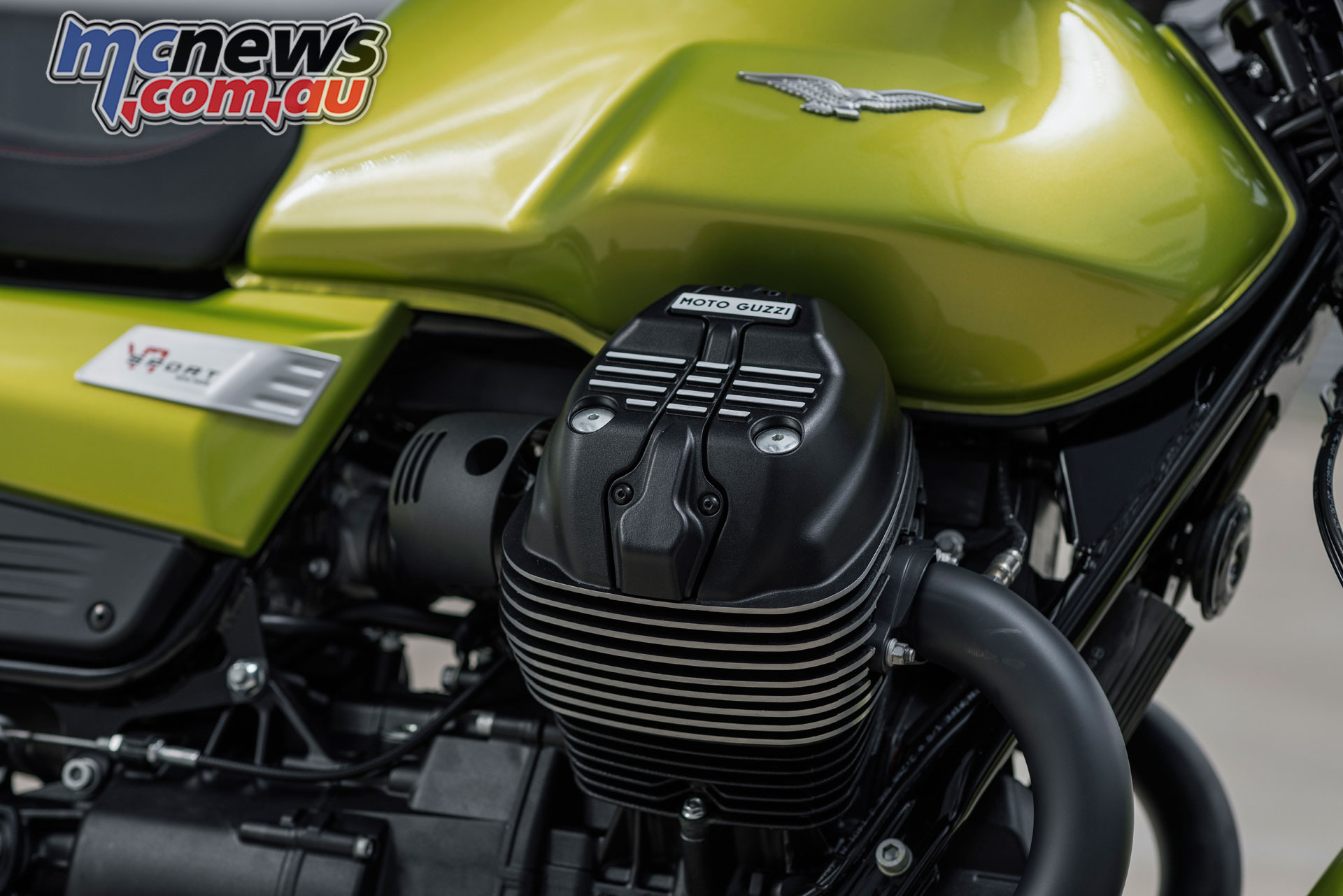 Guzzi’s transverse air-cooled twin remains a unique offering
Numbers like that won’t ruffle too many feathers, but on the road, they translate into a delightful spread of performance that’s going to appeal to almost all riders, regardless of skill level.
With the torque available so low in the rev range, you can short-shift lazily through the gearbox and ride the sub-5000 rpm wave, or you can get sporty with it and blast up through the rev range to the above 7000 rpm mark, at which point there’s a reasonable amount of performance, but it does start to feel a little stressed up top.
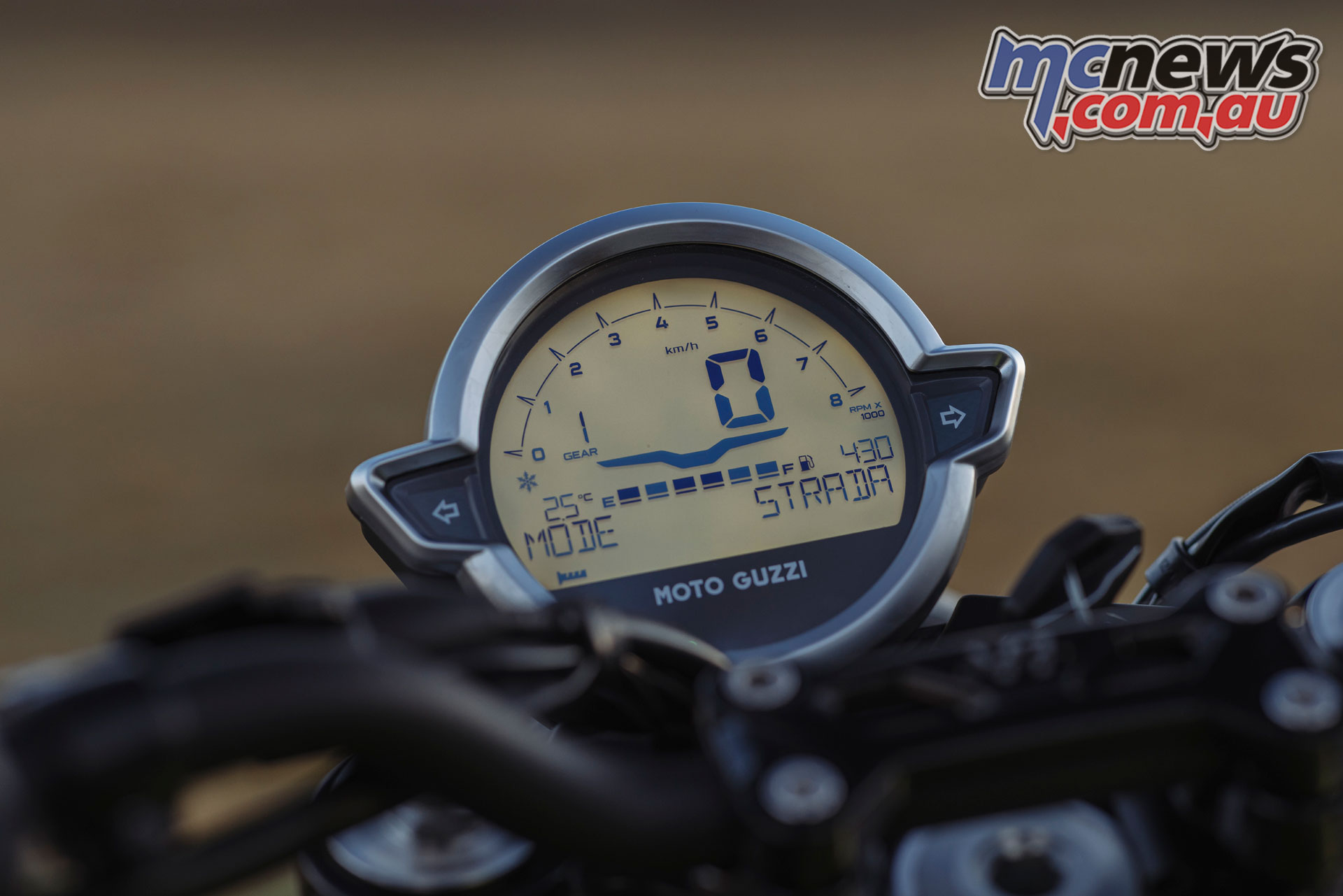 An LCD dash is a little dated by modern standards, considering the other tech inclusions
Moto Guzzi has graced the Sport with three modes in Sport, Road and Rain (the V7 Classic and V7 Stone only get two modes of Rain and Road). The throttle response in Sport mode is crisp without being jumpy, and the gearbox, which has long been criticised in previous generations for being clunky, especially on downshifts, is now much slicker, albeit with a still quite long throw.
Coupled with a light clutch pull and maintenance-free shaft drive, the powertrain feels robust, smooth, and distinctly Guzzi. Although it’s not a track weapon, the Sport begins to earn its moniker in the chassis.
Up front, a 41 mm inverted fork offers preload adjustment, while the rear features twin shocks with preload adjustment. The V7 rolls on 17-inch rear and 18-inch front wheels laced with Michelin Road Classic rubber. If you want to really wick it up, the tyre and suspension combination hasn’t quite worked as I had hoped.
 Shocks and fork both provide preload adjustment
There’s a distinct patter from the front end while on long radius corners under power, something I tried to dial out with preload adjustment but couldn’t quite put my finger on. At sedate speeds, all is well with the front end, but perhaps I was getting too sporty for the Sport’s own good during the test and needed to take a chill pill.
The Brembo four-piston calipers clamping 320 mm discs provide decent stopping confidence, now that there’s a caliper and disc on both sides (the previous version only had brakes on the left side of the front wheel). Just don’t expect to be doing stoppies given how quickly the ABS kicks in with a decent squeeze on the brake lever.
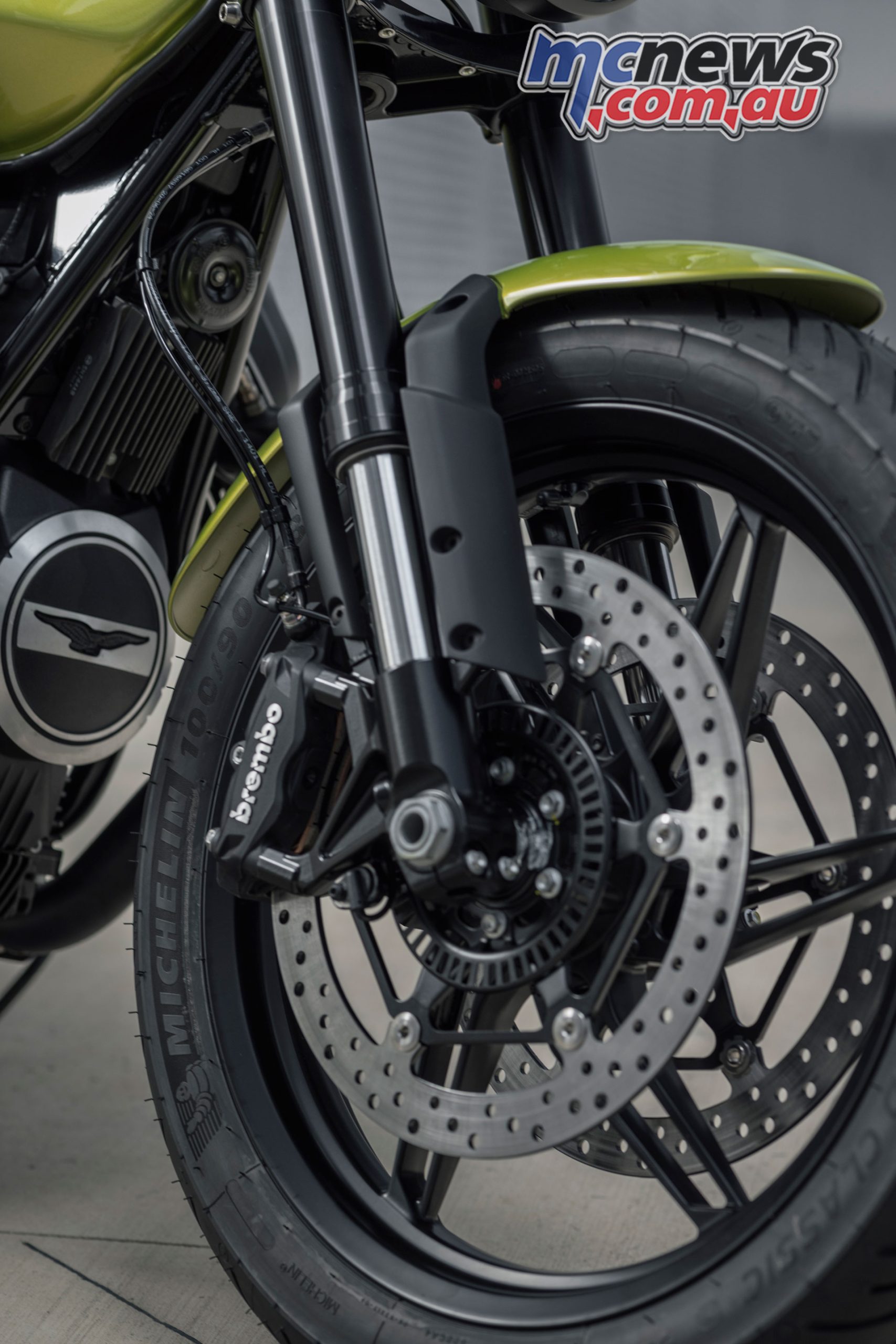 Brembo four-piston calipers are run, now with a double disc front
Moto Guzzi has taken 1.8 kg of unsprung weight out of the front and rear wheels, which aids initial turning and side-to-side agility. It’s no hard-nosed track weapon, but on a winding backroad, the V7 Sport proves poised and agile, holding its line and shrugging off mid-corner bumps without drama, just don’t up the ante too much, lest you get that dreaded front-end patter.
Layered beneath that old-school ride feel is a suite of modern electronics exclusive to the Sport that the V7 Stone and Special don’t get. A six-axis IMU enables cornering ABS and lean-sensitive traction control, and cruise control comes standard. However, it’s a bizarre system to use, as there’s no dedicated cruise control button and it must be accessed via the mode button on the right handlebar.
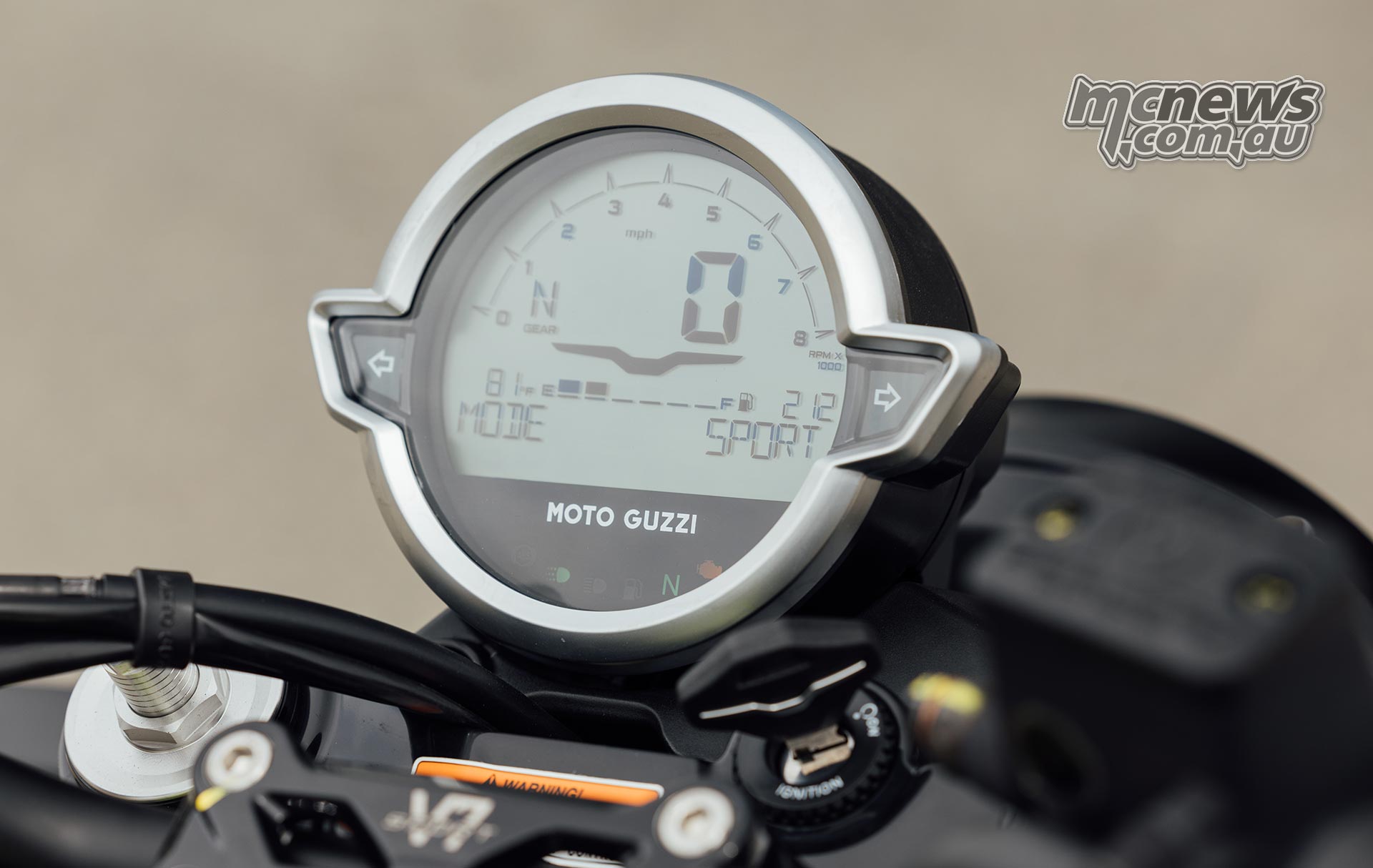 That LCD dash is clear viewing, and now features a fuel gauge
The dash is a simple LCD display, but it is legible, uncluttered, and now finally includes a fuel gauge, something the company had been hesitant to fit for God knows how long.
Then there’s the design. Remember how I said at the beginning that the V7 Sport is a bike you just love looking at in the garage? The V7 Sport is pretty from every angle. Our test bike was painted in the gorgeous Verde Legnano green that nods to the original V7 Sport of the 1970s and the legendary 500 cc V8 MotoGP machine of the early 1950s.
The generous 25-litre fuel tank’s familiar profile, the aluminium side panels, the bar-end mirrors, and the lovely, red-stitched seat are all these touches that tickle the nostalgic bone, but give the Sport a touch of coolness to its aesthetic.
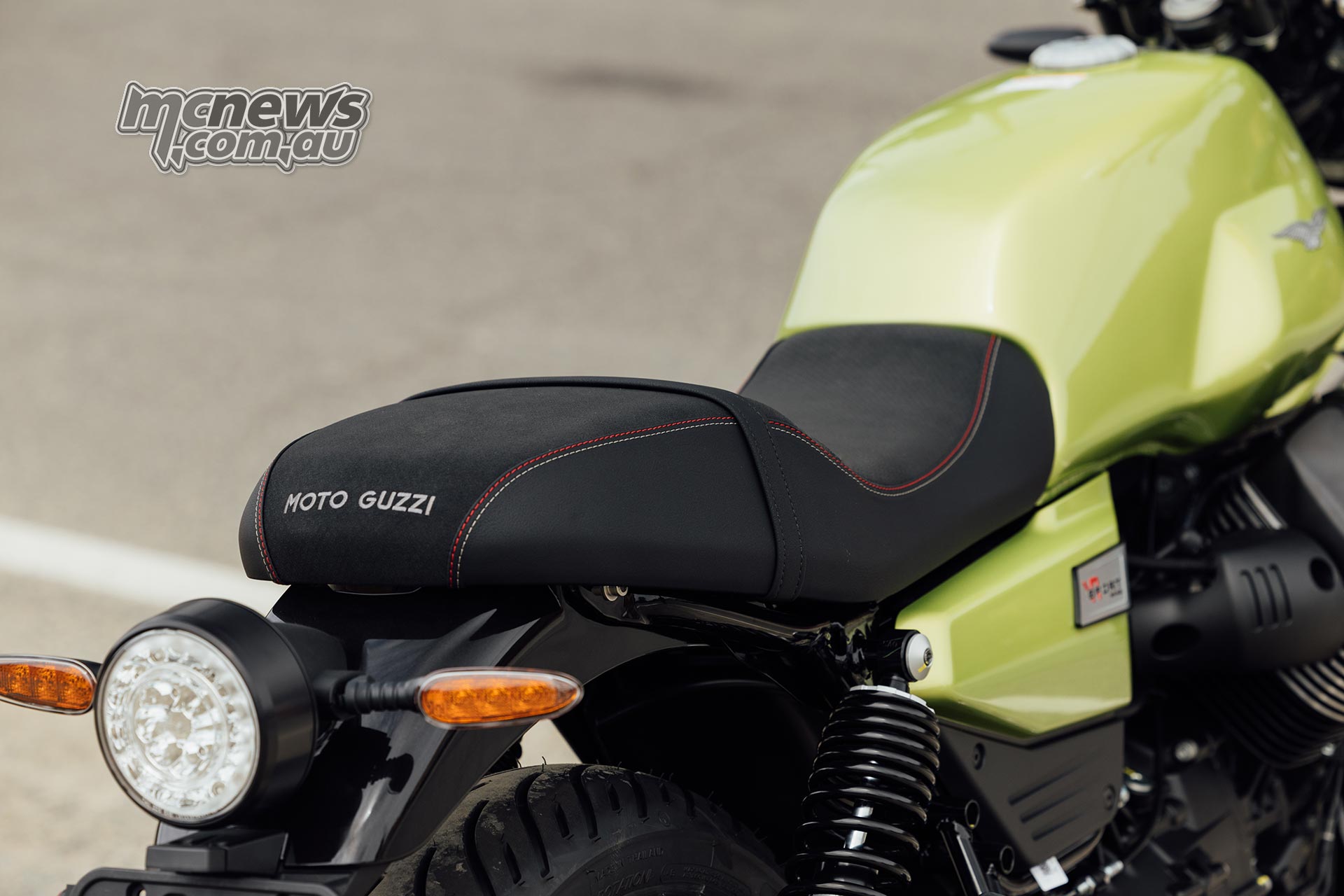 Seat comfort is good. A compact design and small rider triangle proportions impact longer rides
Park the V7 Sport next to a row of modern bikes, and I guarantee the Guzzi will draw the longest glances. The styling isn’t loud or obnoxious—it’s confident, timeless, and distinctly Italian. That personality shines through in the unhurried ride experience.
At a gentle cruise, the V7 Sport is calm and composed, humming along smoothly as the miles unwind under its 18-inch Michelins. The V7 Sport feels every inch the classic roadster, the kind of bike you could keep for years without getting bored with the soundtrack.
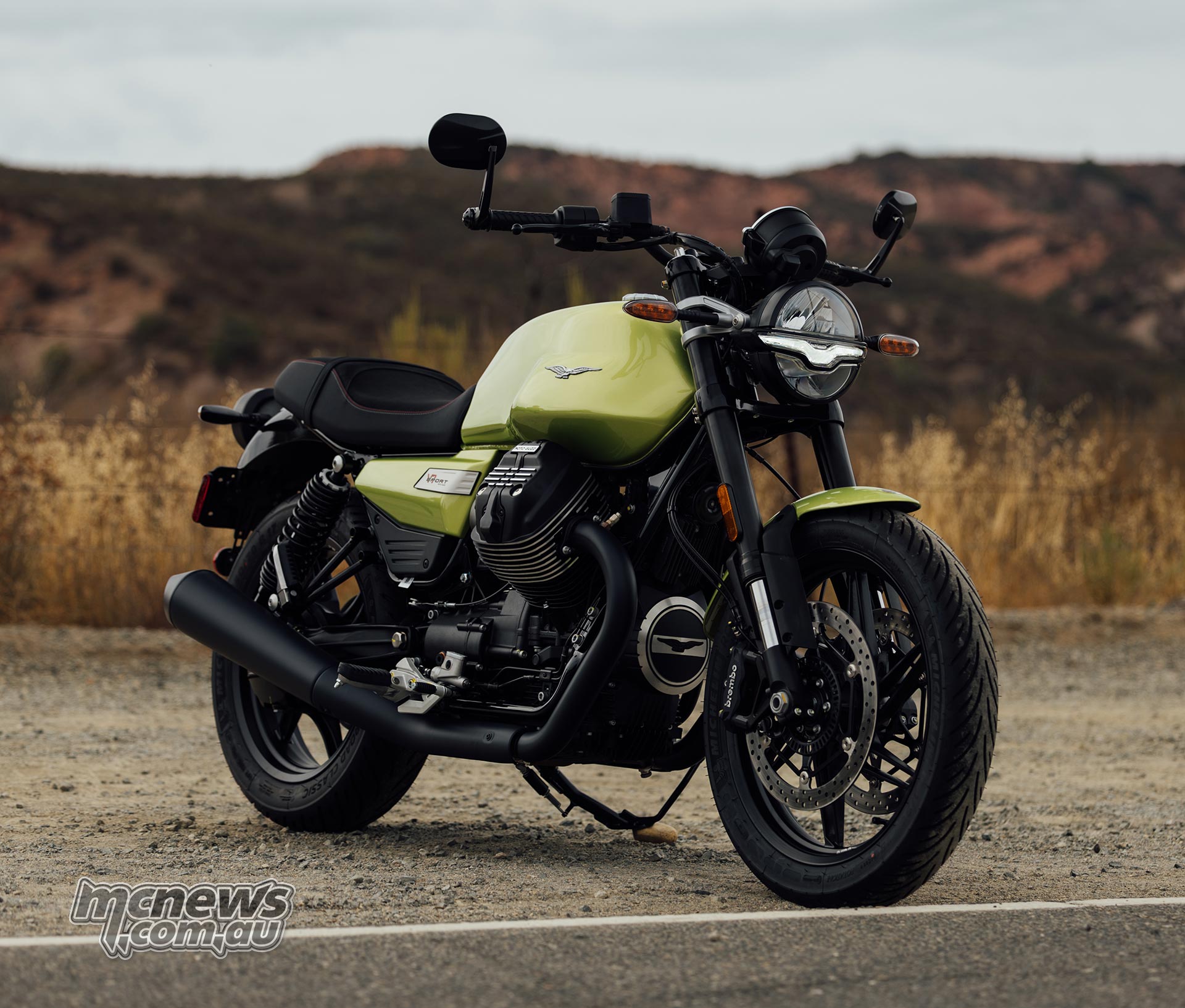 The V7 Sport draws attention everywhere it goes
It’ll happily play along when the road gets twisty, but only to a point (as I found out). There’s a certain satisfaction a rider gets from riding a V7 Sport into the higher road speeds, and you can’t help but wonder what it would be like riding one through the hills surrounding the Mandello del Lario factory, with oil-painting beauty of Lake Como topping the view to the east (I’ve done it. It’s better than you could imagine).
Living with the V7 Sport isn’t without its quirks. The suspension, while competent and compliant, doesn’t offer much adjustability, and you’ll want more adjustability if you plan on pushing this bike past its given realm.
 Front end ‘patter’ was noticeable when pushing hard
The dash, functional as it is, feels a step behind the TFT units that are now ubiquitous. Taller riders may find the ergonomics a little cramped after extended periods.
What lingers after a ride isn’t the numbers, but the experience you’ve just had, and this is especially true given that I take my son on almost every test ride these days. If it gets the eight-year-old’s approval, it immediately gains a few bonus points, and the little man loves the V7 so much he’s decided it’ll be his first bike when he’s old enough to get his licence (yeah, right).
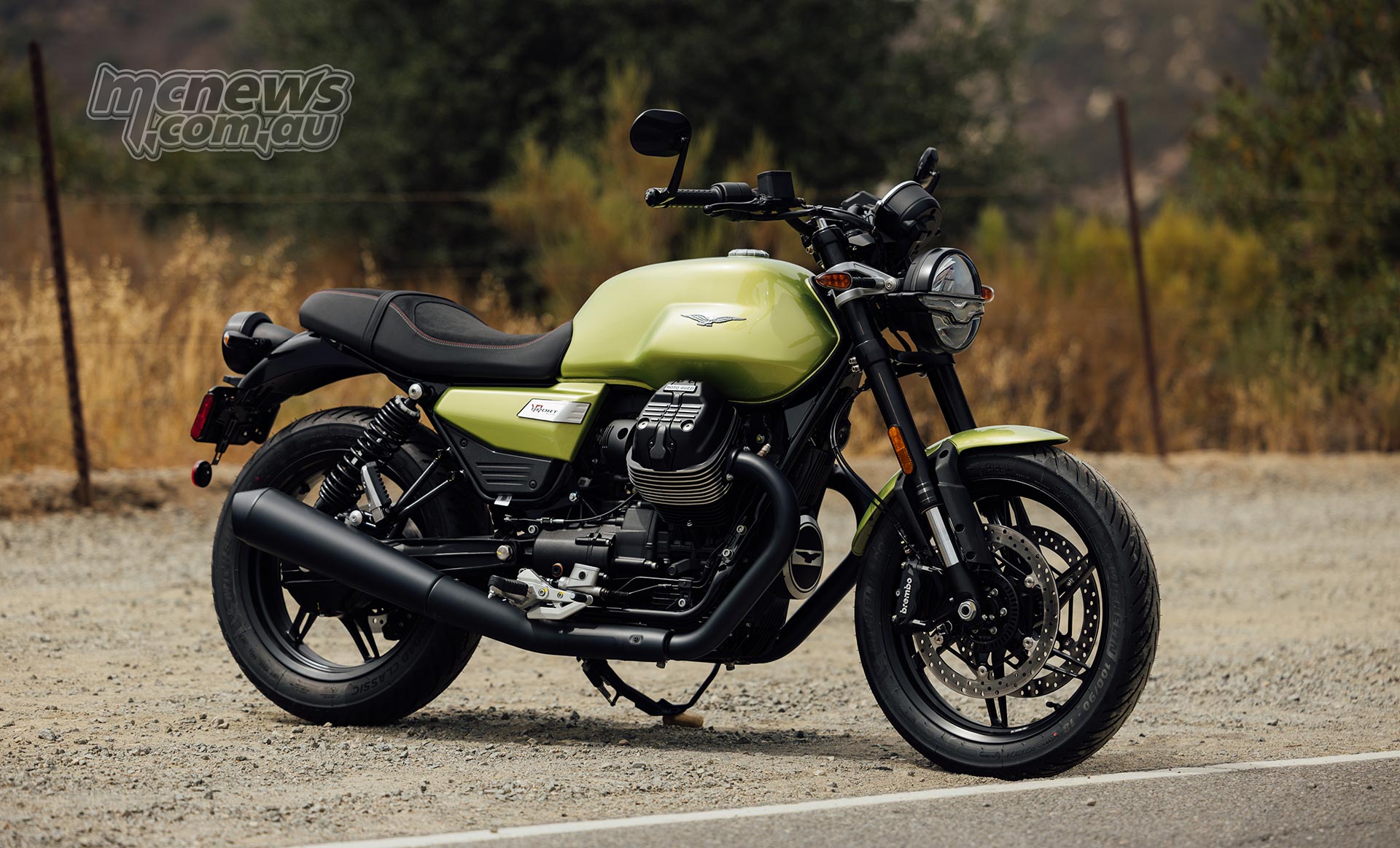 Moto Guzzi V7 Sport
The V7 Sport has a personality built into its very being. The way that the transverse twin rocks side-to-side, the shaft drive; that deep, luminous paint, that funny-sized front wheel. It’s a bike that makes you want to go for a quick cruise, just because. The V7 Sport’s charisma is its currency.
The 2025 Moto Guzzi V7 Sport isn’t the fastest middleweight you can buy, nor the lightest, nor the most technologically advanced, but it’s almost certainly the most charming. For riders who want their motorcycle to be a touch more than just transportation, and who value looks equally to performance, with a touch of tech thrown in for good measure, the V7 Sport delivers in spades.
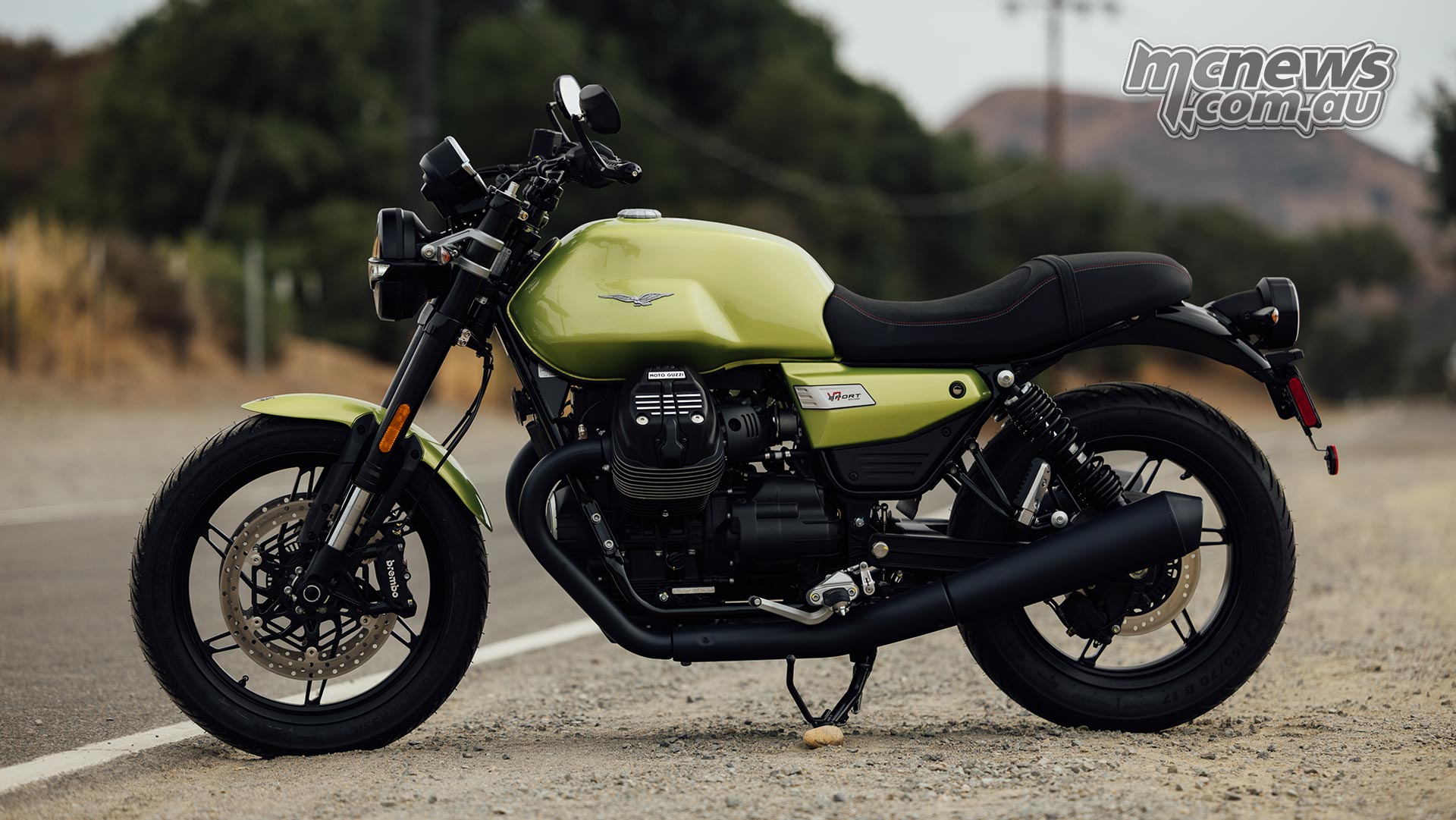 Moto Guzzi V7 Sport
If that sounds like something that floats your boat, you can ride one away from $20,590. More info here.
Moto Guzzi V7 Sport Specifications
|
Specficiations |
|
|
Engine |
Transversal 90° V-Twin, two valves per cylinder, air cooled with Ride by Wire |
|
Displacement |
853 cc |
|
Bore x Stroke |
84 x 77 mm |
|
Maximum Power |
67.3 hp (49.5 kW) @ 6,900 rpm |
|
Maximum Torque |
79 Nm @ 4,400 rpm |
|
Final Drive |
Shaft drive |
|
Gearbox |
6 speed |
|
Front Suspension |
Ø41 mm USD fork with adjustable preload |
|
Rear Suspension |
Twin shock with preload adjustment |
|
Front Brake |
Twin Ø 320 mm floating discs, 4-piston Brembo monobloc radial calipers, Cornering ABS |
|
Rear Brake |
Single Ø 260 mm floating disc, 2-piston floating caliper, Cornering ABS |
|
Front Wheel |
Cast aluminium, 18” x 2.5” |
|
Rear Wheel |
Cast aluminium, 17” x 4.25” |
|
Seat Height |
780 mm |
|
Dry Weight |
200 kg |
|
Wet Weight |
220 kg |
|
Fuel Tank Capacity |
21 L |
|
Consumption |
4.9 L/100 km |
|
Compliance |
Euro 5+ |
|
Features |
Full LED headlight with DRL, LED indicators, Cornering ABS, Traction Control, Cruise Control, 3 Riding Modes with dedicated Sport mode, LCD instrument with fuel gauge |
|
Ready For |
Moto Guzzi MIA, TPMS |
Moto Guzzi V7 Sport Images

2025-Moto-Guzzi-V7-Sport-23

2025-Moto-Guzzi-V7-Sport-22

2025-Moto-Guzzi-V7-Sport-21

2025-Moto-Guzzi-V7-Sport-20

2025-Moto-Guzzi-V7-Sport-19

2025-Moto-Guzzi-V7-Sport-18

2025-Moto-Guzzi-V7-Sport-17

2025-Moto-Guzzi-V7-Sport-16

2025-Moto-Guzzi-V7-Sport-15

2025-Moto-Guzzi-V7-Sport-14

2025-Moto-Guzzi-V7-Sport-13

2025-Moto-Guzzi-V7-Sport-12

2025-Moto-Guzzi-V7-Sport-11

2025-Moto-Guzzi-V7-Sport-25

2025-Moto-Guzzi-V7-Sport-10

2025-Moto-Guzzi-V7-Sport-24

2025-Moto-Guzzi-V7-Sport-9

2025-Moto-Guzzi-V7-Sport-8

2025-Moto-Guzzi-V7-Sport-7

2025-Moto-Guzzi-V7-Sport-6

2025-Moto-Guzzi-V7-Sport-5

2025-Moto-Guzzi-V7-Sport-4

2025-Moto-Guzzi-V7-Sport-3

2025-Moto-Guzzi-V7-Sport-1

2025-Moto-Guzzi-V7-Sport-2



 English (US) ·